

Navigating the Immaterial: The Philosophical Experience of Time and Space
The human encounter with time and space is not merely a physical phenomenon but a profound philosophical enigma. From the fleeting moment to the boundless cosmos, our experience of these fundamental dimensions shapes our very perception of reality, self, and existence. This article delves into the rich tapestry of philosophical thought, exploring how thinkers across millennia have grappled with time as an elusive river and space as an encompassing canvas, examining how our sense perceptions construct, and are constructed by, these omnipresent concepts. We will journey through classical and modern perspectives, revealing the deeply subjective yet universally compelling nature of our temporal and spatial reality.
The Inescapable Frameworks: An Introduction to Temporal and Spatial Experience
At the very core of our existence lie two concepts so fundamental they often escape explicit scrutiny: time and space. We live within them, measure our lives by them, and understand the world through their lens. Yet, what are they? Are they objective realities, independent of our minds, or are they mere constructs of our consciousness, the very lenses through which we sense and experience anything at all? This question, seemingly simple, has vexed philosophers from antiquity to the present day, forming a cornerstone of metaphysics, epistemology, and even ethics. Our experience of a sunrise, the touch of a loved one, or the memory of a past event are all inextricably bound to our inherent, often unexamined, understanding of time and space. It is this primal sense of being-in-time and being-in-space that forms the crucible of philosophical inquiry.
The Subjectivity of Our Sense: How Experience Shapes Reality
Before delving into the specifics of time and space, it's crucial to acknowledge the role of experience itself, mediated through our sense organs and cognitive faculties. Ancient Greek philosophers, as found in the Great Books of the Western World, already grappled with this. Plato, in his Allegory of the Cave, famously suggested that our perceived reality might be but shadows of a truer, unseen realm. Our sense perceptions, while providing the raw data of existence, are inherently limited and interpretive.
Aristotle, in contrast, grounded knowledge more firmly in empirical experience, categorizing the ways we understand being, including notions of "when" (time) and "where" (space). For Aristotle, time was the measure of motion, and space (or "place") was the innermost boundary of the containing body. These concepts were not abstract entities separate from the world, but inherent properties of the world as we experience it through our senses.
Later, empiricists like John Locke argued that all our knowledge stems from experience, either through sensation (external sense data) or reflection (internal experience). This perspective highlights that our understanding of time and space is built upon the foundational input of our senses.
Key Philosophical Questions Regarding Experience:
- How much of our experience of time and space is objective reality, and how much is subjective interpretation?
- Can we sense time and space directly, or only indirectly through changes and distances?
- Does our language influence our experience of these fundamental dimensions?
Time: The Unfolding Riddle
Few concepts are as universally felt yet as stubbornly elusive as time. We speak of its passage, its duration, its linearity, yet trying to grasp it intellectually often leads to paradox.
Augustine's Dilemma:
In his Confessions, St. Augustine famously pondered: "What then is time? If no one asks me, I know; if I wish to explain it to one who asks, I know not." He recognized that time is not a substance but an extension of the soul, a measure of past, present, and future within our consciousness. The past exists as memory, the future as expectation, and the present as a fleeting point of attention. His profound insight emphasizes that our experience of time is deeply internal and psychological.
Kant's A Priori Intuition:
Immanuel Kant, in his Critique of Pure Reason, offered a revolutionary perspective. He argued that time (and space) are not empirical concepts derived from experience, but rather a priori forms of intuition, inherent structures of the mind itself. They are the necessary preconditions for any experience to be possible. We don't sense time as an object; rather, we sense objects in time. Without this innate mental framework, we couldn't organize sensory input into a coherent succession of events.
Perspectives on the Nature of Time:
| Philosophical View | Description | Key Proponents (GBWW Context) |
|---|---|---|
| Relational Time | Time is not an independent entity but a measure of relations between events. | Aristotle, Gottfried Wilhelm Leibniz |
| Absolute Time | Time exists independently of events, flowing uniformly. | Isaac Newton |
| Subjective/Psychological | Time is primarily an internal construct, a function of consciousness. | St. Augustine, Henri Bergson (though not explicitly in GBWW, his ideas resonate) |
| A Priori Form of Intuition | Time is an innate mental framework, a condition for all experience. | Immanuel Kant |
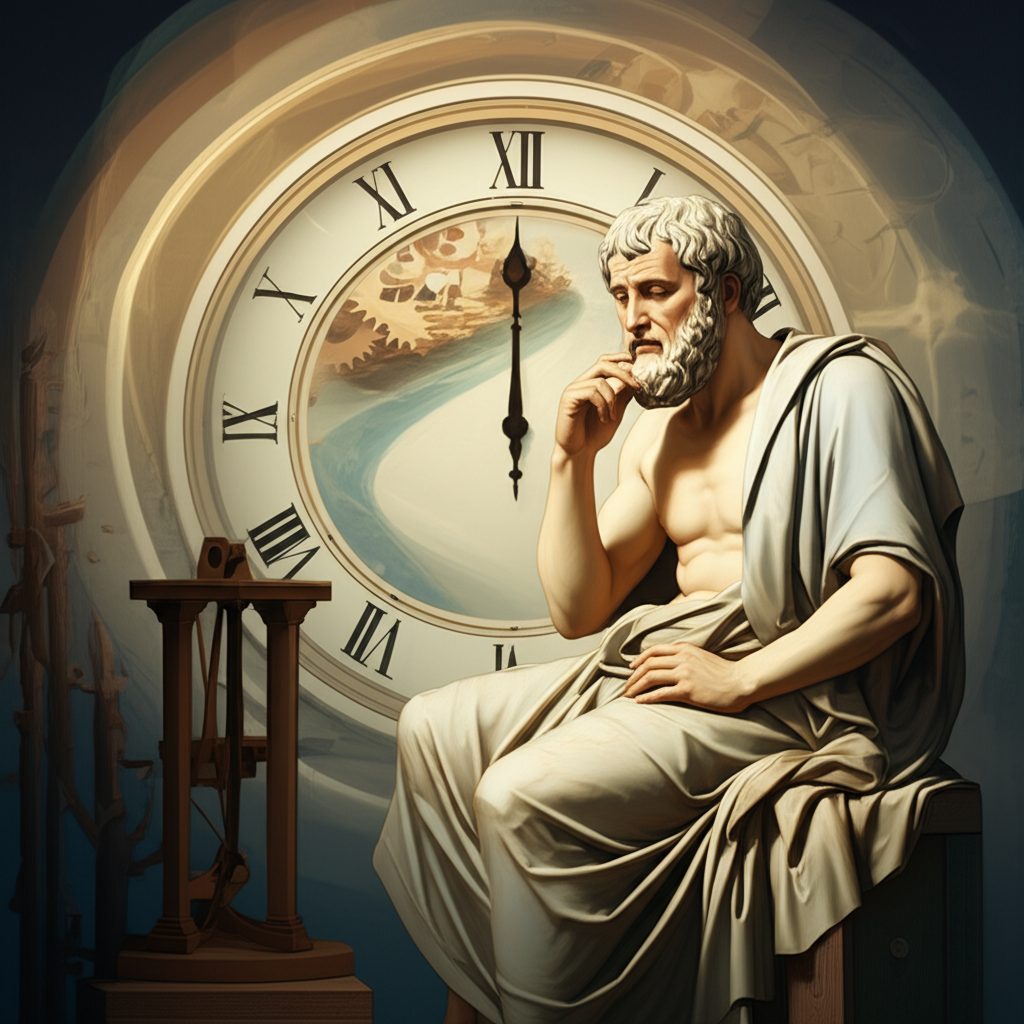
Space: The Boundless Container
Like time, space is a concept that seems self-evident until we attempt to define its true nature. Is it an empty container waiting to be filled, or is it merely the arrangement of objects within it?
Newton vs. Leibniz: The Absolute and the Relational:
The famous debate between Isaac Newton and Gottfried Wilhelm Leibniz exemplifies this tension. Newton posited absolute space: an infinite, immutable, and uniform container existing independently of matter. It was, in essence, God's sensorium, a fixed backdrop against which all motion occurred. For Newton, to say something moves is to say it changes its position within this absolute space.
Leibniz, conversely, argued for relational space. He believed space was not an independent entity but simply the order or arrangement of coexisting objects. If there were no objects, there would be no space. To say something moves, for Leibniz, is to say its relation to other objects changes. This view emphasizes that our sense of space is derived from the relationships we perceive between things.
Kant's Spatial Intuition:
Again, Kant offered a synthesis. For him, space is also an a priori form of intuition, an inherent structure of our minds that allows us to perceive objects as having extension, shape, and position. We cannot experience objects except as spatially extended. It's not a concept we derive from external experience, but a necessary condition for any external experience to make sense.
The Experience of Space:
Our experience of space is profoundly embodied. We navigate it, feel its constraints, and orient ourselves within it. Our sense of up and down, left and right, near and far, is fundamental to our interaction with the world. This embodied experience raises questions about how our physical form influences our understanding of space.
The Intertwined Tapestry: Time-Space and Consciousness
While we often discuss time and space separately for analytical clarity, our lived experience rarely segregates them. Every event occurs somewhere and sometime. Our memories are not just of past events, but of past places. Our plans for the future involve actions that will unfold in specific locations.
Philosophers like Henri Bergson (though outside the core GBWW, his ideas are highly relevant to the experience of time) emphasized the concept of duration, a continuous, flowing quality of lived time that resists spatialization. When we try to measure time with clocks, we are, in a sense, treating it like space – dividing it into discrete units. But our actual experience of time is more fluid, more qualitative.
The advent of modern physics, particularly Einstein's theory of relativity, further solidified the notion of spacetime as a unified continuum, challenging the absolute separation of time and space that permeated much classical thought. While relativity is a scientific theory, its philosophical implications resonate deeply with Kant's idea that these dimensions are fundamentally intertwined in the fabric of reality itself, or at least in our experience of it. Our sense of reality is inherently spatio-temporal.
Philosophical Implications and Ongoing Inquiry
The philosophical exploration of time and space is far from concluded. These inquiries delve into the very nature of reality, the limits of human cognition, and our place in the cosmos.
Questions for Continued Reflection:
- The Nature of Reality: If time and space are a priori forms of intuition, what does that imply about the "Ding an sich" (thing-in-itself) – reality as it exists independently of our minds? Can we ever truly experience it?
- Consciousness and Temporality: How does our consciousness, with its ability to recall the past and anticipate the future, influence our experience of time? Is consciousness itself fundamentally temporal?
- The Illusion of Passage: If time is merely a dimension, like space, does its "passage" (the feeling of moving from past to future) become an illusion of consciousness?
- Embodied Cognition: How does our physical embodiment – having a body that moves through space and ages through time – constrain and enable our understanding of these dimensions?
Understanding our experience of time and space is not just an academic exercise; it is an endeavor to comprehend the very grounds of our being. It challenges us to look beyond the immediate data of our sense and question the fundamental structures that allow us to perceive, think, and exist. The great thinkers of the Western tradition have provided invaluable frameworks, but the ultimate experience of time and space remains a deeply personal and perpetually unfolding mystery.
YouTube Video Suggestions:
-
📹 Related Video: KANT ON: What is Enlightenment?
Video by: The School of Life
💡 Want different videos? Search YouTube for: ""Augustine on Time: What is Time?""
2. ## 📹 Related Video: KANT ON: What is Enlightenment?
Video by: The School of Life
💡 Want different videos? Search YouTube for: ""Kant's Philosophy of Space and Time Explained""