

The Enduring Enigma: Our Experience of Time and Space
The way we experience the world is fundamentally shaped by two pervasive, yet profoundly mysterious, dimensions: time and space. From the fleeting moment to the vast expanse, these concepts are not merely external realities but active constructions of our minds, mediated by our senses. This article delves into the rich philosophical history of how humanity has grappled with the experience of time and space, tracing a path from ancient Greek metaphysics to Kant's revolutionary insights, exploring how these fundamental aspects of reality are perceived, understood, and ultimately, lived.
The Elusive Canvas: Early Philosophical Inquiries into Time and Space
Our most basic sense of reality is inherently temporal and spatial. We exist in a place and at a moment. Yet, when we attempt to define these concepts, they slip through our grasp. Philosophers from the earliest traditions of the Western world have wrestled with this paradox, laying the groundwork for millennia of inquiry.
Plato's Ideal Forms and the Cosmos
For Plato, as explored in works like the Timaeus, time was intimately linked to the cosmos and the eternal Forms. He conceived of time as the "moving image of eternity," a reflection of an unchanging, perfect realm within the ever-changing material world. This view suggests that our experience of time is a shadow of a deeper, more fundamental reality. Space, similarly, was often understood as the receptacle or "chora" in which the Forms were imperfectly manifested, a canvas for the material world. Our senses, for Plato, offered only imperfect access to these ultimate realities.
Aristotle's Empirical Grounding
Aristotle, ever the keen observer of the natural world, offered a more empirical and grounded perspective. In his Physics, he famously defined time not as an independent entity, but as "the number of motion with respect to 'before' and 'after'." This means that time is inseparable from change and movement. Without events unfolding, without things moving, there would be no time to measure. Our sense of time is thus derived directly from our experience of sequences of events. Similarly, space was understood as "place" – the immediate boundary of a body, rather than an empty void. This relational view rooted time and space firmly in the observable world of our senses.
Augustine's Subjective Abyss
Centuries later, Saint Augustine of Hippo, in his Confessions, articulated one of the most profound and relatable philosophical struggles with time. He famously mused: "What then is time? If no one asks me, I know; if I wish to explain it to one who asks, I know not." Augustine realized that time is not an external, objective river flowing past us, but rather a deeply subjective, internal experience. He argued that past, present, and future exist not 'out there' but within the human mind: the past as memory, the present as attention, and the future as expectation. This groundbreaking insight highlighted the psychological dimension of our experience of time, paving the way for later phenomenological approaches.
Measuring the Immeasurable: Absolute, Relational, and Perceptual Frameworks
The scientific revolution brought new urgency to understanding time and space, leading to a grand debate that shaped modern philosophy and physics.
Newton's Absolute Stage
Sir Isaac Newton, whose monumental Philosophiæ Naturalis Principia Mathematica laid the foundation for classical physics, posited the existence of absolute time and absolute space. For Newton, these were not merely conceptual constructs but real, independent entities existing apart from any observer or content.
- Absolute Space: Exists independently and is immovable, infinite, and uniform. It is the fixed stage upon which all events unfold.
- Absolute Time: Flows equably without relation to anything external, a steady, unchangeable progression.
Our senses, according to Newton, merely perceive objects moving within this absolute framework. The experience of time and space might vary, but the underlying reality remained constant.
Leibniz's Relational Dance
Gottfried Wilhelm Leibniz, a contemporary and intellectual rival of Newton, vehemently opposed the idea of absolute time and space. For Leibniz, these were not substances but relations.
- Space: A collection of relations of coexistence among objects. Without objects, there is no space.
- Time: A collection of relations of succession among events. Without events, there is no time.
Leibniz argued that if time and space were absolute, God could have created the universe a moment earlier or shifted it a few feet to the left without any observable difference, which he considered a violation of the Principle of Sufficient Reason. Our experience of time and space is, therefore, fundamentally tied to the relationships between the things we sense.
Here's a simplified comparison of their views:
| Feature | Newton's View | Leibniz's View |
|---|---|---|
| Nature of Time | Absolute, independent, flows equably | Relational, order of successive events |
| Nature of Space | Absolute, independent, uniform container | Relational, order of coexisting objects |
| Existence | Exists prior to and independent of matter/events | Emerges from the relations between matter/events |
| Experience | Perception of events within fixed framework | Direct perception of relations among objects/events |
The Mind's Imperative: How We Construct Reality
The debate between Newton and Leibniz highlighted a critical question: are time and space external realities we discover, or are they fundamental aspects of how our minds structure experience? It was Immanuel Kant who offered a revolutionary synthesis, shifting the focus from the objective world to the subjective architecture of human cognition.
Kant's A Priori Forms of Intuition
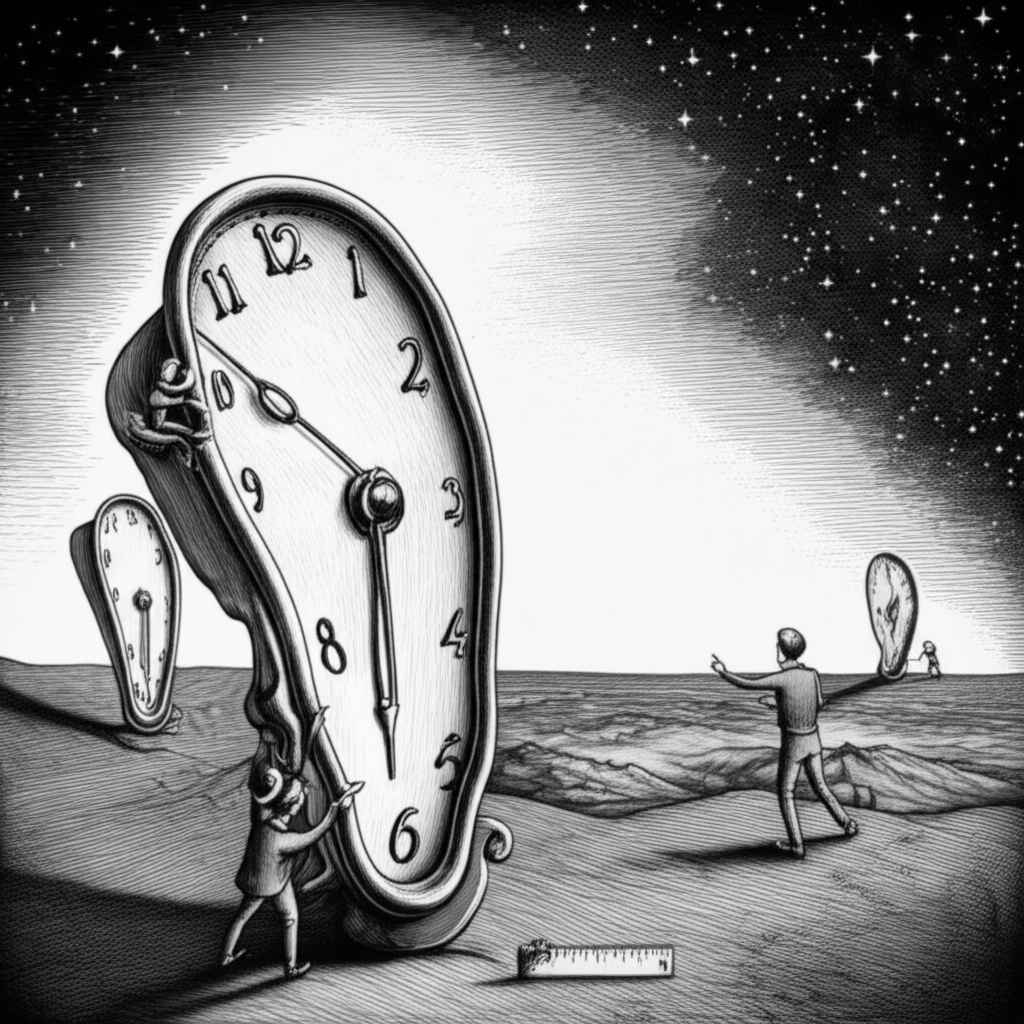
In his Critique of Pure Reason, Immanuel Kant performed what he called a "Copernican Revolution" in philosophy. He argued that time and space are not properties of objects in themselves, nor are they mere relations between objects. Instead, they are a priori forms of intuition – fundamental structures inherent to the human mind, which pre-exist any experience and make experience possible.
- Space: The a priori form of our outer sense, allowing us to perceive objects as existing alongside each other and occupying distinct locations.
- Time: The a priori form of our inner sense, allowing us to perceive events as occurring in succession and simultaneously.
For Kant, we don't perceive the world and then apply time and space to it; rather, we can only experience anything because our minds are already structured to perceive things in time and space. They are like the spectacles through which we must view the world, shaping everything we see. This means our experience of time and space is universal among humans because it's built into our cognitive apparatus.
Beyond Pure Reason: Phenomenological Insights
Following Kant, later philosophical movements, particularly phenomenology, continued to explore the lived experience of time and space. Thinkers like Edmund Husserl and Maurice Merleau-Ponty emphasized the embodied nature of our perception, arguing that our sense of time and space is deeply intertwined with our physical presence in the world, our intentions, and our actions. Time isn't just a sequence of moments but a horizon of past and future that gives meaning to our present. Space isn't an abstract grid but a field of possibilities and obstacles relative to our body. This perspective brings the experience of time and space back to the individual, dynamic, and corporeal existence.
The Enduring Mystery of Our Dimensions
From Plato's eternal forms to Aristotle's empirical observations, Augustine's internal reflections, the scientific clash of Newton and Leibniz, and Kant's revolutionary insights into the mind's architecture, the philosophical journey through the experience of time and space is a testament to humanity's relentless quest for understanding. These dimensions are not mere backdrops to our lives; they are integral to our very being, shaping every sense, every thought, every experience.
While physics continues to redefine our understanding of time and space at cosmic scales, philosophy reminds us that the most profound mystery lies not just in their objective nature, but in how we, as conscious beings, experience and construct them. The question of time and space remains open, inviting each of us to ponder the fundamental canvas of our existence.
YouTube Video Suggestions:
-
📹 Related Video: KANT ON: What is Enlightenment?
Video by: The School of Life
💡 Want different videos? Search YouTube for: "Immanuel Kant philosophy time space explained"
-
📹 Related Video: ARISTOTLE ON: The Nicomachean Ethics
Video by: The School of Life
💡 Want different videos? Search YouTube for: "Aristotle physics time space summary"