

The Unfolding Tapestry of Understanding: From Mythos to Logos
The journey of human understanding, from ancient myths to quantum physics, is a testament to the continuous evolution of our capacity for knowledge. This article explores how science, initially intertwined with philosophy, emerged as a distinct, systematic method, driving unprecedented progress in our comprehension of the cosmos and ourselves. We trace this intellectual lineage, acknowledging the pivotal insights gleaned from the Great Books of the Western World, as we examine the dynamic interplay between inquiry and discovery that shapes our ever-expanding grasp of reality.
For millennia, humanity has grappled with the fundamental questions of existence: What is real? How do we know what we know? The answers, far from static, represent a magnificent evolution of thought, a relentless pursuit of knowledge that has transformed our perception of the world. This profound intellectual journey, meticulously documented and debated within the pages of the Great Books of the Western World, reveals a fascinating progression from speculative philosophy to rigorous scientific inquiry. It's a story not of a sudden paradigm shift, but of a gradual, often contentious, unfolding of human ingenuity and critical reasoning.
The Ancient Roots of Inquiry: Philosophy as the Cradle of Science
In the earliest chapters of human civilization, knowledge was often interwoven with myth, religion, and practical observation. Yet, it was in ancient Greece that the seeds of systematic inquiry were truly sown. Philosophers like Plato, with his emphasis on ideal forms, and Aristotle, a prodigious observer and categorizer of the natural world, laid foundational stones. Aristotle, in particular, with his treatises on physics, biology, and logic, epitomized an early form of empirical investigation, seeking to understand the causes of phenomena. His work, alongside Euclid's geometry, represented a monumental leap towards structured thought, demonstrating an early, albeit nascent, form of science embedded within the broader philosophical quest for truth. These thinkers, though lacking modern instrumentation, pioneered methods of classification, deduction, and reasoned argument that would prove indispensable to future intellectual progress.
The Great Awakening: The Scientific Revolution and the Birth of Modern Science
The true inflection point in the evolution of knowledge arrived with the Scientific Revolution, a period that fundamentally reconfigured humanity's approach to understanding. Figures such as Copernicus, Galileo, Kepler, and Newton didn't merely add to existing knowledge; they revolutionized the method of acquiring it. This was the era where science began to distinguish itself from philosophy, not by abandoning reason, but by adding the crucial elements of systematic observation, experimentation, and mathematical formulation. Francis Bacon, advocating for inductive reasoning and empirical evidence, articulated a new vision for scientific progress, emphasizing the accumulation of verifiable facts.
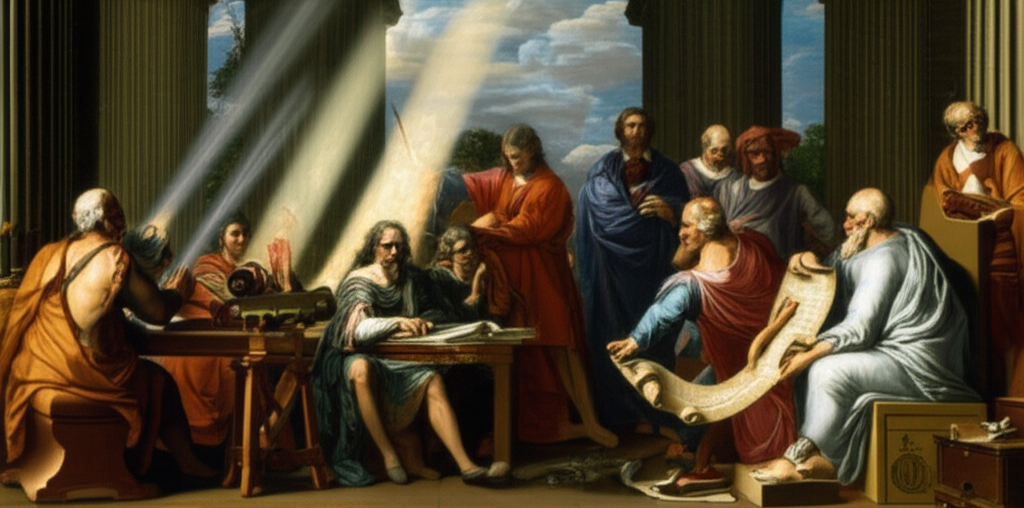
This period marked a profound shift: no longer was truth solely derived from ancient texts or pure reason, but increasingly from direct engagement with the natural world. The universe, once seen as a realm of divine mystery, began to reveal itself as a system governed by discoverable laws. This wasn't merely an accumulation of facts; it was a fundamental shift in epistemology—how we understand what knowledge is and how it is validated.
The Continuous Dialogue: How Science and Knowledge Drive Progress
The centuries following the Scientific Revolution witnessed an accelerating pace of progress. Disciplines like physics, chemistry, biology, and astronomy blossomed, each building upon the cumulative knowledge of its predecessors. What distinguishes modern science is its iterative, self-correcting nature. Hypotheses are proposed, tested, refined, or discarded, leading to an ever-more precise and comprehensive understanding. This dynamic process exemplifies the very essence of evolution – not a straight line, but a branching, adapting, and refining journey.
The relationship between knowledge and science remains symbiotic. Science generates new knowledge, pushing the boundaries of what we understand about the universe. Conversely, philosophical inquiries into the nature of reality, ethics, and the limits of human understanding continue to frame scientific endeavors, prompting new questions and challenging established paradigms. The Great Books continue to offer a rich context for these discussions, reminding us that the pursuit of truth is a continuous dialogue across eras.
Consider the ongoing evolution of our understanding of matter:
| Era/Thinker | Concept of Matter | Impact on Knowledge |
|---|---|---|
| Ancient Greeks | Four Elements (Earth, Air, Fire, Water), Atoms (Democritus) | Early systematic categorization, philosophical debate |
| Medieval Alchemy | Transmutation of elements, mystical properties | Proto-scientific experimentation, but limited by dogma |
| Boyle/Lavoisier | Elements as irreducible substances, conservation of mass | Foundation of modern chemistry, empirical measurement |
| Dalton | Atomic theory, definite proportions | Quantitative understanding of chemical reactions |
| Rutherford/Bohr | Planetary model of atom, subatomic particles | Revolutionized physics, led to quantum mechanics |
| Quantum Physics | Wave-particle duality, quarks, leptons | Deepened understanding of fundamental reality, new technologies |
This table illustrates not just an accumulation of facts, but a fundamental transformation in how we conceptualize the very fabric of existence, demonstrating profound progress in our scientific knowledge.
The Unending Pursuit: Knowledge, Science, and the Future of Progress
The evolution of knowledge and science is far from complete. Each discovery opens new vistas of inquiry, revealing the vastness of what we still do not know. From the mysteries of consciousness to the origins of the universe, the frontier of understanding continues to expand. The legacy of the Great Books reminds us that this journey is fundamentally human – driven by curiosity, critical thought, and an insatiable desire to make sense of our place in the cosmos. As we continue to refine our scientific instruments and conceptual frameworks, we are not merely accumulating data; we are continually redefining what it means to know, propelling humanity towards an ever-deeper, albeit perpetually evolving, comprehension of reality. The story of knowledge and science is, in essence, the story of human progress itself, a journey without end.
📹 Related Video: KANT ON: What is Enlightenment?
Video by: The School of Life
💡 Want different videos? Search YouTube for: ""History of Science Documentary""
📹 Related Video: What is Philosophy?
Video by: The School of Life
💡 Want different videos? Search YouTube for: ""Philosophy of Science Explained""