

The journey of human understanding, from nascent curiosity to the sophisticated methodologies of today, represents a profound and continuous evolution of both knowledge and science. This article explores how our grasp of the world has transformed over millennia, driven by an insatiable quest for truth and a persistent refinement of inquiry. We will trace the historical arc of these intertwined pursuits, examining the pivotal shifts that have led to our current state of intellectual progress, always mindful that the horizon of discovery perpetually recedes.
From Ancient Inquiries to Modern Understanding: A Journey Through Epistemology
Our earliest ancestors, facing a world of bewildering phenomena, began the arduous task of constructing knowledge. Initially, this might have been pragmatic, rooted in survival and observation of natural cycles. However, with the dawn of civilization, the pursuit of understanding transcended mere utility, blossoming into philosophical inquiry. The ancient Greeks, foundational figures in the Great Books of the Western World, epitomized this intellectual awakening.
Consider Plato's allegory of the cave, a powerful metaphor for the arduous ascent from mere opinion to true knowledge. His distinction between the sensory world and the realm of Forms laid a cornerstone for epistemological debate, questioning the very nature of reality and how we can genuinely know it. Aristotle, in contrast, championed a more empirical approach, meticulously observing the natural world and systematizing logic as a tool for rational thought. His vast treatises, from ethics to zoology, demonstrate an early, systematic attempt to classify and understand the world, laying groundwork for what would much later become science.
This early evolution of thought was characterized by:
- Philosophical Speculation: Grand theories about the cosmos and human nature.
- Logical Deduction: The development of reasoning frameworks to derive conclusions.
- Early Observation: Systematic, though often qualitative, examination of phenomena.
These foundational efforts, though not "scientific" in our modern sense, were crucial steps in the long march toward developing robust methods for acquiring reliable knowledge.
The Crucible of Method: Science's Emergence
The true evolution of science as a distinct discipline, separate from pure philosophy, began in earnest with the Renaissance and the Scientific Revolution. This period marked a profound shift from relying primarily on received wisdom or purely deductive reasoning to emphasizing empirical observation, experimentation, and mathematical analysis.
Figures like Francis Bacon, whose Novum Organum challenged the Aristotelian scholastic tradition, advocated for an inductive method – building knowledge from specific observations to general principles. René Descartes, in his Discourse on Method, championed systematic doubt and the power of rational deduction, emphasizing clarity and distinctness in ideas. These thinkers, also prominent in the Great Books, provided the philosophical underpinnings for a new way of knowing.
The key developments during this transformative period include:
| Aspect of Inquiry | Pre-Scientific Revolution Approach | Scientific Revolution Approach |
|---|---|---|
| Primary Source of Truth | Authority, Tradition, Revelation | Observation, Experimentation, Reason |
| Methodology | Deduction, Speculation | Induction, Deduction, Experiment |
| Focus | Metaphysics, Theology | Natural Phenomena, Observable Laws |
| Verification | Consensus, Philosophical Argument | Empirical Evidence, Reproducibility |
This period saw an unprecedented acceleration of progress in understanding the physical world, leading to breakthroughs in astronomy, physics, and anatomy. The systematic application of a verifiable method transformed the pursuit of knowledge into the rigorous endeavor we now recognize as science.
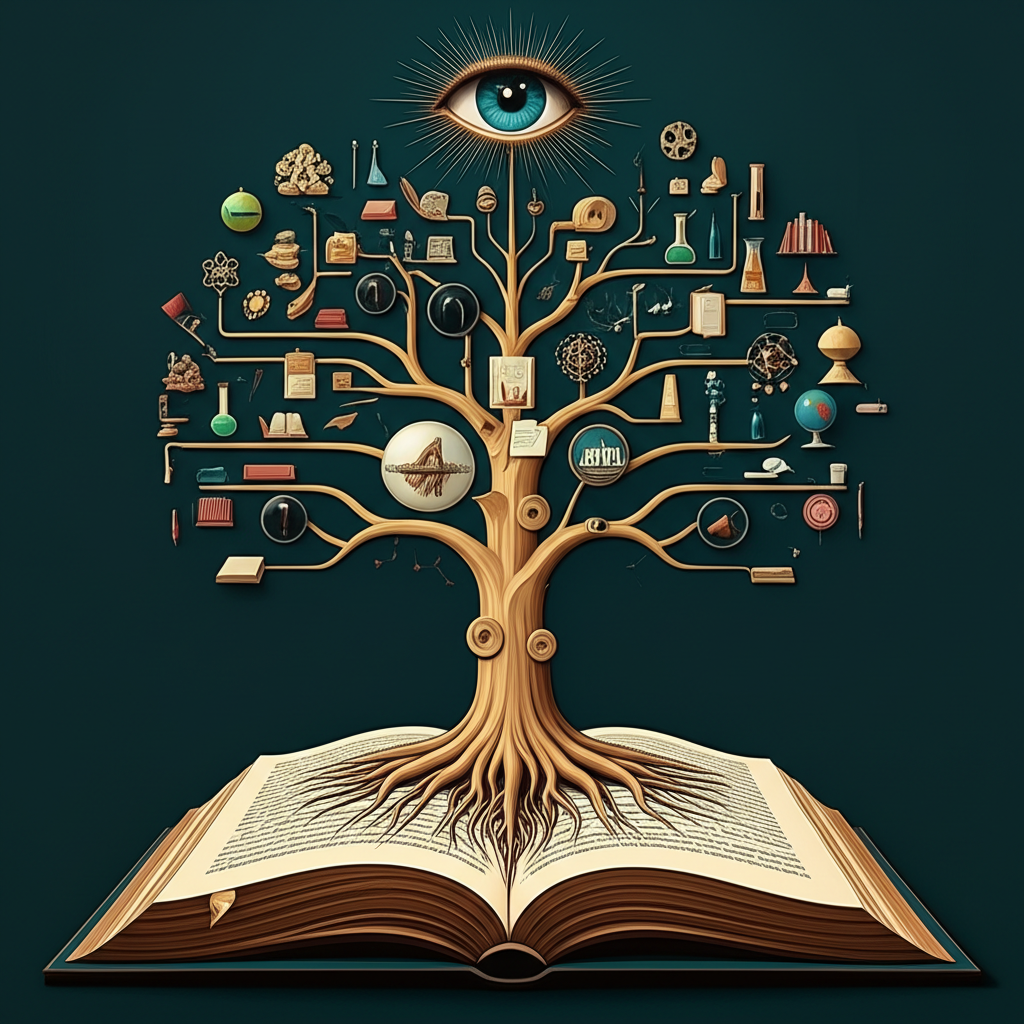
Paradigms and Revolutions: The Dynamic Nature of Scientific Progress
The evolution of science is not a smooth, linear ascent but often a series of dramatic shifts, or "paradigm shifts," as philosophers of science have described. Our understanding of the universe, once thought to be static, is perpetually refined, challenged, and overthrown by new evidence and theoretical frameworks.
Consider the following pivotal transformations:
- From Geocentric to Heliocentric Model: The Ptolemaic system, placing Earth at the center of the universe, dominated for over a millennium. Copernicus, Kepler, and Galileo, through careful observation and mathematical reasoning, ushered in the heliocentric model, fundamentally altering humanity's perceived place in the cosmos. This wasn't merely an update; it was a conceptual revolution.
- Newtonian Mechanics to Relativity: Isaac Newton's laws of motion and universal gravitation provided a comprehensive framework for understanding the physical world for centuries. Yet, at the turn of the 20th century, Albert Einstein's theories of special and general relativity revolutionized physics, demonstrating that space, time, and gravity are far more complex and interconnected than previously imagined, especially at extreme scales.
- Classical Genetics to Molecular Biology: Early understandings of heredity were based on observable traits and Mendelian ratios. The discovery of DNA's structure by Watson and Crick, building on the work of many others, launched molecular biology, explaining heredity at a fundamental chemical level and opening doors to genetic engineering.
Each of these shifts represents not just an accumulation of new facts, but a fundamental reordering of how we conceptualize reality and how science approaches its questions. This dynamic process ensures that knowledge is never truly settled, but always in a state of evolution and refinement, pushing the boundaries of what is known and knowable.
The Intertwined Destinies of Knowledge and Science
Today, the relationship between knowledge and science is more symbiotic than ever. Science is our most powerful tool for generating reliable knowledge about the natural world, while philosophical inquiry continues to examine the nature of that knowledge, its limitations, and its ethical implications.
The progress of science continually feeds philosophical discourse:
- Cosmology: Scientific discoveries about the origins and fate of the universe provoke profound questions about existence and meaning.
- Neuroscience: Our growing understanding of the brain challenges traditional views on consciousness, free will, and the self.
- Artificial Intelligence: The development of intelligent machines forces us to reconsider what constitutes intelligence, knowledge, and even personhood.
The evolution of knowledge is, therefore, a dual process: the relentless pursuit of empirical data and theoretical models by science, and the ongoing philosophical reflection on what these findings mean for human understanding and our place in the universe. This constant interplay ensures that our intellectual journey remains vibrant and critically engaged.
Beyond the Horizon: The Unending Quest
The evolution of knowledge and science is an unfinished symphony. From the rudimentary inquiries of ancient philosophers to the complex models of quantum mechanics and artificial intelligence, humanity's drive to understand remains undiminished. The progress we have made is staggering, yet the expanse of the unknown still dwarfs our current comprehension.
As we continue to explore the cosmos, delve into the intricacies of life, and unravel the mysteries of consciousness, both knowledge and science will undoubtedly undergo further transformations. The enduring lesson from the Great Books and the history of scientific thought is that the most profound insights often emerge from questioning assumptions, embracing uncertainty, and relentlessly pursuing inquiry. The journey of understanding is an unending quest, a testament to the boundless curiosity that defines our species.
📹 Related Video: PLATO ON: The Allegory of the Cave
Video by: The School of Life
💡 Want different videos? Search YouTube for: ""Philosophy of Science: The Nature of Scientific Progress" or "The History of Epistemology from Plato to Modernity""