

The Unfolding Tapestry: The Evolution of Knowledge and Science
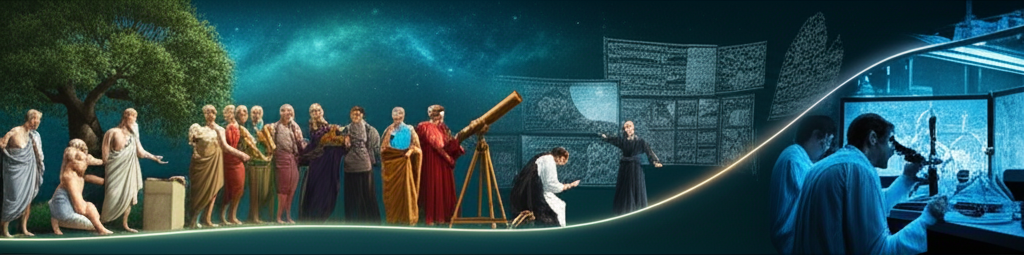
The human endeavor to comprehend the world around us is not a static pursuit, but a dynamic, ever-unfolding narrative. From the earliest whispers of myth to the rigorous methodologies of modern inquiry, the evolution of knowledge and science represents humanity's most profound and enduring quest. This journey, chronicled across the pages of the Great Books of the Western World, reveals a relentless drive for understanding, a continuous process of questioning, observing, and refining our grasp of reality. It is through this persistent intellectual progress that civilizations have advanced, technologies have emerged, and our collective consciousness has expanded, demonstrating that knowledge is not merely accumulated but fundamentally transformed over time.
From Mythos to Logos: The Dawn of Inquiry
One might contend that the very bedrock of human civilization rests upon the relentless evolution of knowledge. From the earliest attempts to rationalize the cosmos, as chronicled in the foundational myths and philosophical dialogues of antiquity, to the sophisticated empirical methodologies that define modern science, our understanding of the world has undergone a profound and ceaseless transformation. This journey, far from a straight line, is a testament to humanity's inherent drive for progress – a yearning to peel back the layers of ignorance and to illuminate the obscure.
In the ancient world, the pursuit of understanding often intertwined with philosophical speculation and metaphysical contemplation. Thinkers such as Plato and Aristotle, whose works form cornerstones of the Great Books, laid the groundwork for systematic thought. Aristotle, with his meticulous observations and classifications of the natural world, alongside his development of formal logic, provided an early, albeit often deductive, framework for what would later become scientific inquiry. His emphasis on understanding causes and effects, and his categorization of phenomena, are clear precursors to modern scientific method. Yet, much of this ancient knowledge was derived from observation and reason, sometimes lacking the rigorous experimental verification we now expect.
The Scientific Revolution: A Paradigm Shift
The true inflection point in the evolution of science arrived with the Scientific Revolution, a period that fundamentally reshaped how humanity sought and validated knowledge. This era saw a dramatic shift from reliance on ancient authorities and purely deductive reasoning to an emphasis on empirical observation, experimentation, and mathematical description. Figures like Copernicus challenged entrenched geocentric views, daring to propose a heliocentric model of the universe. Galileo, through his telescopic observations and experiments on motion, exemplified the new spirit of inquiry, often facing significant opposition for his findings.
The work of Isaac Newton, synthesizing the celestial mechanics of Copernicus and Kepler with Galileo's terrestrial physics, provided a grand, unified theory that described the physical world with unprecedented precision. His formulation of universal laws, expressed mathematically, demonstrated the immense power of this new scientific approach. This period marked a crucial leap in progress, moving beyond mere description to predictive power, fundamentally altering humanity's relationship with the natural world.
The Continuous Refinement of Understanding
The journey, however, did not conclude with Newton. The evolution of knowledge is an ongoing process of refinement, self-correction, and expansion. As science advanced, new fields emerged, from chemistry and biology to geology and psychology. Each discipline developed its own sophisticated methodologies, contributing to a more nuanced and comprehensive understanding of the universe, from the subatomic to the cosmic.
Consider the shift from classical Newtonian physics to Einstein's theories of relativity and quantum mechanics. These revolutions were not mere additions to existing knowledge; they represented fundamental re-evaluations of space, time, matter, and energy, demonstrating that even our most robust scientific frameworks are subject to revision in the face of new evidence and deeper insight. This iterative process, where hypotheses are tested, theories are challenged, and new paradigms emerge, is the very engine of scientific progress.
Key Stages in the Evolution of Knowledge and Science
| Stage | Primary Focus | Key Methodologies | Notable Contributions |
|---|---|---|---|
| Ancient Inquiry | Metaphysics, Ethics, Cosmology | Deductive reasoning, philosophical argumentation | Foundations of logic, classification, moral philosophy |
| Medieval Synthesis | Reconciling Faith and Reason | Scholasticism, logical debate, textual commentary | Preservation of classical texts, refinement of argumentation |
| Scientific Revolution | Empirical observation, Mechanics, Astronomy | Inductive reasoning, systematic experimentation | Modern scientific method, heliocentric model, universal laws of motion |
| Enlightenment & Modern | Reason, Social Science, Specialization | Empirical expansion, statistics, peer review | Unprecedented technological advancement, deeper understanding across disciplines |
The Interplay of Knowledge and Progress
The relationship between knowledge and progress is symbiotic. As our scientific understanding deepens, our capacity to effect change – technological, social, and medical – expands proportionally. The invention of the printing press, a crucial innovation highlighted in the Great Books tradition, accelerated the dissemination of knowledge, fueling further scientific inquiry and societal progress. Similarly, modern advancements in computing and communication have created unprecedented opportunities for collaboration and discovery, pushing the boundaries of what is knowable.
This evolution is not without its philosophical challenges. Questions regarding the nature of truth, the limits of scientific inquiry, and the ethical implications of technological progress remain central to philosophical discourse. The Great Books provide a rich tapestry of these ongoing debates, reminding us that the pursuit of knowledge is as much about understanding ourselves and our place in the cosmos as it is about mastering the external world.
Looking Forward: The Unending Quest
The evolution of knowledge and science is an unending quest. Each answer begets new questions, each discovery opens new horizons. From the mysteries of dark matter and quantum gravity to the complexities of consciousness and artificial intelligence, the frontiers of understanding continue to expand. The ongoing progress is not merely about accumulating facts, but about developing more sophisticated ways of asking questions, more precise methods of investigation, and a deeper appreciation for the intricate fabric of reality.
As we continue to navigate the vast ocean of the unknown, the lessons from the Great Books remain pertinent: the importance of critical thinking, the value of open inquiry, and the enduring human spirit that compels us to seek knowledge and strive for progress, ensuring that the tapestry of understanding will forever continue to unfold.
📹 Related Video: What is Philosophy?
Video by: The School of Life
💡 Want different videos? Search YouTube for: ""History of Science Philosophy" or "Epistemology: The Nature of Knowledge""
📹 Related Video: ARISTOTLE ON: The Nicomachean Ethics
Video by: The School of Life
💡 Want different videos? Search YouTube for: ""Key Ideas in the Great Books of the Western World""