

The Evolution of Beauty in Art: A Philosophical Journey Through Changing Aesthetics
The concept of Beauty in Art is not a static ideal, but a dynamic entity that has undergone profound Evolution across millennia. From the earliest cave paintings to the most avant-garde contemporary installations, our understanding and appreciation of what constitutes artistic beauty have continually shifted, reflecting the prevailing philosophical, cultural, and societal currents of each era. This article delves into this fascinating journey, exploring how our aesthetic sensibilities have transformed, challenging us to reconsider the very nature of art and its enduring appeal.
Ancient Visions: Order, Harmony, and the Ideal Form
In the foundational texts of Western thought, such as Plato's Symposium and Aristotle's Poetics (both seminal works within the Great Books of the Western World canon), Beauty was often intrinsically linked to order, proportion, and the pursuit of an ideal form. For the ancient Greeks, beauty was an objective quality, a reflection of the cosmic order, discernible through mathematical ratios and harmonious compositions.
- Platonic Idealism: Plato posited that true beauty resided in the eternal Forms, with earthly manifestations merely imperfect shadows. The artist, in striving for beauty, sought to capture a glimpse of this transcendent ideal.
- Aristotelian Mimesis: Aristotle, while more grounded in the observable world, emphasized art as imitation (mimesis). The beauty of art lay in its ability to faithfully represent nature, often by perfecting it, showing things not merely as they are, but as they ought to be.
This philosophical underpinning profoundly influenced ancient Art. Greek sculpture, for instance, idealized the human form, striving for anatomical perfection, balance, and serene composure. The Parthenon, with its precise architectural ratios and subtle optical corrections, stands as a testament to this pursuit of ordered, harmonious beauty. This period established a benchmark for aesthetic appreciation that would resonate for centuries.
Key Aesthetic Shifts in Antiquity:
- Objective Beauty: Rooted in universal principles and mathematical harmony.
- Idealization: Striving for perfection in form, often transcending mere realism.
- Mimesis: Art's role as an elevated imitation of nature.
Medieval Metamorphosis: Divine Light and Symbolic Splendor
With the advent of Christianity, the focus of Beauty underwent a significant Change. The material world, and consequently its artistic representation, became secondary to the spiritual realm. Beauty was no longer primarily about earthly perfection or humanistic ideals but served as a conduit to the divine.
Medieval Art, exemplified by Byzantine mosaics, Gothic cathedrals, and illuminated manuscripts, often prioritized symbolic meaning and spiritual instruction over naturalistic depiction. Figures were elongated, colors were vibrant and symbolic, and perspective was often flattened to emphasize the otherworldly. The beauty of a stained-glass window, for example, lay not just in its intricate design, but in the ethereal light it cast, evoking a sense of the sacred.
Philosophers of the era, drawing upon Neoplatonism, saw beauty as a reflection of God's glory, an emanation of divine light. The splendor of a cathedral, its soaring arches and intricate carvings, was designed to inspire awe and devotion, guiding the viewer towards a higher truth. This marked a significant Evolution from classical humanism to a more theocentric aesthetic.
The Renaissance Revival: Humanism, Perspective, and Naturalistic Grace
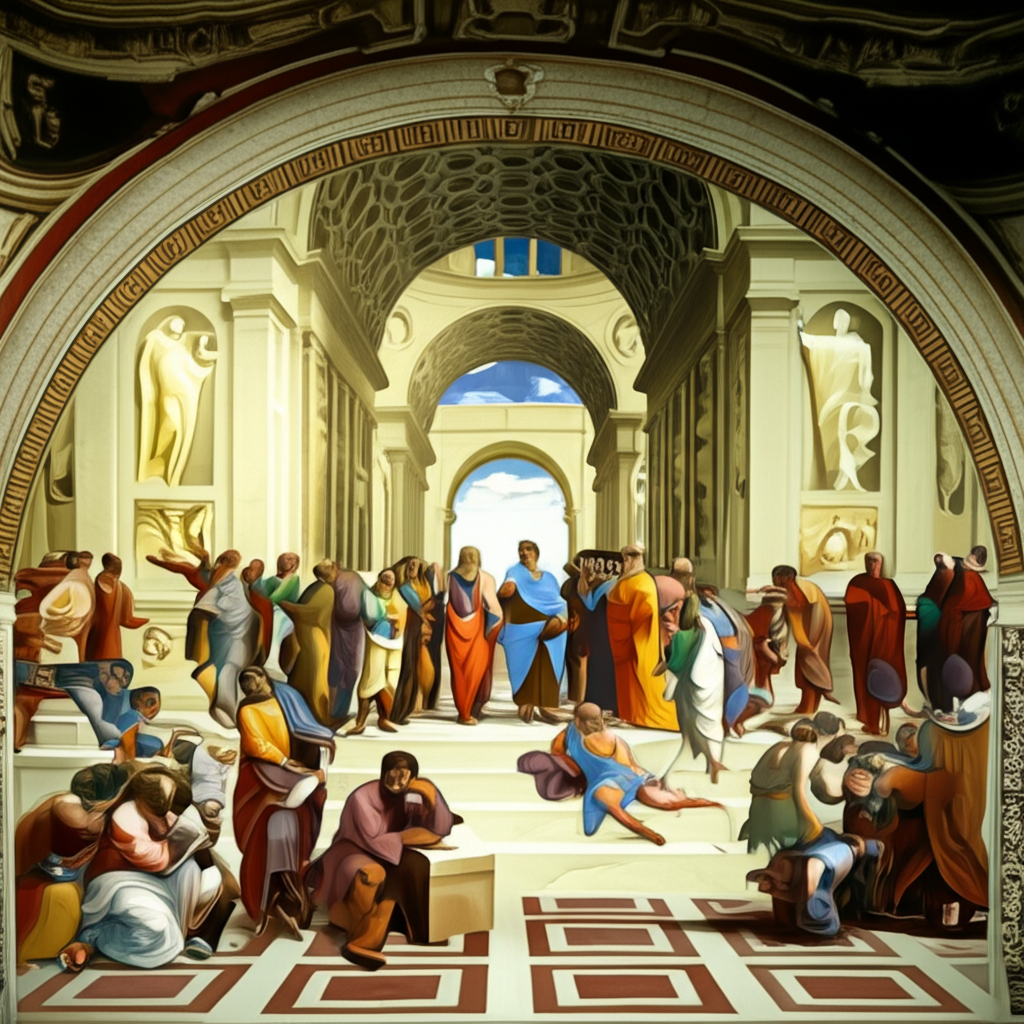
The Renaissance witnessed a profound Change in the perception of Beauty in Art, marking a return to classical ideals infused with a renewed focus on human experience. Inspired by rediscovered Greek and Roman texts (again, drawing from the wellspring of the Great Books), artists and thinkers like Leonardo da Vinci, Michelangelo, and Raphael championed humanism, placing humanity at the center of their artistic endeavors.
This era saw the mastery of perspective, anatomy, and chiaroscuro, leading to a stunning naturalism and emotional depth in painting and sculpture. The beauty of Renaissance art lay in:
- Realistic Depiction: A meticulous study of the human form and natural world.
- Emotional Expression: Capturing the psychological depth of subjects.
- Harmonious Composition: Employing balance, symmetry, and classical proportions.
The Evolution of artistic technique allowed for a more compelling and relatable beauty. Whether it was the serene grace of Botticelli's Birth of Venus or the powerful dynamism of Michelangelo's David, the beauty celebrated the human spirit, its potential, and its place in a divinely ordered, yet human-centered, universe.
Enlightenment and Romanticism: Subjectivity, Emotion, and the Sublime
The Enlightenment introduced a critical shift towards individual reason and subjective experience, profoundly impacting aesthetic theory. Immanuel Kant, in his Critique of Judgment (another essential text from the Great Books), explored the nature of aesthetic judgment, distinguishing between the "beautiful" and the "sublime." For Kant, beauty was associated with harmonious form and disinterested pleasure, while the sublime evoked a sense of awe, even terror, in the face of overwhelming power or vastness.
This philosophical groundwork paved the way for Romanticism, which emphasized emotion, individuality, and the raw power of nature. The Evolution of Beauty moved beyond mere objective harmony to embrace:
- Subjective Experience: The viewer's emotional response became paramount.
- The Sublime: A fascination with grandeur, wildness, and the terrifying aspects of nature.
- Individual Expression: Artists sought to convey personal feelings and dramatic narratives.
Art from this period, like the landscapes of J.M.W. Turner or the dramatic narratives of Eugène Delacroix, celebrated intense emotion and the untamed aspects of existence. The beauty here was often unsettling, powerful, and deeply personal, marking a significant Change from the classical pursuit of serene perfection.
Modernism and the Challenge to Traditional Aesthetics: Abstraction and Disruption
The late 19th and 20th centuries witnessed a radical rupture with traditional notions of Beauty in Art. Modernism, in its myriad forms, deliberately challenged established aesthetic conventions, questioning the very purpose and definition of art. The pursuit of mimetic beauty, once paramount, was increasingly abandoned.
Key Modernist Movements and Their Aesthetic Impact:
| Movement | Aesthetic Focus | Example Artist/Work |
|---|---|---|
| Impressionism | Capturing fleeting moments of light and color, subjective perception. | Claude Monet, Impression, Sunrise |
| Cubism | Deconstruction of form, multiple perspectives, geometric abstraction. | Pablo Picasso, Les Demoiselles d'Avignon |
| Expressionism | Conveying intense emotion through distorted reality and vibrant colors. | Edvard Munch, The Scream |
| Surrealism | Exploring the subconscious, dreams, and irrational juxtapositions. | Salvador Dalí, The Persistence of Memory |
| Abstract Expressionism | Spontaneous, gestural painting, focusing on pure emotion and process. | Jackson Pollock, Number 1A, 1948 |
This period saw an unprecedented Evolution in what could be considered Art and, by extension, Beauty. Marcel Duchamp's "readymades," such as Fountain, famously challenged the very notion of artistic skill and the inherent beauty of an object, positing that the artist's conceptual intent could transform an ordinary item into art. This was a profound Change, shifting the locus of beauty from the object itself to the idea behind it, or the experience it provoked.
Postmodernism and Contemporary Pluralities: Deconstruction and Reinterpretation
In the late 20th and early 21st centuries, Postmodernism further deconstructed established narratives and celebrated a plurality of perspectives. The idea of a universal Beauty was largely abandoned, replaced by an acceptance of diverse, often contradictory, aesthetic values.
Contemporary Art often engages with social commentary, identity politics, and new technologies, blurring the lines between disciplines. Beauty can be found in:
- Conceptual Depth: The power of an idea or message.
- Emotional Resonance: The ability to provoke thought or feeling, regardless of traditional aesthetic appeal.
- Experiential Engagement: Immersive installations or performance art.
- Reinterpretation: Artists often re-contextualize existing imagery or forms, challenging viewers to reconsider their assumptions.
The ongoing Evolution of Beauty in Art is characterized by its boundless experimentation and its refusal to be confined by any single definition. From the provocative to the sublime, from the minimalist to the maximalist, contemporary art reflects a world grappling with constant Change, where beauty is often found in the unexpected, the challenging, and the deeply personal.
Conclusion: The Enduring Power of Aesthetic Inquiry
The journey through the Evolution of Beauty in Art reveals a profound truth: beauty is not merely in the eye of the beholder, nor is it solely an objective truth. Rather, it is a complex interplay between cultural context, philosophical inquiry, individual perception, and artistic innovation. From the ordered harmony of ancient Greece to the conceptual provocations of the postmodern era, our understanding of what constitutes Art and Beauty has continually adapted and expanded. This ongoing Change reminds us that the pursuit of aesthetic understanding is a perpetual and deeply human endeavor, one that enriches our lives and challenges our perceptions of the world.
YouTube Video Suggestions:
-
📹 Related Video: PLATO ON: The Allegory of the Cave
Video by: The School of Life
💡 Want different videos? Search YouTube for: "The Philosophy of Beauty from Plato to Modernism"
-
📹 Related Video: KANT ON: What is Enlightenment?
Video by: The School of Life
💡 Want different videos? Search YouTube for: "Why is Modern Art So Hard to Understand? Aesthetics Explained"