

The Unfolding Tapestry: A Philosophical Reflection on the Evolution of Animal Species
Summary: The theory of Evolution stands not merely as a scientific principle, but as a profound philosophical lens through which we apprehend Nature, the very essence of Animal existence, and the inexorable cycle of Life and Death. This article explores how evolutionary thought compels us to re-evaluate our place within the natural order, challenging long-held assumptions about purpose, design, and the dynamic, ever-changing character of being. From the relentless struggle for existence to the intricate web of interconnected species, evolution offers a compelling narrative of change that resonates deeply with ancient philosophical inquiries into permanence and flux.
Nature's Grand Narrative: Evolution Beyond Biology
For centuries, humanity has pondered its origins and the bewildering diversity of the natural world. Before the advent of modern evolutionary theory, explanations often leaned towards static creation or a divinely ordained hierarchy. However, the insights brought forth by thinkers like Charles Darwin, echoing earlier philosophical musings on change and adaptation, irrevocably shifted our perspective. Evolution is not just a biological mechanism; it is a profound philosophical statement about the fundamental nature of existence. It posits a universe in constant motion, where form follows function, and where the line between species is less a rigid boundary and more a fluid, ever-shifting frontier.
The Great Books of the Western World, while predating Darwin's seminal work, are replete with philosophical groundwork that grapples with similar themes. From Heraclitus's assertion that "everything flows" to Aristotle's meticulous classifications of Animal life and his inquiries into teleology (the study of ends or purposes), the intellectual landscape was ripe for a theory that could explain the apparent design without recourse to a singular, static designer. Evolution, in this philosophical context, becomes the ultimate narrative of becoming.
The Relentless Dance of Life and Death: Driving Forces of Change
At the heart of Evolution lies the stark reality of Life and Death. These are not mere biological events but the very engines of natural selection. Every organism, from the simplest bacterium to the most complex mammal, is engaged in a continuous struggle for survival and reproduction. This struggle, often brutal and indifferent, is what sculpts species over vast stretches of time.
- Natural Selection: The differential survival and reproduction of individuals due to differences in phenotype. This is the primary mechanism of evolutionary change.
- Adaptation: Traits that enhance an organism's survival and reproduction in a specific environment.
- Variation: The raw material for evolution, arising from genetic mutation and recombination.
This interplay of Life and Death is not a flaw in Nature's design, but its very genius. It ensures that only the most fitting traits persist, leading to an astonishing array of adaptations. Lucretius, in De rerum natura (On the Nature of Things), speaks of atoms in perpetual motion, forming and dissolving, a cosmic dance that mirrors the cycles of generation and corruption we observe in the biological realm. While not anticipating natural selection, his work captures the relentless, mechanistic unfolding of the universe, free from divine intervention, which resonates with the materialist implications of evolutionary theory.
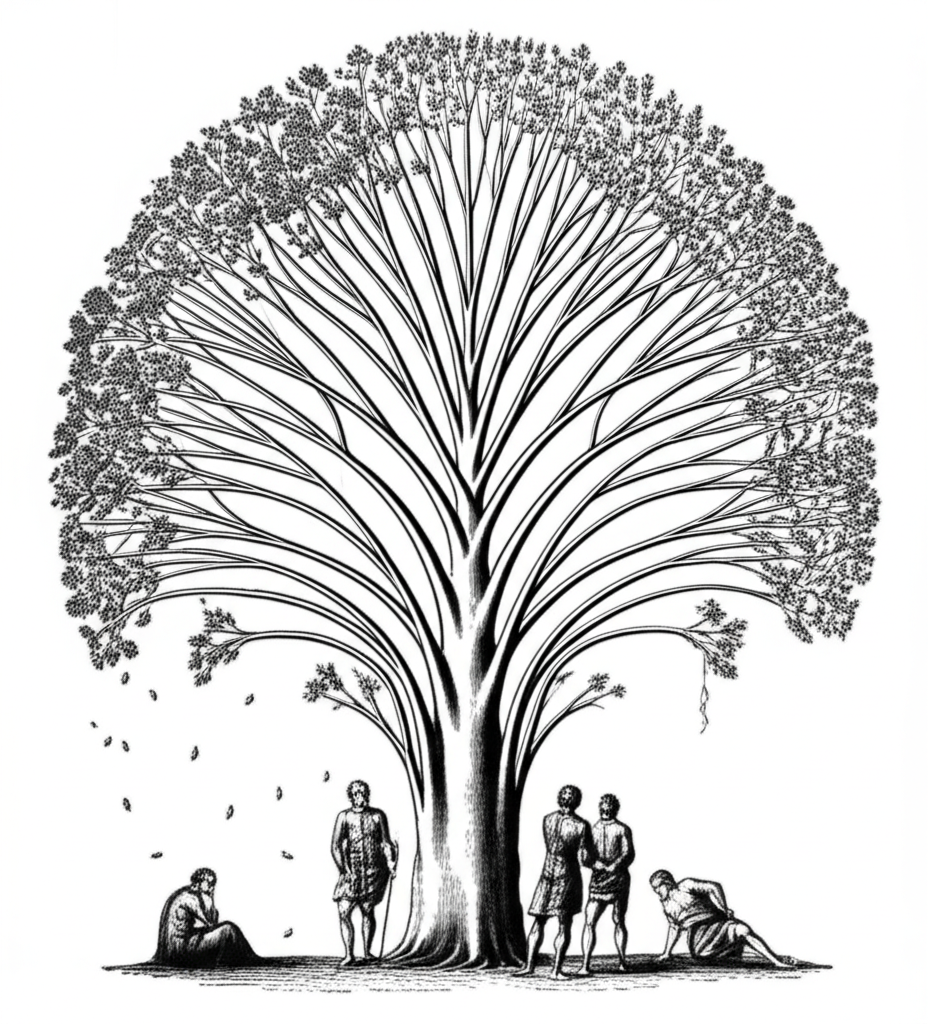
The Animal Condition: A Place in the Continuum
The Evolution of Animal species profoundly redefines our understanding of what it means to be an animal, including ourselves. No longer can humanity stand entirely apart, distinct from the lower beasts by virtue of some unique, immutable essence. Instead, we are placed firmly within the grand Nature continuum, sharing common ancestors and a deep genetic kinship with all living things.
This realization has significant philosophical implications:
- Challenging Anthropocentrism: Evolutionary theory forces us to question the notion of human exceptionalism and our perceived dominion over Nature. If we are products of the same processes, then our ethical responsibilities towards other species become more pressing.
- The Problem of Purpose: If species evolve through blind, undirected processes, does this negate the idea of inherent purpose or teleology in nature? Aristotle's concept of an organism's telos (end or purpose) is challenged by a process driven by contingent environmental pressures rather than an inherent, pre-ordained trajectory.
- Continuity of Mind: The gradual development of complex brains and behaviors across Animal species suggests a continuity of mental faculties, rather than a sharp break. This opens philosophical avenues for discussing animal consciousness, pain, and even rudimentary forms of reason.
| Philosophical Concept | Pre-Evolutionary View (e.g., Plato, Aristotle, Medieval) | Post-Evolutionary View (e.g., Darwin, Modern Philosophy) |
|---|---|---|
| Species Origin | Divine creation, fixed forms, immutable essences | Common descent, gradual change, adaptive radiation |
| Human Place | Unique, separate from animals, often divinely ordained | Part of the animal kingdom, shared ancestry with primates |
| Nature's Purpose | Often teleological, directed towards an end/perfection | Undirected, driven by natural selection, no inherent end |
| Change | Cyclical, degeneration from ideal, or catastrophic | Gradual, cumulative, adaptive, branching |
YouTube Video Suggestions:
-
📹 Related Video: ARISTOTLE ON: The Nicomachean Ethics
Video by: The School of Life
💡 Want different videos? Search YouTube for: ""Philosophical implications of evolution" - look for discussions on ethics, purpose, and human nature"
2. ## 📹 Related Video: ARISTOTLE ON: The Nicomachean Ethics
Video by: The School of Life
💡 Want different videos? Search YouTube for: ""Great Books discussion Darwin Origin of Species" - look for analyses of Darwin's work within a humanities context"
Conclusion: Embracing the Evolving Self
The Evolution of Animal species is more than a scientific theory; it is a foundational pillar for understanding our philosophical existence. It presents a dynamic, interconnected Nature where Life and Death are not antithetical forces but complementary aspects of an ongoing creative process. As Henry Montgomery, I find myself continually drawn to the profound questions evolution poses: What does it mean to be an Animal in a world shaped by such relentless change? How do we reconcile our yearning for meaning with a universe that appears indifferent to our individual fate? The answers, perhaps, lie not in fixed certainties, but in our ongoing capacity for reflection, adaptation, and an ever-evolving understanding of our place within this magnificent, unfolding tapestry of life.