

The Relentless Unfolding: A Philosophical Gaze Upon Animal Evolution
The Evolution of Animal species is more than a scientific theory; it is a profound philosophical narrative, a testament to the ceaseless dynamism of Nature. It speaks to the fundamental processes of Life and Death that sculpt existence, challenging our understanding of fixity, purpose, and our own place within the grand biological tapestry. From the simplest protozoa to the most complex mammals, the story of life on Earth is one of constant flux, adaptation, and an intricate, often brutal, dance of survival. This article delves into the philosophical implications of this magnificent unfolding, drawing insights from the enduring wisdom of the Great Books.
I. Ancient Whispers of Change: Pre-Darwinian Perspectives
Before Darwin articulated the mechanisms of natural selection, thinkers across millennia grappled with the observation of diverse life forms and the apparent stability, yet subtle variation, within species. The idea of species immutability, often tied to a divine creation, held sway for centuries.
- Aristotle's Classification and Telos: In his History of Animals, Aristotle meticulously categorized species, laying foundational groundwork for biology. He observed variations and continuities, yet his philosophy often posited an inherent telos or purpose within each organism, suggesting a fixed essence striving towards its ideal form. This teleological view, deeply influential, implied a designed, rather than evolved, perfection. The concept of an organism's inherent purpose stood as a significant intellectual hurdle for later evolutionary thought, which emphasized adaptation to external conditions over an internal, predetermined drive.
- Plato's Forms and the Impermanence of the Material World: Plato's theory of Forms, where perfect, immutable essences exist independently of the material world, presented a challenge. If a perfect Form of "Dog" exists, how could species evolve and change? The material world, for Plato, was an imperfect reflection, inherently prone to change and decay, but the underlying Forms remained eternal. Evolutionary theory, by contrast, suggests that species themselves are not fixed reflections but dynamic entities shaped by earthly processes.
The philosophical journey towards accepting species change was a gradual one, requiring a shift from essentialist thinking to a more empirical and process-oriented view of Nature.
II. Darwin's Revolution: The Mechanics and Metaphysics of Natural Selection
The 19th century brought about a seismic shift with Charles Darwin's On the Origin of Species. While not a philosopher in the traditional sense, Darwin’s work had profound philosophical implications, fundamentally altering our understanding of Evolution.
Key Principles of Natural Selection:
- Variation: Individuals within a species exhibit natural variations.
- Inheritance: Many of these variations are heritable.
- Overproduction: Organisms produce more offspring than can survive.
- Differential Survival and Reproduction: Individuals with advantageous variations are more likely to survive and reproduce in a given environment, passing those traits to their progeny.
This elegant mechanism, devoid of explicit divine intervention or inherent telos, explained the astonishing diversity and adaptation of Animal life. It suggested that complex forms arise from simpler ones through a blind, iterative process of selection, driven by the stark realities of Life and Death.
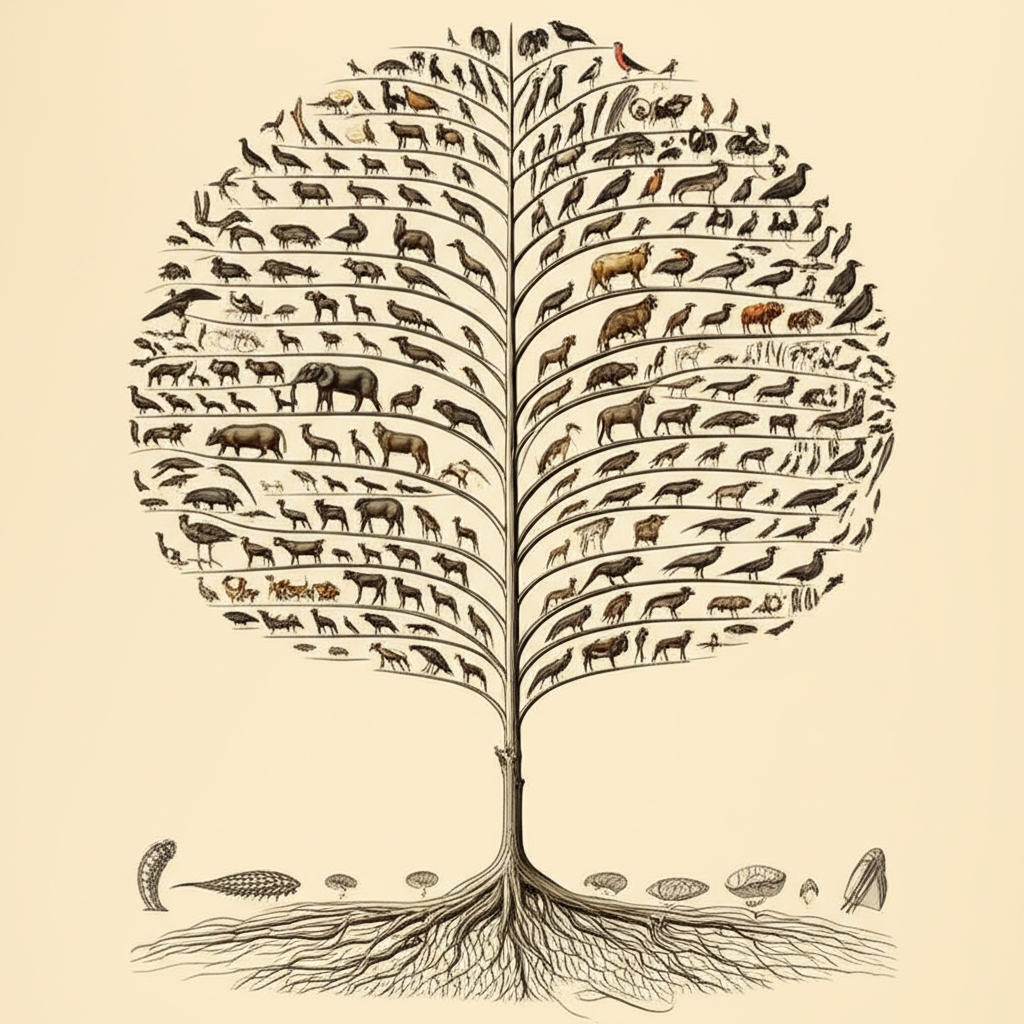
III. The Dance of Life and Death: Nature's Grand Choreography
The engine of Evolution is fueled by the twin forces of Life and Death. This is not a gentle unfolding but often a brutal, relentless process where only the fittest, in a given context, survive to propagate.
- Survival of the Fittest: This phrase, often misconstrued, refers to reproductive success. Those individuals best adapted to their environment are more likely to survive long enough to reproduce, passing on their advantageous traits. Those less adapted face extinction, a constant culling that refines species over generations.
- Extinction as a Creative Force: Death, in the evolutionary context, is not merely an end but a catalyst for new beginnings. Extinction events clear ecological niches, allowing surviving species to diversify and new forms to emerge. The vast majority of species that have ever lived are now extinct, a sobering reminder of Nature's indifference to individual forms, yet its enduring capacity for innovation.
- The Role of Chance and Necessity: Evolution is a blend of chance (random mutations, environmental shifts) and necessity (the imperative to adapt or perish). This interplay challenges deterministic views, suggesting a universe that is both ordered by natural laws and unpredictable in its specific outcomes.
YouTube: The Philosophy of Evolution - Crash Course Philosophy
YouTube: Evolution and Ethics: Morality's Roots in Nature
IV. Humanity's Place in the Evolutionary Narrative
Understanding Animal Evolution inevitably leads to a reflection on humanity's own origins and place. Far from being a separate creation, Homo sapiens is an integral part of this grand narrative, sharing common ancestry with all life on Earth.
- A Continuous Spectrum: Evolution dissolves the rigid boundaries between species, revealing a continuous spectrum of life. This perspective encourages a deeper empathy and responsibility towards other living beings, recognizing our shared biological heritage.
- The Evolving Self: If species are not fixed, what does that mean for human nature? Philosophy has long pondered the essence of humanity. Evolutionary thought suggests that "human nature" is not static but itself a product of ongoing adaptation, subject to change over vast timescales. This opens new avenues for ethical and political philosophy, as we consider the implications of our biological past for our future.
V. Conclusion: An Unfinished Symphony of Existence
The Evolution of Animal species is an ongoing, dynamic process, an unfinished symphony orchestrated by Nature's profound laws. It is a story of adaptation, diversification, and the relentless interplay of Life and Death. From the ancient philosophers who first wondered at the diversity of creatures to Darwin's revolutionary insights, the journey to understand this phenomenon has continually reshaped our worldview. By embracing the fluidity and interconnectedness revealed by Evolution, we gain a deeper appreciation for the intricate beauty and profound mystery of existence itself, reminding us that we are but one note in Nature's magnificent, ever-changing composition.
📹 Related Video: What is Philosophy?
Video by: The School of Life
💡 Want different videos? Search YouTube for: "The Evolution of Animal Species philosophy"