

The Genesis of Forms: Philosophical Reflections on Animal Evolution
Summary: The concept of Evolution has profoundly reshaped our understanding of Animal Life, moving us from a static view of Nature to one of constant change and adaptation. This article explores the philosophical journey from ancient Greek insights into flux and being, through the revolutionary proposals of Darwin, and into the enduring questions Evolution poses regarding purpose, humanity's place, and the intricate dance of Life and Death that shapes all species. We delve into how this scientific theory continues to challenge and enrich our philosophical inquiries into the very fabric of existence.
From Immutable Forms to Dynamic Flux: Early Philosophical Speculations
Before the advent of modern biology, philosophers wrestled with the perplexing variety and apparent order of Animal Life. The "Great Books of the Western World" reveal a long-standing intellectual tradition seeking to comprehend the origins and transformations of species. For many, Nature seemed to present an unchanging tableau, a divine blueprint.
Consider Aristotle, whose meticulous observations of Animal anatomy and behavior, detailed in works like History of Animals, laid foundational biological classifications. He conceived of a scala naturae, a "ladder of Nature," where beings were arranged in a hierarchy from the simplest to the most complex, with humans at the apex. Yet, for Aristotle, species were generally fixed, each striving to fulfill its inherent potential, its telos. While he acknowledged change within individuals, the form of the species itself was considered immutable.
However, whispers of a more dynamic Nature existed. Heraclitus, the pre-Socratic philosopher, famously asserted that "you cannot step into the same river twice," emphasizing the constant flux of all things. While not directly addressing Animal Evolution, his philosophy of perpetual change certainly provided a conceptual framework that, in hindsight, resonates with evolutionary thought. More directly, Lucretius, in his epic poem On the Nature of Things, offered a striking, atomistic vision of the world. He posited that various forms of Life arose from random combinations of atoms, and only those "fitted" for survival by their physical attributes endured. This ancient Roman's mechanistic worldview, describing a struggle for existence and the accidental emergence of viable forms, bears a remarkable, proto-evolutionary resemblance to later scientific theories, albeit without the mechanism of natural selection.
- Key Pre-Darwinian Ideas on Species and Change:
- Aristotle: Fixed species, scala naturae, teleological development.
- Plato: Eternal Forms, imperfect earthly manifestations.
- Heraclitus: Universal flux, constant change as the essence of reality.
- Lucretius: Atomistic origins of diverse life forms, survival of the fittest by chance.
The Unfolding Tapestry: Darwin, Descent, and the Redefinition of Life
The 19th century witnessed a paradigm shift that irrevocably altered our understanding of Animal Life and Nature: Charles Darwin's theory of Evolution by natural selection. Published in On the Origin of Species, Darwin's meticulously gathered evidence presented a compelling case for common descent, proposing that all species, including humans, share a common ancestor and have diversified over vast stretches of time through a process driven by environmental pressures.
Darwin's central mechanism, natural selection, hinges on several key observations: variation within populations, heritability of traits, and differential survival and reproduction. In the relentless struggle for Life and Death, individuals with advantageous traits are more likely to survive, reproduce, and pass those traits to their offspring. Over countless generations, these small, cumulative changes lead to the development of new species.
This groundbreaking theory challenged deeply entrenched philosophical and theological doctrines. It suggested that the intricate design of Animal bodies was not the result of a divine architect's direct intervention but rather the product of an undirected, mechanistic process. This profoundly impacted our perception of Nature, moving it from a static, divinely ordained order to a dynamic, ever-changing system where Life itself is a continuous, unfolding experiment. The concept of common ancestry also blurred the lines between species, emphasizing the deep interconnectedness of all Animal Life.
Beyond Biology: Evolution's Echoes in Ethics, Metaphysics, and Epistemology
The implications of Evolution extend far beyond the biological sciences, permeating the very core of philosophical inquiry. It forced a re-evaluation of fundamental questions that thinkers had pondered for millennia.
The Question of Purpose and Design
If Animal Life is the product of undirected natural selection, does this eliminate the concept of cosmic purpose or teleology? The intricate complexity of the eye, for instance, once cited as irrefutable proof of intelligent design, could now be explained through incremental evolutionary steps. This shift challenged traditional arguments for the existence of God based on design and opened new avenues for understanding Nature as a self-organizing system.
Humanity's Place in Nature
Perhaps the most profound philosophical jolt came from the realization that humans are not separate from, but rather an integral part of, the Animal kingdom. Darwin’s theory, particularly as explored in The Descent of Man, placed humanity squarely within the evolutionary lineage, sharing common ancestry with other primates. This challenged centuries of anthropocentric thought, forcing us to re-evaluate our unique status, our moral obligations to other species, and the very definition of what it means to be human. Are our moral instincts, our capacity for altruism, also products of Evolution? This question continues to fuel debates in ethics and moral philosophy.
The Morality of Nature
The evolutionary process itself, with its emphasis on competition and the constant specter of Life and Death, presents a stark, amoral view of Nature. Is Nature "red in tooth and claw," as Tennyson described? If so, what does this imply for deriving moral principles from the natural world? Philosophers have grappled with the "naturalistic fallacy," the idea that what is natural is not necessarily what ought to be. Evolution compels us to distinguish between biological facts and ethical values, even as it provides insights into the potential origins of our moral sentiments.
The Nature of Knowledge
Even our cognitive faculties – our ability to reason, perceive, and understand the world – can be viewed through an evolutionary lens. If our brains are products of natural selection, optimized for survival and reproduction in specific environments, what does this imply about the reliability or scope of human knowledge? This question delves into epistemology, asking whether our categories of thought and perception are universal truths or adaptive tools shaped by our evolutionary history.
The Enduring Mystery: Evolution, Consciousness, and the Future of Evolutionary Thought
The journey of Evolution continues, both in the natural world and in our philosophical understanding. The intricate dance of Life and Death plays out across ecosystems, constantly shaping and reshaping species. Scientists continue to uncover the astonishing complexity of Animal Life, from the molecular mechanisms of genetic inheritance to the vast timescales of planetary change.
Philosophically, new questions emerge. How does consciousness arise from purely material evolutionary processes? What are the ethical implications of genetic engineering and directed Evolution? As our understanding of Nature deepens, so too does our appreciation for the profound mystery inherent in the emergence and diversification of Life. Evolution is not merely a biological fact; it is a foundational philosophical concept that challenges us to reconsider our place in the cosmos, the origins of our values, and the dynamic, ever-changing character of existence itself. It invites us to engage with the Animal world not as a static backdrop, but as a vibrant, interconnected tapestry woven through deep time, a testament to the relentless power of change.
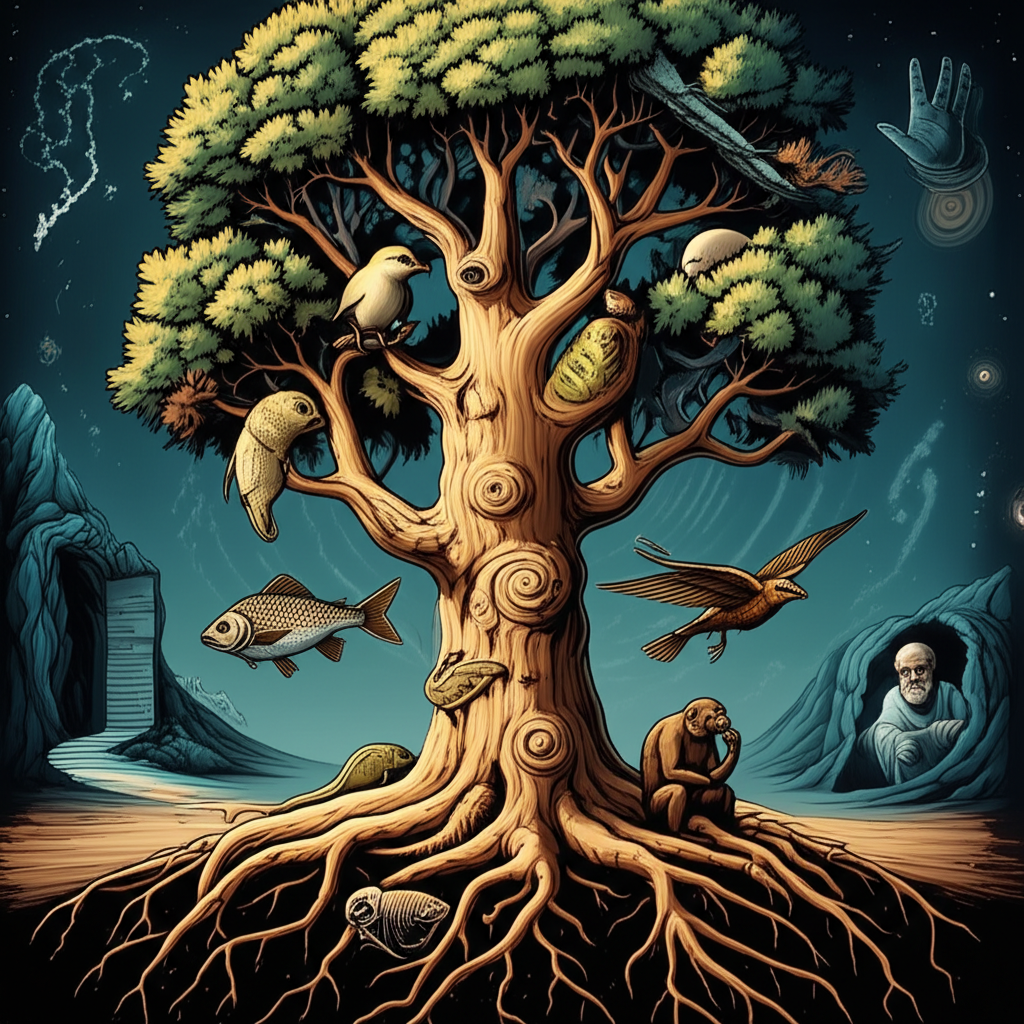 subtly integrated into the natural landscape, inviting contemplation on the origins of life, knowledge, and our place within the grand evolutionary narrative.)
📹 Related Video: ARISTOTLE ON: The Nicomachean Ethics
Video by: The School of Life
💡 Want different videos? Search YouTube for: ""Philosophy of Evolution and Ethics""
📹 Related Video: ARISTOTLE ON: The Nicomachean Ethics
Video by: The School of Life
💡 Want different videos? Search YouTube for: ""Great Books on Nature and Human Place""