

The Uneasy Conscience: Navigating the Ethics of Wealth Distribution
The question of how societies ought to distribute wealth is not merely an economic quandary; it is a profound ethical challenge that has plagued philosophers from antiquity to the present day. At its heart lies the tension between individual liberty, collective well-being, and the fundamental principles of justice. This article delves into the philosophical underpinnings of wealth distribution, exploring how thinkers have grappled with the origins of wealth, the moral claims of labor, and the very definition of a just society. We will examine various ethical frameworks that seek to provide answers, acknowledging that the path to a truly equitable distribution remains fraught with complex considerations.
Unpacking the Philosophical Foundations of Economic Justice
From the moment our ancestors first claimed a piece of land or the fruits of their toil, the ethical dimensions of property and prosperity began to emerge. The very concept of wealth itself – whether it manifests as land, currency, or capital – is imbued with layers of social and moral meaning, far beyond its material form.
Why is Wealth Distribution an Ethical Issue?
- Fundamental Needs: Does everyone have a right to basic sustenance, regardless of their contribution?
- Equality of Opportunity vs. Outcome: Should society strive for equal starting points, or equal results?
- Desert and Merit: Do individuals deserve wealth based on their effort, talent, or contribution?
- Social Cohesion: Does extreme inequality threaten the stability and justice of a community?
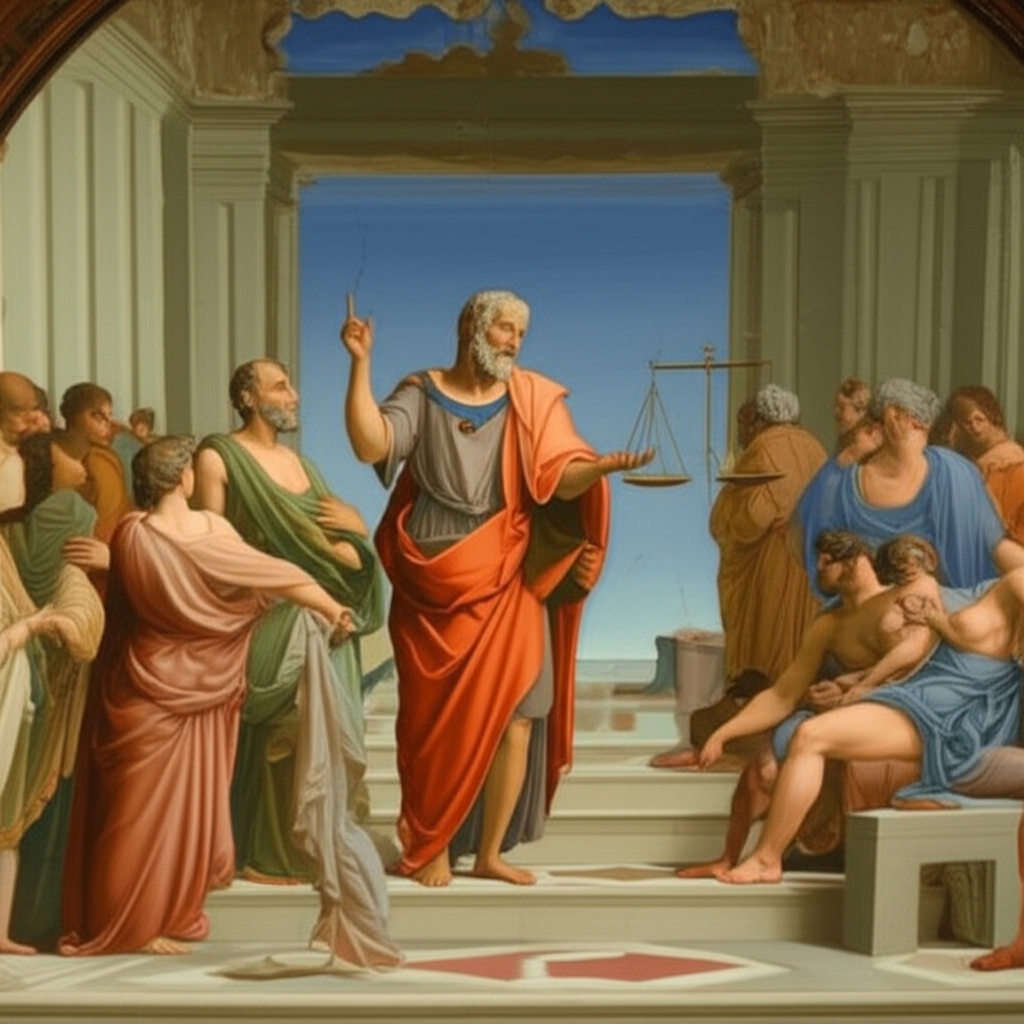
Ancient Echoes: Property, Virtue, and the Polis
Our journey into the ethics of wealth distribution begins with the foundational texts of Western thought, where the relationship between property, citizenship, and the good life was fiercely debated.
- Plato's Republic: For Plato, in his ideal state, the guardian class (philosopher-kings and soldiers) would hold no private property, sharing all possessions and even families. This radical vision aimed to eliminate self-interest and foster a singular devotion to the common good, particularly among those entrusted with governance. While not advocating for universal wealth distribution, it highlights a concern for how property can corrupt the soul and destabilize the polis.
- Aristotle's Politics and Nicomachean Ethics: Aristotle, ever the pragmatist, acknowledged the necessity of private property for human flourishing, arguing it fosters responsibility and allows for generosity. However, he was deeply concerned with distributive justice – the fair allocation of common advantages and burdens. He proposed a system of proportional equality, where distribution should be based on merit or contribution, not strict numerical equality. He also warned against the dangers of excessive wealth and poverty, seeing them as destabilizing forces. A just society, for Aristotle, was one that enabled its citizens to live a virtuous life, and this often required a moderate distribution of resources.
The Dawn of Modernity: Labor, Rights, and the Social Contract
The Enlightenment brought a renewed focus on individual rights and the origins of legitimate government, profoundly impacting discussions on wealth and property.
John Locke and the Labor Theory of Property
In his Two Treatises of Government, John Locke laid a cornerstone for modern property rights. He argued that individuals acquire a right to property by mixing their labor with natural resources. When a person cultivates land or gathers fruit, that labor makes it their own, removing it from the common state of nature.
Locke's Provisos:
Locke's theory wasn't without caveats. He stipulated two crucial conditions:
- Sufficiency: Enough and as good must be left in common for others.
- Spoilage: One must not take more than one can use before it spoils.
These provisos, however, became contentious as societies grew more complex and money (which "spoils not") allowed for the accumulation of vast wealth. The question then becomes: Is modern wealth accumulation still justified by Locke's labor theory when it seemingly violates the sufficiency proviso for many?
Rousseau's Critique of Property
Jean-Jacques Rousseau, in his Discourse on the Origin and Basis of Inequality Among Men, offered a starkly different perspective. He famously declared, "The first man who, having fenced in a piece of land, said 'This is mine,' and found people naive enough to believe him, was the true founder of civil society." For Rousseau, private property, while perhaps inevitable, was the source of much human misery and inequality, leading to dependence and moral corruption. He questioned the very legitimacy of property claims that led to vast disparities, seeing them as fundamentally unjust and contrary to humanity's natural state.
Industrial Revolutions and the Problem of Value: Who Deserves What?
The advent of industrial capitalism intensified the debate over wealth distribution, particularly concerning the relationship between labor, capital, and value.
Adam Smith and the Invisible Hand
Adam Smith, in The Wealth of Nations, posited that individual self-interest, guided by an "invisible hand," could lead to collective prosperity. While he acknowledged the importance of labor in creating value, his focus was on the efficiency of markets and the division of labor as engines of wealth creation. He believed that even with economic disparities, a free market system would ultimately benefit all, including the poor, through increased productivity and opportunity.
Karl Marx and the Critique of Capital
Karl Marx, however, offered a devastating critique of capitalist wealth distribution. In Das Kapital, he argued that under capitalism, the labor of workers creates all value, but they are only paid a subsistence wage. The surplus value, the difference between what workers produce and what they are paid, is appropriated by the capitalists as profit. This, for Marx, was inherent exploitation and the root of fundamental injustice. He envisioned a communist society where the means of production were collectively owned, and wealth distributed "from each according to his ability, to each according to his needs."
Contemporary Ethical Frameworks for Wealth Distribution
In the wake of these historical debates, modern philosophy has developed several key frameworks for addressing the ethics of wealth distribution.
1. Utilitarianism: Maximizing Overall Well-being
- Core Idea: The best action or policy is the one that maximizes overall happiness or utility for the greatest number of people.
- Application to Wealth: A utilitarian approach might support wealth redistribution if it leads to a net increase in societal happiness. For instance, taking from the very rich (whose marginal utility of money is low) and giving to the very poor (whose marginal utility is high) could increase overall utility.
- Challenges: It can potentially justify policies that harm a minority if it significantly benefits the majority. It also struggles with defining and measuring "happiness" or "utility."
2. Egalitarianism: The Pursuit of Equality
- Core Idea: Advocates for a more equal distribution of wealth, income, and opportunities.
- John Rawls' Theory of Justice: A prominent egalitarian, Rawls, in A Theory of Justice, proposed two principles of justice that individuals would choose behind a "veil of ignorance" (not knowing their own social position, talents, or wealth):
- Equal Basic Liberties: Each person is to have an equal right to the most extensive scheme of equal basic liberties compatible with a similar scheme of liberties for others.
- Difference Principle: Social and economic inequalities are to be arranged so that they are both (a) to the greatest benefit of the least advantaged, and (b) attached to offices and positions open to all under conditions of fair equality of opportunity.
- Implications: Rawls's difference principle specifically justifies wealth redistribution if it benefits the worst-off members of society, even if it allows for some inequality.
3. Libertarianism: Prioritizing Individual Rights and Minimal State
- Core Idea: Emphasizes individual liberty, property rights, and a minimal state.
- Robert Nozick's Entitlement Theory: In Anarchy, State, and Utopia, Nozick argued against patterned principles of distribution (like egalitarianism or utilitarianism) because they require constant state interference with individual liberty. His entitlement theory has three principles:
- Principle of Acquisition: How unowned things can be justly acquired.
- Principle of Transfer: How holdings can be justly transferred from one person to another.
- Principle of Rectification: How past injustices in acquisition or transfer should be corrected.
- Implications: If wealth is acquired and transferred justly, then any resulting distribution, no matter how unequal, is just. Taxation for redistribution is considered a violation of property rights, akin to forced labor.
The Ongoing Debate: Navigating the Ethical Labyrinth
The philosophical landscape of wealth distribution is not a settled one. These frameworks offer distinct lenses through which to view the problem, each with compelling arguments and significant challenges.
Key Points of Contention:
- The Nature of Property: Is property a natural right, a social construct, or a means to a collective end?
- The Role of Merit vs. Need: Should wealth be distributed based on individual contribution and effort (meritocracy), or on basic human requirements (needs-based)?
- The Scope of Justice: Does justice primarily concern individual rights and non-interference, or does it demand active intervention to ensure a more equitable society?
- Global Inequality: How do these ethical considerations extend beyond national borders to address vast global wealth disparities?
The ethics of wealth distribution forces us to confront our deepest values regarding fairness, freedom, and the very structure of human society. There are no easy answers, only a continuous philosophical struggle to articulate and implement principles that genuinely reflect our aspirations for a just and flourishing world.
YouTube Video Suggestions:
-
📹 Related Video: PLATO ON: The Allegory of the Cave
Video by: The School of Life
💡 Want different videos? Search YouTube for: ""Justice: What's The Right Thing To Do? Episode 8: 'Whose America?' Michael Sandel"" - This episode of Michael Sandel's Harvard lecture series directly engages with Robert Nozick's libertarian arguments and Rawls's theory of justice in the context of wealth and taxation.
2. ## 📹 Related Video: PLATO ON: The Allegory of the Cave
Video by: The School of Life
💡 Want different videos? Search YouTube for: ""The School of Life: Karl Marx"" - A concise and accessible overview of Marx's critique of capitalism and his ideas on labor, value, and exploitation, offering a foundational understanding of his ethical stance on wealth distribution.