

The Eternal Question: Navigating the Ethical Labyrinth of Immortality
The prospect of immortality, once confined to myth and theological discourse, is increasingly entering the realm of scientific speculation. But as we inch closer to potentially extending human life and death as we know it, we must pause and confront the profound ethical consequences such a transformation would unleash. Immortality isn't merely an extension of existence; it's a fundamental paradigm shift that challenges the very foundations of our moral frameworks, our understanding of purpose, change, and what it means to be human. This article delves into the intricate web of dilemmas that arise when the finite nature of our lives is stripped away, drawing upon the wisdom of the Great Books of the Western World to illuminate the timeless questions at stake.
The Finitude Paradox: Meaning in Mortality
Our current ethical systems are intrinsically linked to the finite nature of human existence. The urgency of striving for goodness, the value placed on a "life well-lived," and the concept of a legacy are all predicated on the knowledge that our time is limited. Aristotle, in his Nicomachean Ethics, speaks of eudaimonia – human flourishing – as an activity of the soul in accordance with virtue over a complete life. But what constitutes a "complete life" if it never ends?
- The Value of Scarcity: Does life lose its preciousness, its unique value, if it is no longer a finite resource?
- Motivation for Virtue: If there is no ultimate end, no final judgment or natural conclusion, what drives individuals to make sacrifices, to strive for improvement, or to leave a positive mark on the world? The immediacy of our mortality often sharpens our focus on what truly matters.
- The Burden of Memory: An immortal being would accumulate an infinite store of memories, triumphs, and losses. How would the psyche cope with such an endless repository, and what would it mean for personal growth and the ability to forget and forgive?
Justice, Governance, and Infinite Lives
The implications of immortality for social structures, legal systems, and resource allocation are staggering. Plato, in his Republic, meticulously outlines an ideal state founded on principles of justice, division of labor, and the pursuit of the common good. How would such an ideal, or any functional society, contend with an eternally living populace?
- Resource Depletion and Overpopulation: Perhaps the most immediate concern. An ever-growing, never-dying population would rapidly deplete Earth's resources, leading to unprecedented conflicts over land, food, and energy. Who would be granted the gift of immortality, and who would be denied? Such decisions would be the ultimate ethical gatekeeping.
- Law and Punishment: Current legal systems are designed with the understanding of finite sentences. What would "life imprisonment" mean for an immortal? How would rehabilitation be conceived, or retribution applied, if there's no natural end to a person's existence?
- Political Stagnation: Would immortal leaders lead to stagnation, preventing necessary societal change and the infusion of new ideas? The natural cycle of generations bringing fresh perspectives is a vital engine of progress.
- Economic Disparity: If immortality treatments become available, it's highly probable they would initially be accessible only to the wealthy, exacerbating existing inequalities to an unimaginable degree, creating an eternal elite and a mortal underclass.
The Self in Perpetuity: Identity and Change
One of the deepest philosophical questions concerns the nature of personal identity. Am I the same person I was ten years ago? One hundred years from now? Heraclitus famously stated that "you cannot step into the same river twice," emphasizing the constant flux of being. If we live forever, how much change can a person undergo before they are no longer recognizably "themselves"?
- Loss of Purpose: Many of our life goals – raising a family, building a career, achieving mastery in a field – are framed within a finite lifespan. What new goals would sustain an immortal through millennia? The risk of profound boredom, anhedonia, and existential ennui is immense.
- The Evolution of Personality: Would an immortal's personality ossify, or would it continually evolve? If the latter, at what point does it become a new identity altogether?
- Relationships and Loss: The pain of outliving loved ones would become a constant companion. Forming deep bonds would inevitably lead to the repeated agony of their eventual, mortal demise, or the burden of eternal, possibly stagnant, companionship.
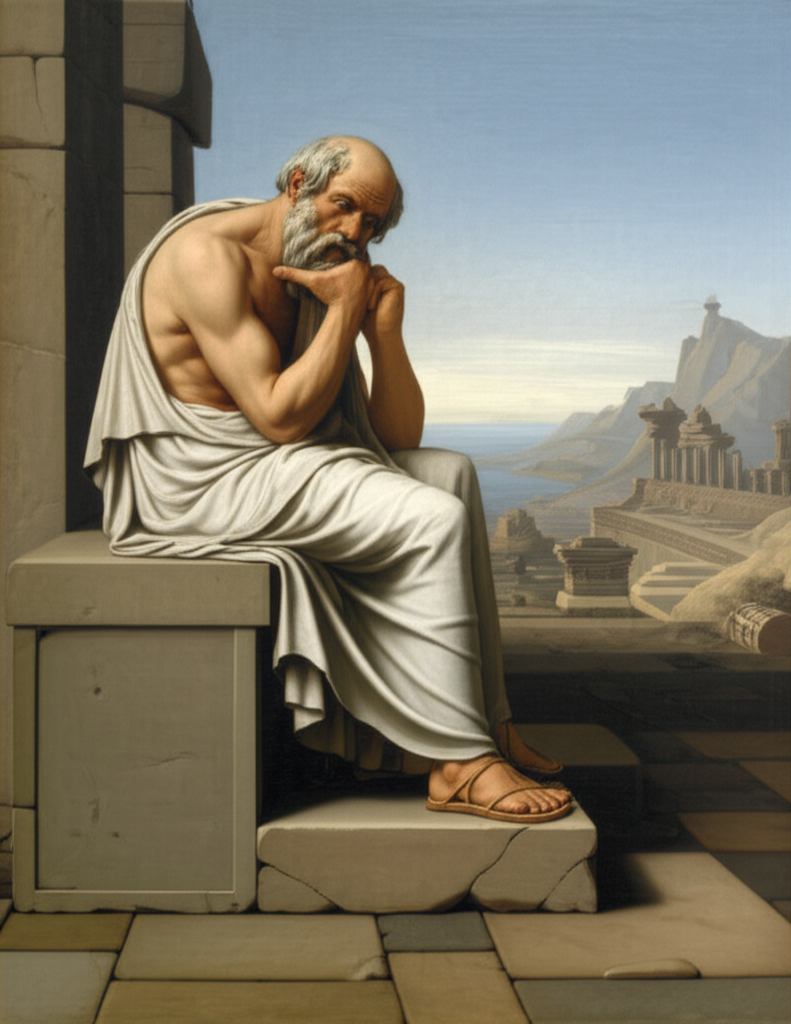
The Quest for Wisdom: An Infinite Journey?
Socrates's life, as chronicled by Plato, was dedicated to the relentless pursuit of wisdom through critical examination. He believed that "the unexamined life is not worth living." For an immortal, would this quest ever reach a conclusion? Would the accumulation of knowledge eventually lead to a state of ultimate wisdom, or merely an infinite expansion of questions?
The pursuit of knowledge is often driven by the desire to understand our place in the cosmos, to make sense of our brief existence. If existence is no longer brief, does the urgency of this quest diminish, or does it transform into something entirely new? The very definition of wisdom might need to be re-evaluated.
Ethical Dilemmas of Immortality
The ethical landscape of immortality is rife with complex challenges, demanding a re-evaluation of our core values:
- Equity of Access: Who deserves immortality? Is it a right, a privilege, or a burden?
- Environmental Impact: How do we sustain an ever-growing, never-dying population without devastating the planet?
- Social Dynamics: How would relationships, family structures, and intergenerational learning adapt?
- Psychological Well-being: Can the human mind truly cope with endless existence without succumbing to despair, anhedonia, or a loss of identity?
- Meaning and Purpose: What gives life meaning when death is no longer a factor?
- Global Governance: What new forms of international cooperation and regulation would be necessary to manage an immortal population?
Conclusion: Redefining Our Ethical Compass
The contemplation of immortality serves as a powerful thought experiment, even if it remains a distant dream. It forces us to confront the unspoken assumptions embedded within our current ethical frameworks, assumptions largely built upon the premise of finite life and death. From Aristotle's pursuit of eudaimonia to Plato's vision of justice, the great thinkers of the Western tradition have explored the ideal human condition within the bounds of a natural lifespan.
Should humanity ever unlock the secret to eternal life, it will necessitate a profound and unprecedented redefinition of virtually every aspect of our existence. Our ethics must evolve to consider not just the good life, but the eternal good life, grappling with questions of sustainability, identity, change, and the very essence of human purpose. While the scientific journey towards immortality may be long, the philosophical journey to understand its consequences must begin now.
📹 Related Video: ARISTOTLE ON: The Nicomachean Ethics
Video by: The School of Life
💡 Want different videos? Search YouTube for: ""Philosophical implications of immortality" or "Ethics of eternal life""