

The Ethical Implications of Cloning: Navigating the Frontiers of Life and Causality
The advent of cloning technology, born from the relentless march of science, has thrust humanity into a profound ethical crucible. What began as a fascinating biological experiment quickly escalated into a complex philosophical debate, challenging our fundamental understanding of life and death, individuality, and the very nature of creation. This article delves into the multifaceted ethical considerations surrounding cloning, exploring how this powerful application of medicine compels us to re-evaluate our role as a cause in shaping the future of biological existence.
The Promise and Peril of Scientific Endeavor
The capacity to replicate living organisms, once confined to the realm of myth and speculative fiction, is now a tangible reality. This scientific breakthrough, while offering tantalizing possibilities, simultaneously unearths a Pandora's Box of moral dilemmas.
A New Frontier in Medicine
From a purely utilitarian perspective, the potential benefits of cloning, particularly therapeutic cloning, are immense. Imagine the ability to grow patient-specific tissues and organs, eliminating the scourge of transplant rejection. This application of medicine holds the promise of alleviating suffering and extending healthy lives, fundamentally altering our approach to disease and injury. The creation of stem cell lines that are genetically identical to a patient could revolutionize treatments for conditions ranging from Parkinson's disease to spinal cord injuries.
The Causal Chain of Creation
However, the power to initiate life outside traditional reproductive processes forces us to confront our role as a cause. When humanity takes on the mantle of creator, even in a biological sense, profound questions arise about responsibility, purpose, and the inherent value of the life brought into being. Philosophers, from Aristotle's exploration of efficient and final causes to later thinkers grappling with human agency, have long pondered the implications of creation. Cloning re-positions humanity not merely as a participant in nature, but as an architect of its very fabric, raising concerns about hubris and the potential unintended consequences of such profound intervention.
Identity, Individuality, and the Soul
Perhaps the most visceral ethical concerns revolve around the cloned individual itself. What does it mean to be a copy? Does a clone possess the same rights, dignity, and unique identity as any other human being?
What Makes Us 'Us'?
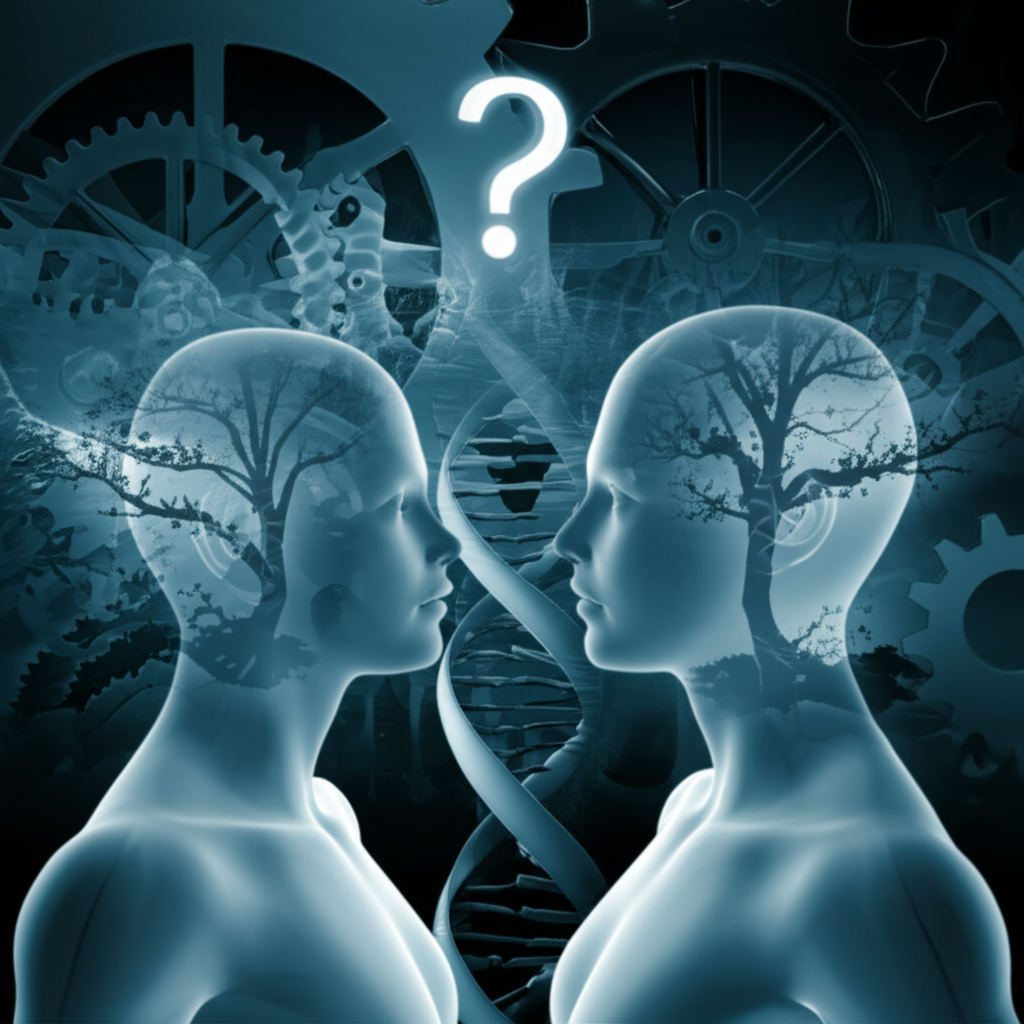
The Great Books of the Western World are replete with inquiries into personal identity. From Locke's theories of consciousness and memory to discussions on the soul and essence, philosophers have grappled with what constitutes a unique self. A clone, sharing identical genetic material with another, challenges these notions directly. Is identity solely genetic, or is it forged through experience, environment, and free will? The very existence of a clone compels us to re-examine the intricate tapestry that weaves together our individuality.
The Specter of Duplication
The idea of human reproductive cloning evokes a deep unease. Concerns range from the potential psychological burden on the cloned individual – living as a genetic replica of another – to the fear of creating a "designer baby" or even a subclass of humans engineered for specific purposes. This raises fundamental questions about autonomy, dignity, and the intrinsic value of each unique life. Would a clone be seen as an individual with inherent worth, or merely as a means to an end, a biological product of human design?
The Boundaries of Life and Death
Cloning, particularly its therapeutic applications involving embryonic stem cells, brings us to the very edge of the life and death debate, challenging our definitions and moral thresholds.
Playing God or Healing Humanity?
The phrase "playing God" is frequently invoked in discussions about cloning. This reflects a deep-seated apprehension about humanity overstepping its natural bounds, intervening in processes traditionally viewed as divine or inherently natural. Yet, many argue that medicine inherently "plays God" by extending lives, curing diseases, and manipulating natural processes for human benefit. The ethical dilemma lies in where we draw the line, and what principles guide our decisions when we have the power to create and manipulate life.
Therapeutic vs. Reproductive Cloning: A Moral Divide
It's crucial to differentiate between therapeutic cloning and reproductive cloning.
| Aspect | Therapeutic Cloning | Reproductive Cloning |
|---|---|---|
| Purpose | To create embryonic stem cells for medical research or treatment. | To create a genetically identical copy of an existing or previously existing organism. |
| Outcome | Cells/tissues for research, not a full organism. | A new, living organism. |
| Ethical Debate | Primarily concerns the status of the embryo and the morality of its destruction. | Concerns about identity, dignity, human uniqueness, and potential exploitation. |
| Link to Medicine | Direct application in regenerative medicine. | Potential for infertility treatment, but widely condemned due to ethical concerns. |
The ethical landscape shifts dramatically depending on the intent. Therapeutic cloning, while still controversial due to the destruction of an embryo, is often viewed as a more justifiable pursuit of medicine given its potential to save and improve countless lives. Reproductive cloning, on the other hand, raises a host of ethical red flags that few societies are willing to endorse.
Societal Impact and Legal Frameworks
Beyond individual ethics, cloning presents significant challenges to societal norms, legal structures, and the equitable distribution of advanced science.
Potential for Exploitation and Inequality
If reproductive cloning were ever permitted, there's a serious risk of exacerbating social inequalities. Access to such technology might be limited to the wealthy, potentially creating a new form of eugenics or a "clone economy." Furthermore, the potential for exploitation of cloned individuals, or the women who would carry them, cannot be overlooked. The very idea challenges our commitment to human rights and universal dignity.
The Need for Deliberation
The rapid pace of science often outstrips our capacity for ethical and legal deliberation. As technology advances, it is imperative that philosophy, law, and public discourse engage in robust discussion to establish clear ethical guidelines and legal frameworks. The decisions we make today about cloning will profoundly impact future generations, shaping our understanding of life and death and our ethical responsibilities as a cause in the biological realm.
Conclusion
The ethical implications of cloning are not merely scientific quandaries; they are fundamental philosophical challenges that touch upon the core of human existence. As science and medicine continue to push the boundaries of what is possible, our collective wisdom, informed by centuries of philosophical inquiry (from the Great Books to contemporary ethics), must guide our actions. We must navigate these frontiers with caution, humility, and an unwavering commitment to human dignity, ensuring that our power to be a cause of new life is always tempered by a profound respect for its inherent value and the ultimate mysteries of life and death.
📹 Related Video: ARISTOTLE ON: The Nicomachean Ethics
Video by: The School of Life
💡 Want different videos? Search YouTube for: ""Cloning Ethics Philosophy Debate""
📹 Related Video: KANT ON: What is Enlightenment?
Video by: The School of Life
💡 Want different videos? Search YouTube for: ""The Nature of Identity in a Scientific Age""