

The Ethical Duty of the Citizen: A Philosophical Exploration
The concept of the "citizen" extends far beyond mere legal residency; it encapsulates a complex web of rights, responsibilities, and, crucially, duties. For centuries, philosophers have grappled with what it truly means to be an ethical citizen, an individual who contributes meaningfully to the common good of their society. This pillar page delves into the profound question of the ethical duty of the citizen, drawing insights from the foundational texts of Western thought to illuminate the historical and contemporary dimensions of this vital concept. From ancient Greek ideals of civic virtue to Enlightenment theories of social contract and modern ethical frameworks, we explore the multifaceted obligations that bind individuals to their communities, examining the interplay of Law, morality, and the perennial struggle between good and evil in the public sphere.
Defining the Core: Duty, Citizen, and Ethical Frameworks
Before we embark on our philosophical journey, it's essential to establish a clear understanding of our core terms:
- Duty: In a philosophical context, duty refers to a moral or legal obligation; an action or task required by one's position or by conscience. It often implies a commitment to a principle or a responsibility to others. Immanuel Kant, for instance, famously argued for a duty-based ethics, where actions are moral only if performed out of respect for the moral Law itself, irrespective of their consequences.
- Citizen: More than just a resident, a citizen is typically understood as a legally recognized subject or national of a state, with both rights and responsibilities. Philosophically, the term often implies an active participant in the political life of a polis or state, invested in its welfare and governance.
- Ethics: The branch of philosophy that involves systematizing, defending, and recommending concepts of right and wrong conduct. When we speak of the ethical duty of the citizen, we are exploring the moral principles that ought to guide an individual's actions and relationships within their community and state.
Echoes from the Great Books: Historical Perspectives on Civic Duty
The question of the citizen's duty is not new; it has been a central concern for thinkers across millennia, shaping our understanding of governance, justice, and the ideal society.
Ancient Greek Foundations: Virtue, Polis, and Law
The philosophers of ancient Greece laid much of the groundwork for Western political thought, emphasizing the interconnectedness of the individual and the state.
- Plato (c. 428–348 BCE): In his seminal work, The Republic, Plato explores the nature of justice, both in the individual and in the ideal state. For Plato, the citizen's duty is intrinsically linked to their role within a just society, where each individual performs the function for which they are best suited. The philosopher-king, for example, has a duty to rule with wisdom, while other citizens have a duty to obey and contribute to the harmony of the polis. The ultimate aim is the good of the whole, achieved through rational order and virtue.
- Aristotle (384–322 BCE): In Politics and Nicomachean Ethics, Aristotle defines the citizen as someone who shares in the administration of justice and in offices. He argues that humans are "political animals," meaning that our full potential, our good life (eudaimonia), can only be realized within a community. Active participation and the cultivation of virtues like courage, temperance, and justice are paramount duties for the citizen to ensure the flourishing of the polis. The Law, for Aristotle, is a rational expression of the common good, guiding citizens towards virtuous conduct.
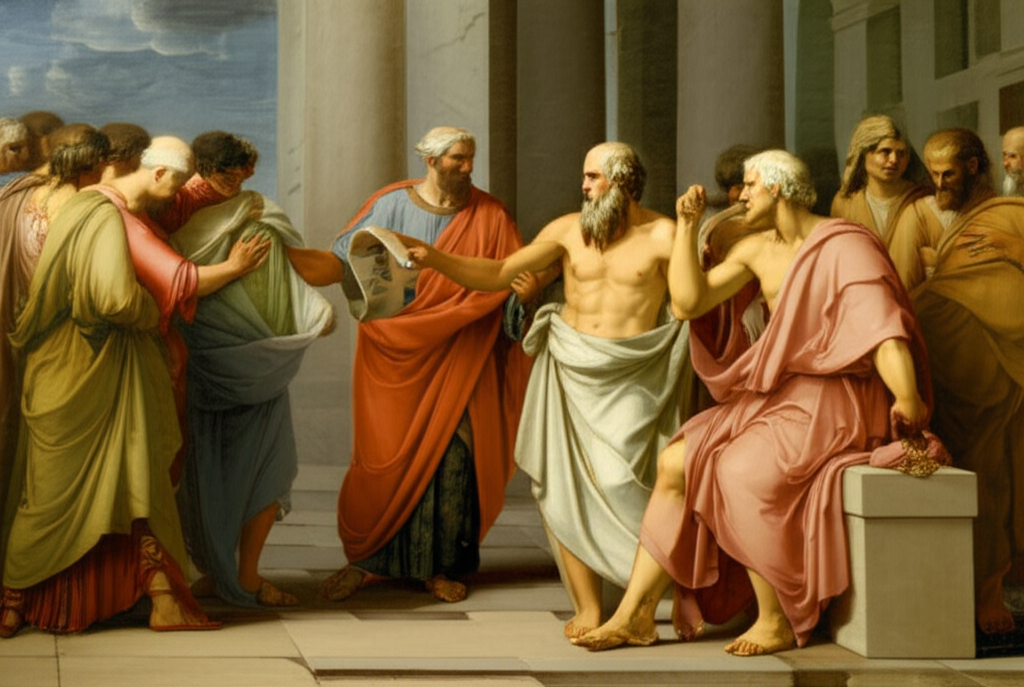
- Socrates (c. 470–399 BCE): Though he wrote nothing himself, Socrates's trial and execution, as chronicled by Plato in works like Crito, provide a powerful illustration of the duty to obey the Law. Faced with an opportunity to escape an unjust death sentence, Socrates famously refused, arguing that having lived under Athens's laws, he had an implicit agreement to abide by them, even when they seemed to act unjustly towards him. His choice underscores a profound duty to the established legal framework, even at personal cost, to uphold the integrity of the state and its foundational principles.
Roman Ideals: Public Service and Moral Obligation
Roman thinkers expanded upon Greek concepts, emphasizing the practical application of civic virtues and the duty of public service.
- Cicero (106–43 BCE): In On Duties (De Officiis), Cicero systematically explores the concept of officium (duty) for Roman citizens. He stresses the duty to serve the state (res publica), to uphold justice, and to prioritize the common good over personal gain. Cicero's work is a guide to moral conduct in public and private life, arguing that true honor and happiness come from fulfilling one's duties to family, community, and state.
Enlightenment and Modernity: Social Contract and Universal Law
The Enlightenment brought new perspectives, focusing on individual rights, the social contract, and the rational basis for moral duty.
- John Locke (1632–1704): In Two Treatises of Government, Locke argues that government derives its legitimacy from the consent of the governed. Citizens enter into a "social contract" to protect their natural rights (life, liberty, property). While emphasizing rights, Locke also implies corresponding duties: to respect the rights of others, to obey just laws, and to participate in the political process to ensure governance serves the common good.
- Jean-Jacques Rousseau (1712–1778): The Social Contract posits that individuals surrender some individual freedoms to the "general will" for the sake of collective liberty and the common good. The citizen's duty becomes one of active participation in creating and upholding the general will, fostering civic virtue, and ensuring that the Law reflects the true interests of the community. Disobedience to this general will is seen as a betrayal of one's own freedom.
- Immanuel Kant (1724–1804): Kant's ethical philosophy, articulated in works like Groundwork of the Metaphysics of Morals, places duty at its core. He argues for a "categorical imperative"—a universal moral Law that commands actions based on reason, not on consequences or personal desires. For Kant, the citizen's duty is to act in accordance with moral principles that could be universalized, respecting the inherent dignity of all individuals. This includes obeying just laws, contributing to a rational society, and striving for moral self-improvement.
- John Stuart Mill (1806–1873): In On Liberty and Utilitarianism, Mill champions individual liberty but also recognizes the citizen's duty to contribute to the greatest happiness for the greatest number. While advocating for minimal state interference, Mill acknowledges that citizens have a duty to participate in democratic processes, to educate themselves, and to contribute to public discourse, all aimed at societal improvement and the promotion of the common good.
Dimensions of the Citizen's Ethical Duty
From these historical perspectives, several key dimensions of the ethical duty of the citizen emerge:
1. Obedience to Law and Justice
The most fundamental duty often cited is obedience to the Law. Without it, social order collapses, leading to chaos and the triumph of evil.
- The Necessity of Law: As Socrates demonstrated, the very fabric of society depends on citizens generally adhering to its legal framework. Laws provide structure, protect rights, and facilitate collective action.
- The Challenge of Unjust Laws: A critical ethical dilemma arises when laws are perceived as unjust. While figures like Socrates prioritized the stability of the legal system, later thinkers and movements (though not always directly from Great Books, the philosophical underpinnings are there) have grappled with the duty to resist or change unjust Law. The ethical citizen must discern when a Law serves the common good and when it perpetuates evil or injustice, and then consider appropriate, often difficult, responses.
2. Active Participation and Civic Engagement
Beyond mere obedience, an ethical citizen is often called to active involvement in their community and governance.
- Informed Participation: This includes the duty to be informed about political issues, to engage in critical thinking, and to participate in democratic processes like voting. Rousseau's concept of the "general will" relies heavily on an engaged and enlightened citizenry.
- Community Contribution: Whether through volunteerism, advocacy, or simply being a responsible neighbor, citizens have a duty to contribute positively to the well-being of their local and broader communities. Aristotle's ideal citizen is one who actively participates in the life of the polis.
3. Promoting the Common Good
A central theme across philosophical traditions is the duty to work towards the common good, balancing individual interests with collective welfare.
- Beyond Self-Interest: The ethical citizen looks beyond their personal gain to consider the impact of their actions on others and on society as a whole. This often involves making sacrifices for the greater good.
- Addressing Societal Challenges: This duty extends to actively addressing societal problems such as poverty, inequality, environmental degradation, and injustice. It requires empathy, moral courage, and a commitment to creating a more just and equitable society.
4. Moral Self-Improvement and Critical Reflection
The ethical duty of the citizen also involves a personal commitment to moral growth and intellectual rigor.
- Cultivating Virtue: Following Aristotle, the citizen has a duty to cultivate virtues that enable them to act rightly and contribute positively to the community.
- Rational Deliberation: Kant's emphasis on reason highlights the duty to think critically, to evaluate moral principles, and to act autonomously based on a rational understanding of duty. This helps in discerning between good and evil in complex situations.
Navigating the Labyrinth: Challenges and Dilemmas
The ethical duty of the citizen is rarely straightforward and often presents profound challenges:
- Conflicting Duties: What happens when one's duty to family conflicts with one's duty to the state? Or when a duty to one's conscience clashes with an unjust Law? These dilemmas test the very core of ethical citizenship.
- Defining "Good" in a Pluralistic Society: In diverse societies, what constitutes the "common good" can be highly contested. The citizen's duty then involves engaging in respectful dialogue, seeking consensus, and understanding different perspectives without succumbing to moral relativism that paralyzes action against clear evil.
- The Problem of Unjust Systems: When the entire political or social system is structured in a way that perpetuates injustice or evil, the citizen's duty can become revolutionary, calling for radical change rather than mere participation. This raises profound questions about the limits of obedience and the justification for civil disobedience.
- Balancing Liberty and Security: Modern societies constantly grapple with the tension between individual freedoms and the collective need for security. The citizen's duty involves a careful consideration of this balance, ensuring that neither extreme undermines the principles of a just society.
Conclusion: The Enduring Imperative of Ethical Citizenship
The ethical duty of the citizen is a dynamic and evolving concept, profoundly shaped by historical context and philosophical inquiry. From the ancient Greek emphasis on civic virtue and the polis, through the Roman ideal of public service, to the Enlightenment's focus on social contracts and universal moral Law, the message remains clear: citizenship is not a passive status but an active, moral undertaking.
To be an ethical citizen is to engage with the world consciously, to understand the intricate relationship between individual actions and collective well-being. It is to grapple with the complexities of Law and justice, to strive for the common good, and to confront the perennial forces of good and evil within oneself and in society. This duty demands constant reflection, moral courage, and an unwavering commitment to the principles that allow human flourishing. As we continue to navigate the challenges of the 21st century, the philosophical insights into the duty of the citizen remain more relevant than ever, urging each of us to consider our role in shaping a more just and humane world.
YouTube Video Suggestions:
-
📹 Related Video: PLATO ON: The Allegory of the Cave
Video by: The School of Life
💡 Want different videos? Search YouTube for: ""Socrates Crito Explained" or "Plato Crito Summary""
2. ## 📹 Related Video: ARISTOTLE ON: The Nicomachean Ethics
Video by: The School of Life
💡 Want different videos? Search YouTube for: ""Kant Categorical Imperative Duty Ethics Explained""