

The Primordial Fluid: Water's Enduring Role in Ancient Cosmology
In the tapestry of ancient thought, water stands as an Element of profound significance, often serving as the very foundation of existence. From the earliest philosophical inquiries into the Physics of the World to the rich narratives of creation myths, water consistently emerged as a primordial force, embodying both life-giving sustenance and chaotic power. This article explores how ancient cosmologies, as reflected in works like the Great Books of the Western World, grappled with the fundamental Nature of water, elevating it from a simple compound to a cosmic principle.
Water as the Urstoff: The Primal Substance
Many early thinkers, observing the omnipresence and transformative power of water, posited it as the fundamental Element from which all things originated. This concept, often termed Urstoff (primal matter), is perhaps best exemplified by Thales of Miletus, considered the first philosopher in the Western tradition.
- Thales' Monism: Thales famously declared that "all is water." For him, water was not merely a component of the World, but its very essence. He observed that water could take various forms—liquid, solid (ice), gas (vapor)—and was essential for life. This empirical observation led him to a singular principle underlying all reality.
- Early Natural Philosophy: This early form of natural philosophy, or physics, sought to identify a single, unifying Element that explained the diversity and change observed in the natural World. Water, with its fluidity and capacity for transformation, seemed a logical candidate for this foundational role.
The Life-Giving Force: Water and Genesis
Beyond its role as a primal Element, water was universally recognized as the bringer and sustainer of life. This intrinsic connection to vitality permeated ancient thought, influencing creation stories and agricultural practices alike.
- Fertility and Nourishment: Civilizations arose near rivers and fertile deltas, making the link between water and life undeniable. The annual flooding of rivers like the Nile was not just an environmental event but a cosmic renewal, ensuring the survival of entire societies.
- Biological Necessity: Ancient philosophers understood, even without modern biology, that living things—plants, animals, humans—are composed largely of water and require it to thrive. This observation reinforced its status as a vital Element in the Nature of existence.
Water in Myth and Creation Narratives
Across diverse cultures, water often features prominently in the genesis of the World, frequently appearing as a primordial chaos or a cosmic womb from which order emerges.
- Primordial Waters: Many creation myths describe an initial state of undifferentiated water, a vast, formless expanse preceding the dry land and the heavens.
- Babylonian Enuma Elish: The epic recounts the primeval chaos of Apsu (freshwater) and Tiamat (saltwater), whose mingling gives birth to the gods and, eventually, the cosmos. Tiamat's body is later split to form the heavens and the earth.
- Biblical Genesis: The opening verses state, "The earth was without form and void, and darkness was over the face of the deep. And the Spirit of God was hovering over the face of the waters." Here, water is the pre-existent medium upon which creation begins.
- Egyptian Mythology: Nun, the primordial watery abyss, is the source from which the creator god Atum arises, bringing forth the World from the chaotic waters.
- The World Serpent/Dragon: In many mythologies, a great serpent or dragon dwells in or embodies the primordial waters, representing either chaos to be overcome or the underlying force that supports the World.
Philosophical Interpretations: Beyond Thales
While Thales championed water as the sole Element, later Pre-Socratic philosophers expanded upon or challenged this view, integrating water into more complex cosmologies.
- Anaximenes and Air: Anaximenes, another Milesian, proposed air as the primary Element, but acknowledged water's role as a condensed form of air, demonstrating the interrelation of the elements.
- Empedocles' Four Roots: Empedocles introduced the concept of four irreducible Elements—Earth, Air, Fire, and Water—governed by the forces of Love and Strife. Here, water takes its place as one of the fundamental building blocks of the World, contributing to the composition of all things. This model greatly influenced subsequent Greek thought and was foundational to later concepts of physics.
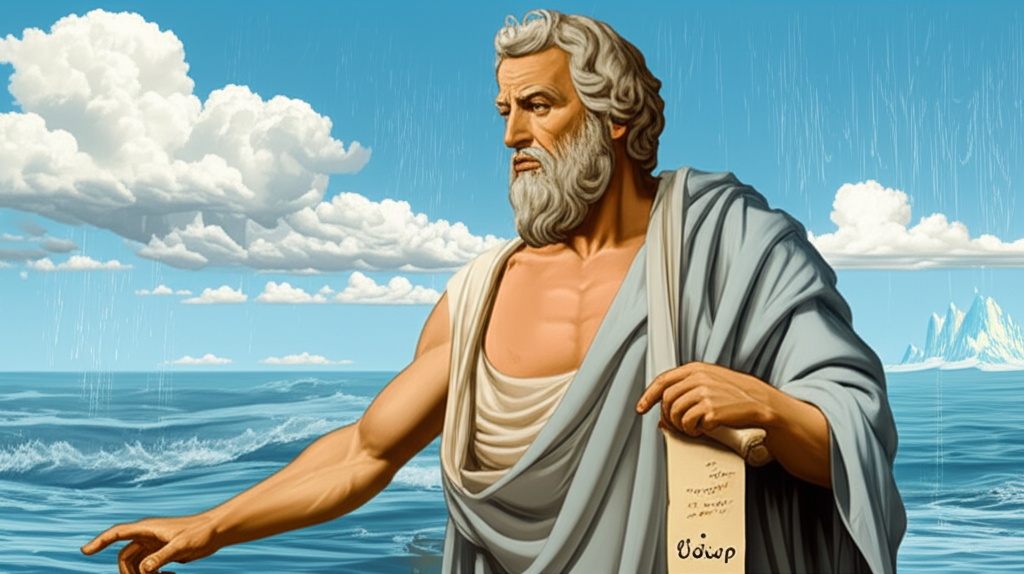 , lies at his feet.)
Water's Dual Nature: Chaos and Order
The ancient perception of water was not monolithic; it encompassed a profound duality. It was simultaneously the source of life and a force of destruction, embodying both order and chaos.
| Aspect of Water | Description in Ancient Cosmology |
|---|---|
| Life-Giving | Essential for agriculture, human survival, and the flourishing of Nature. Often associated with purification and renewal. |
| Chaotic/Destructive | Floods, storms, and the vast, unknown depths of the ocean represented untamed power, potential for engulfment, and the dissolution of order. |
| Transformative | Its ability to change states (liquid, solid, vapor) and to shape landscapes (erosion) made it a symbol of change and the impermanence of the World. |
| Boundary/Passage | Rivers and seas often marked boundaries between realms (e.g., the living and the dead) or served as pathways for exploration and migration. |
This dual Nature made water a powerful metaphor for the human condition and the cosmic struggle between creation and destruction.
The Element in Later Philosophical Systems
Even as philosophical thought evolved beyond the singular Urstoff theories, water retained its elemental status. Plato, in his Timaeus, assigned geometric forms to the elements, associating water with the icosahedron, reflecting its fluidity and ease of movement. Aristotle, while proposing his own system of four Elements and their qualities (wet, dry, hot, cold), still recognized water as a primary constituent of the terrestrial World, characterized by its coldness and wetness.
The enduring presence of water as a fundamental Element across millennia of thought, from the mythological to the philosophical, underscores its profound impact on how ancient civilizations understood the Physics of their World and the very Nature of existence. It was more than just a chemical compound; it was a cosmic principle, a symbol, and the very fabric of reality.
📹 Related Video: What is Philosophy?
Video by: The School of Life
💡 Want different videos? Search YouTube for: ""Ancient Greek Philosophy Thales Water""
📹 Related Video: PLATO ON: The Allegory of the Cave
Video by: The School of Life
💡 Want different videos? Search YouTube for: ""Creation Myths Primordial Waters Explained""