

The Primal Current: Water as the Genesis of Ancient Cosmology
From the earliest stirrings of philosophical inquiry, the element of water has occupied a singular and profound position in humanity's quest to understand the fundamental nature of the world. Far more than a mere substance, water was often conceived as the very arche, the primordial principle from which all existence sprang, or as a crucial component in the intricate physics of creation. This supporting article delves into the ancient cosmological perspectives on water, exploring its multifaceted role as a source of life, a symbol of change, and a foundational building block of the cosmos, as articulated by the great thinkers whose ideas laid the groundwork for Western philosophy.
The Deluge of Thought: Water as the Cosmic Source
The fascination with water's generative power is almost universal, preceding formal philosophical systems. Mythologies across the globe speak of a primordial ocean or a cosmic flood as the source of all life. When philosophy began to disentangle itself from myth, water retained its elemental prestige.
Thales of Miletus: The Arche of All Things
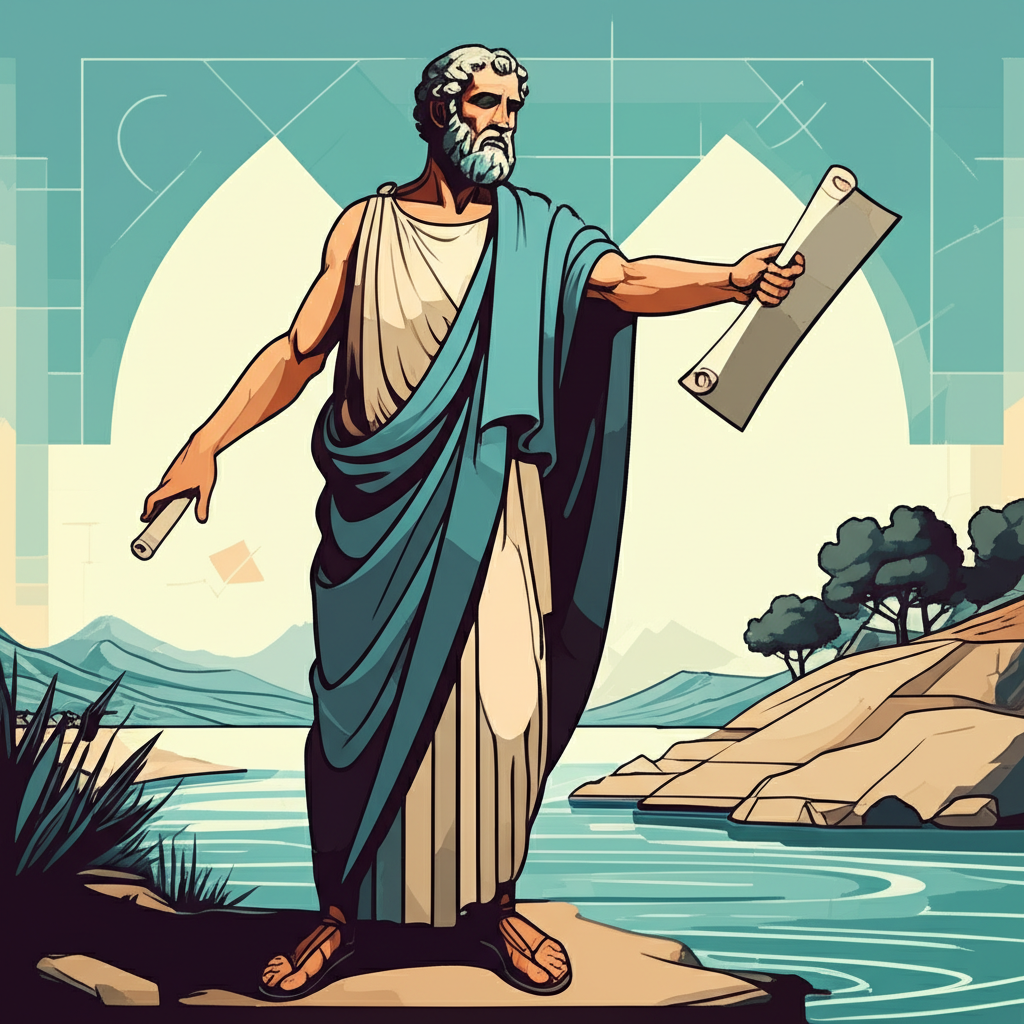
Perhaps the most iconic figure in this regard is Thales of Miletus, considered the first philosopher in the Western tradition. Emerging from the Ionian School, Thales famously posited that water is the arche – the single, ultimate substance from which everything originates and into which everything ultimately dissolves. This was a radical departure, seeking a rational, naturalistic explanation for the world rather than a mythological one.
- Thales's Rationale:
- All things seem to need water to survive (nourishment, seeds).
- Heat itself seems to come from water (steam).
- The Earth itself floats on water, like a ship.
- Water can take on various forms: liquid, solid (ice), gas (vapor), demonstrating its transformative potential.
This assertion, while seemingly simplistic to modern physics, was a monumental leap. It suggested a unified underlying principle for the diversity of nature, setting the stage for all subsequent material monism and pluralism.
Beyond Thales: Water in the Pre-Socratic Mosaic
While Thales championed water as the sole element, other Pre-Socratic philosophers integrated it into more complex systems.
- Heraclitus of Ephesus: Though famous for his dictum "everything flows" (panta rhei), symbolizing constant change and flux, Heraclitus saw fire as the primary element. However, water was intrinsically linked to this dynamic cycle, representing one of the transformations of fire, moving between fire, air, and water. The ever-changing river served as his quintessential metaphor for the impermanence of existence.
- Empedocles of Acragas: Empedocles introduced the concept of four root elements: earth, air, fire, and water. These were eternal and unchangeable, combining and separating under the influence of two cosmic forces, Love (attraction) and Strife (separation). In this pluralistic physics, water was an indispensable component, lending its qualities of coldness and wetness to the myriad forms of the world.
Plato and Aristotle: Refining the Elemental Framework
The philosophical giants of Athens, Plato and Aristotle, inherited and refined these elemental theories, embedding water within their sophisticated cosmologies.
Plato's Geometric Water: The Icosahedron
In his dialogue Timaeus, Plato sought to explain the creation of the cosmos through mathematical principles. He assigned specific regular polyhedra to the four elements of Empedocles:
| Element | Platonic Solid | Number of Faces | Key Characteristic |
|---|---|---|---|
| Fire | Tetrahedron | 4 | Sharp, mobile |
| Air | Octahedron | 8 | Smooth, fluid |
| Water | Icosahedron | 20 | Rounded, flowing |
| Earth | Cube | 6 | Stable, solid |
For Plato, the icosahedron, with its twenty equilateral triangular faces, represented water. This geometric assignment reflected water's perceived qualities – its ability to flow, to be contained, and to form drops, suggesting a certain spherical or rounded nature on a micro-physical level. These elemental particles could transform into one another by breaking down and reassembling their triangular faces, explaining the observed changes in nature.
Aristotle's Qualitative Water: Cold and Moist
Aristotle, ever the empirical observer, rejected Plato's geometric atomism but embraced the four-element theory, defining them by combinations of primary qualities:
- Hot and Cold
- Dry and Moist
Water, for Aristotle, was characterized by the qualities of cold and moist. It occupied a specific place in his nested cosmos, residing below air and above earth in the sublunary sphere – the realm of change and generation. This physics explained why water tended to flow downwards (seeking its natural place) and why it could transform into other elements (e.g., evaporating into moist air, or freezing into cold earth-like ice). The nature of water, defined by these qualities, dictated its behavior and interactions within the world.
The Enduring Legacy of Water's Element
The ancient cosmological understanding of water, whether as the primordial arche or a fundamental component of the world's physics, highlights its enduring significance. It was a tangible, observable substance that nonetheless held profound philosophical implications, linking the microcosm to the macrocosm. The fluidity, life-giving properties, and transformative power of water made it an inescapable subject for those seeking to unravel the mysteries of existence. Its study spurred early scientific inquiry, philosophical debate, and a deep appreciation for the dynamic nature of our world.
YouTube Video Suggestions:
-
📹 Related Video: What is Philosophy?
Video by: The School of Life
💡 Want different videos? Search YouTube for: "Thales of Miletus water arche philosophy"
2. ## 📹 Related Video: PLATO ON: The Allegory of the Cave
Video by: The School of Life
💡 Want different videos? Search YouTube for: "Plato Timaeus elements geometric solids"