

The Element of Water in Ancient Cosmology: A Fluid Foundation of Being
From the earliest stirrings of philosophical inquiry, ancient thinkers grappled with the fundamental composition of the world around them. Among the various candidates for the primordial element, water consistently emerged as a powerful and pervasive force, influencing not only early physics but also profound cosmological and metaphysical conceptions. This article explores water's seminal role in ancient cosmologies, from its position as the arche of existence to its symbolic resonance in understanding nature and the very fabric of reality. We will delve into how this ubiquitous liquid shaped humanity's first attempts to rationalize the universe, drawing insights from the foundational texts of Western thought.
The Primordial Fluid: Thales and the Arche
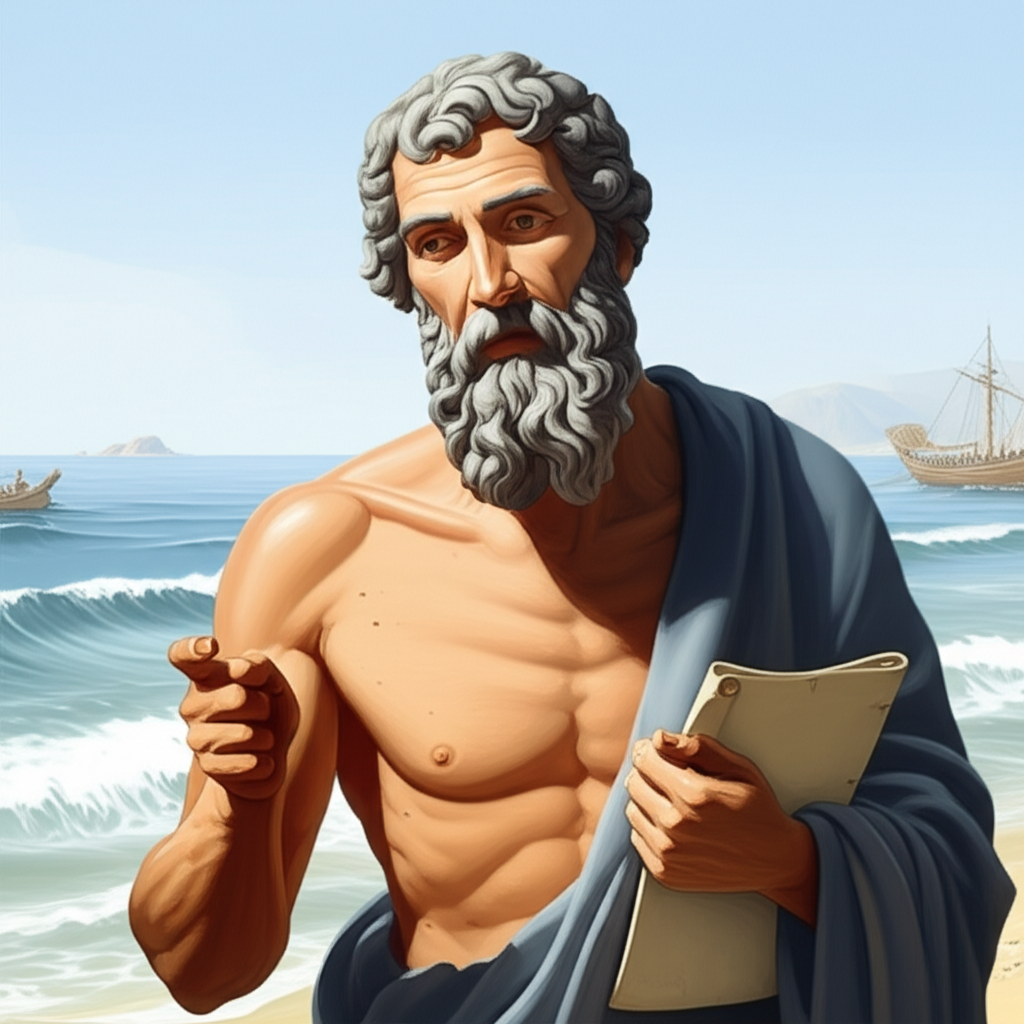
Perhaps no figure is more synonymous with water's philosophical significance than Thales of Miletus, often considered the first philosopher in the Western tradition. According to Aristotle, Thales proposed that water was the arche – the fundamental principle or originating element – from which all things arise and into which they ultimately return. This was a radical departure from mythological explanations, marking a pivotal shift towards rational inquiry into the nature of the world.
Thales' reasoning, while seemingly simplistic to modern sensibilities, was rooted in keen observation:
- Life's Dependence: All living things require water to survive and thrive.
- Ubiquity of Moisture: Seeds, sustenance, and the very earth itself often appear moist.
- States of Matter: Water can be observed in liquid, solid (ice), and gaseous (vapor) forms, suggesting its capacity for transformation into diverse substances.
This proposition laid the groundwork for early materialist physics, asserting a single, identifiable element as the source of all existence. It was an audacious claim, seeking to unify the bewildering diversity of the world under a single explanatory principle.
Water's Multifaceted Manifestations in Ancient Worlds
While Thales offered a specific philosophical claim, water's primordial status resonated across diverse ancient cultures, often predating or running parallel to Greek philosophical developments.
Egyptian and Mesopotamian Cosmogonies
In the ancient Near East, water often represented the unformed chaos or the primordial abyss from which order emerged. In Egyptian cosmology, the god Nun personified the primeval watery expanse, the undifferentiated void before creation. Similarly, Mesopotamian myths, such as the Enuma Elish, depict a watery chaos (Tiamat) preceding the establishment of the cosmos, where the mixing of sweet and salt waters was the origin of the gods and the world. These narratives underscore water's profound symbolic power as both a source of life and an untamed, powerful force.
Greek Pre-Socratics Beyond Thales
Following Thales, other Pre-Socratic philosophers engaged with water, albeit with different interpretations:
- Heraclitus: While not positing water as the sole element, Heraclitus's famous doctrine of flux ("you cannot step into the same river twice") profoundly utilized water's dynamic nature to illustrate the constant change inherent in the world. Water became a powerful metaphor for the ever-flowing, ever-transforming reality.
- Empedocles: Empedocles introduced a more complex system, positing four root elements—earth, air, fire, and water—which combined and separated under the influence of two opposing forces, Love and Strife. Here, water was one of the irreducible components, an essential building block in the physics of the cosmos, rather than the singular arche.
Plato and Aristotle: Systematizing the Elements
As philosophy matured, thinkers like Plato and Aristotle integrated water into more elaborate systems.
- Plato: In his Timaeus, Plato associated water with the icosahedron, one of the five regular polyhedra (Platonic solids), each corresponding to a fundamental element. This geometric assignment reflected water's fluidity and its role in mediating other substances.
- Aristotle: Aristotle refined the concept of elements, defining them by their primary qualities: hot, cold, wet, and dry. Water, for Aristotle, was characterized by the qualities of cold and wet. It occupied a specific place in his terrestrial physics, tending to move downwards towards the center of the world (earth's center). This framework provided a comprehensive natural philosophy that dominated Western thought for over a millennium, where water was an integral, if not singular, element.
The Enduring Philosophical Resonance of Water
The ancient focus on water as a fundamental element was more than a primitive form of physics; it was a profound philosophical inquiry into the nature of being. It forced thinkers to consider:
- Unity in Diversity: How can the myriad forms of the world arise from a single substance?
- Change and Permanence: How does an element maintain its identity while undergoing constant transformation?
- Life and Death: What is the relationship between this vital fluid and the cycle of existence?
Even as scientific understanding evolved, moving beyond the classical elements to a periodic table of atomic structures, the philosophical questions first posed by observing water's omnipresence and transformative power continued to resonate. The ancient cosmologists, by focusing on water, laid a foundation for seeking universal principles, observing nature closely, and developing systematic explanations for the world—a quest that remains at the heart of both physics and philosophy today. The element of water, in its primordial and symbolic grandeur, reminds us of the fluid and ever-changing nature of our understanding.
YouTube Suggestions:
- "Thales of Miletus: The First Philosopher and Water as the Arche"
- "Ancient Greek Elements: Earth, Air, Fire, Water Explained"
📹 Related Video: What is Philosophy?
Video by: The School of Life
💡 Want different videos? Search YouTube for: "The Element of Water in Ancient Cosmology philosophy"