

The Primordial Fluid: Water as a Fundamental Element in Ancient Cosmology
From the earliest stirrings of philosophical inquiry, ancient thinkers grappled with a profound question: What is the fundamental substance from which all things are made? Among the various answers proposed, the Element of water consistently emerged as a powerful and pervasive candidate, shaping early understandings of the World's Physics and Nature. This article explores the central role water played in ancient cosmology, particularly as conceived by the pre-Socratic philosophers who sought to uncover the Elemental truths of existence.
The Quest for the Arche: Water as the First Principle
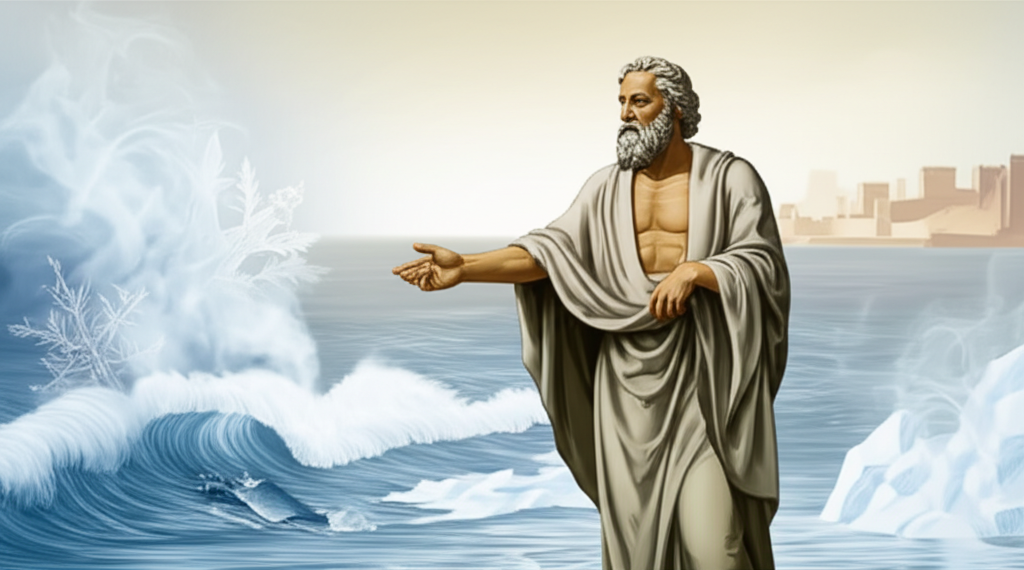
The very foundation of Western philosophy, as we often trace it through the Great Books of the Western World, begins with the Ionian natural philosophers. These thinkers, observing the constant flux and change in Nature, sought a single, enduring principle—an arche—that underpinned all reality. It was Thales of Miletus, often considered the first philosopher, who famously posited water as this ultimate Element.
Thales' Bold Proposition: All is Water
Thales, living in a maritime culture where the sea was both a source of life and an overwhelming force, observed water's ubiquitous presence and transformative properties:
- Life's Dependence: All living things require water to survive; life springs from moisture.
- States of Matter: Water exists as a liquid, can freeze into a solid, and evaporate into a gas, demonstrating its capacity for fundamental change.
- Ubiquity: The Earth itself seemed to float upon water, and moisture was evident everywhere.
For Thales, water was not merely an Element, but the Element—the primordial source and ultimate constituent of the entire World. This was a revolutionary step, moving beyond mythological explanations to a rational, albeit speculative, form of Physics.
Beyond Thales: Water's Role in Diverse Cosmologies
While Thales championed water as the sole Element, other pre-Socratic philosophers, while sometimes proposing different primary substances, often acknowledged water's profound importance in the World's Nature and Physics.
| Philosopher | Primary Element(s) | Role of Water |
|---|---|---|
| Thales of Miletus | Water | The sole arche; the origin and sustaining Element of all things. |
| Anaximenes | Air | Water is formed through the condensation of air, demonstrating its fundamental role in elemental transformation. |
| Heraclitus | Fire | While fire is the primary Element of change, water represents a crucial state in the eternal flux of becoming and perishing. |
| Empedocles | Earth, Air, Fire, Water | One of the four fundamental "roots" or Elements, eternally mixed and separated by Love and Strife to form the World. |
Empedocles' model, in particular, solidified water's place as one of the four irreducible Elements (alongside earth, air, and fire) that constituted all matter. This framework, deeply influential for centuries, provided a comprehensive Physics for understanding the observable Nature of the World.
The Metaphysics of Moisture: Symbolism and Substance
The ancient fascination with water extended beyond its physical properties. It embodied profound philosophical and symbolic meanings, reflecting its diverse manifestations in Nature:
- Purity and Cleansing: Water's ability to wash away impurities made it a symbol of purification, both physically and spiritually.
- Life and Fertility: As the source of all life, water represented fertility, growth, and renewal.
- Chaos and Order: The vast, untamed ocean could symbolize primordial chaos, while controlled rivers and springs represented order and sustenance.
- Change and Flux: Heraclitus' famous dictum, "You cannot step into the same river twice," eloquently captures water's essence as a symbol of constant change and the transient Nature of existence. This idea underscores the dynamic Physics of the World.
These symbolic interpretations, often intertwined with the physical understanding of water as an Element, enriched ancient cosmology, imbuing the World with a deeper, multi-layered meaning. The contemplation of water was not merely a scientific endeavor but a spiritual and existential one.
Enduring Legacy
The ancient cosmologies, particularly their focus on water as a fundamental Element, laid crucial groundwork for subsequent philosophical and scientific inquiry. While modern Physics has long moved beyond the four-element theory, the spirit of inquiry—the search for fundamental constituents and governing principles of the World and Nature—remains a cornerstone of human thought. The primordial fluid, as conceived by the ancients, continues to remind us of the profound mystery and essential role of water in our lives and in the grand scheme of the cosmos.
📹 Related Video: KANT ON: What is Enlightenment?
Video by: The School of Life
💡 Want different videos? Search YouTube for: ""Thales of Miletus Water Arche""
📹 Related Video: What is Philosophy?
Video by: The School of Life
💡 Want different videos? Search YouTube for: ""Ancient Greek Elements Philosophy""