

The Primordial Element: Water in Ancient Cosmology
Water, an omnipresent force, held a profound and multifaceted significance in ancient cosmology. Far more than a mere substance, it was often considered a primordial Element, the very source and substance of the World, shaping early philosophical inquiries into Physics and the fundamental Nature of existence. From the Milesian monists to the sophisticated elemental theories of Plato and Aristotle, water consistently emerged as a cornerstone in humanity's earliest attempts to understand the cosmos, life, and the very fabric of reality. This article delves into the philosophical journey through which water transitioned from a simple liquid to a cosmic principle.
The Arche of All Things: Thales and the Monistic Vision
The earliest systematic philosophical investigations into the Nature of the World often began with a search for a single, underlying principle – the arche. For Thales of Miletus, widely regarded as the first philosopher in the Western tradition, this fundamental Element was water.
- Thales' Hypothesis: Thales posited that everything originated from water and ultimately returned to it. He observed water in its various states (liquid, solid, gas as mist/vapor), its necessity for life, and its role in shaping landscapes. This led him to conclude that water was the universal substratum.
- Implications for Early Physics: This was a radical departure from mythological explanations. Thales sought a rational, naturalistic explanation for the World's genesis and composition. His claim that the Earth itself floated on water provided a simple, albeit crude, model for cosmic structure, marking a crucial step in the development of Physics as a discipline.
Thales' bold assertion laid the groundwork for subsequent pre-Socratic thinkers, even those who disagreed with his specific choice of Element. His contribution was not just the identification of water, but the very act of seeking a singular, natural principle for the World's existence.
Water Among the Four: Empedocles and the Classical Elements
As philosophical thought evolved, the idea of a single arche gave way to more complex theories involving multiple fundamental Elements. Empedocles of Acragas introduced the concept of four classical Elements: earth, air, fire, and water.
The Four Roots of Existence:
- Earth: Associated with solidity, cold, and dryness.
- Air: Associated with lightness, heat, and moisture.
- Fire: Associated with heat and dryness.
- Water: Associated with coldness and moisture.
According to Empedocles, these four Elements were eternal and unchangeable, combining and separating under the influence of two cosmic forces: Love (attraction) and Strife (repulsion). This dynamic interplay explained the generation and destruction of all things in the World. Water, with its distinct qualities of cold and moist, played a crucial role in forming everything from living organisms to atmospheric phenomena. This marked a significant development in ancient Physics, moving towards a more pluralistic understanding of matter and its transformations.
Refining the Element: Plato, Aristotle, and the Cosmic Order
Later philosophers, building upon the pre-Socratic foundations, further refined the concept of water as an Element, integrating it into more comprehensive cosmological systems.
Plato's Geometric Solids in the Timaeus
In his dialogue Timaeus, Plato presented a sophisticated cosmological model where the four classical Elements were geometrically defined. He assigned regular polyhedra to each:
- Fire: Tetrahedron (sharp, mobile)
- Air: Octahedron (smooth, easily moved)
- Water: Icosahedron (most spherical, allowing fluidity)
- Earth: Cube (stable, immobile)
For Plato, these geometric forms were the fundamental building blocks of the physical World, reflecting a deeper mathematical order. Water's icosahedral structure, with its twenty faces, was seen as embodying its fluidity and ability to flow and conform, a philosophical insight into its Nature that connected Physics with ideal forms.
Aristotle's Qualities and Terrestrial Physics
Aristotle, while retaining the four classical Elements, focused on their underlying qualities and their role in the sublunary World. He argued that each Element was defined by a pair of primary qualities:
- Hot & Dry: Fire
- Hot & Moist: Air
- Cold & Dry: Earth
- Cold & Moist: Water
Aristotle's Physics emphasized the natural place and natural motion of these Elements. Water, being cold and moist, naturally moved downwards towards the center of the World (the Earth). This explained phenomena like rain and the formation of seas. His system provided a comprehensive framework for understanding the Nature of matter, change, and the physical World around us, with water playing a vital role in the terrestrial sphere.
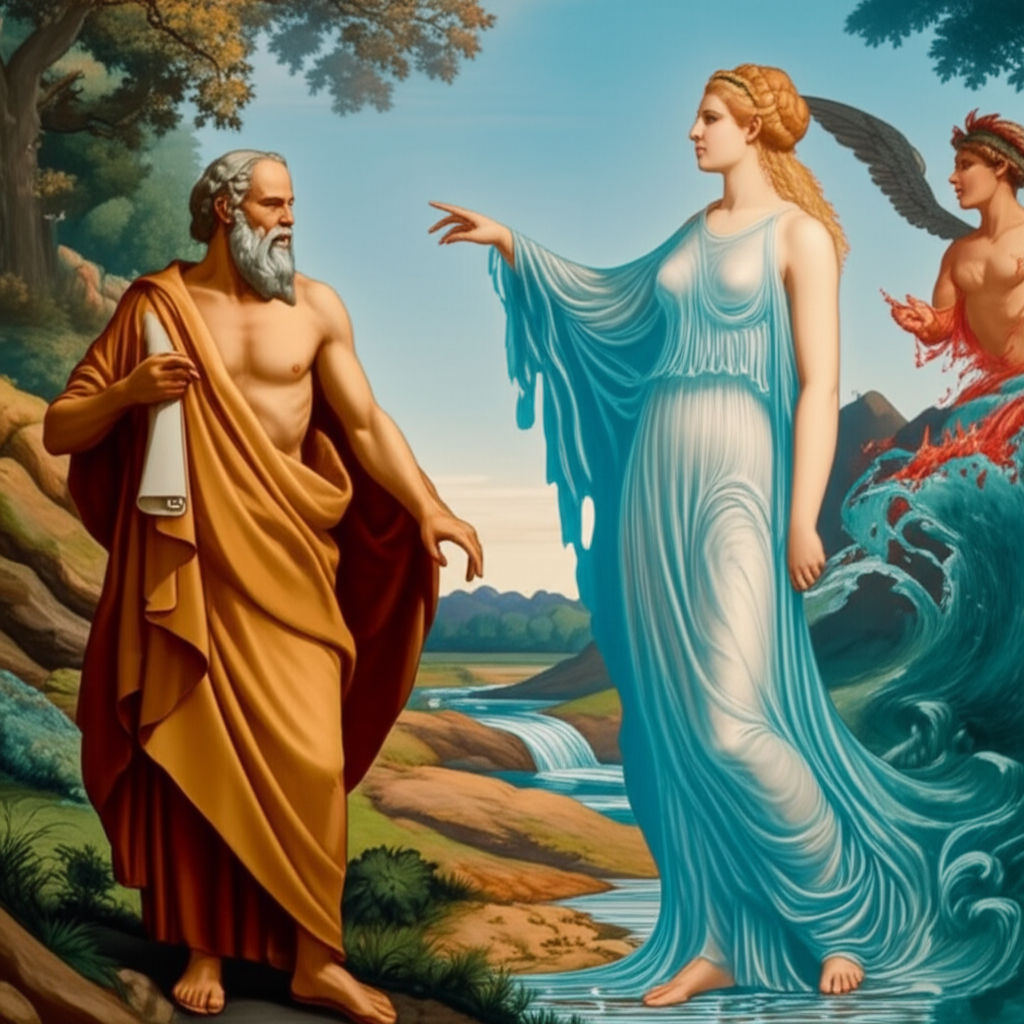
Water, Life, and the Cosmic Nature
Beyond its role as a fundamental Element in Physics, water held profound symbolic and practical significance in ancient cosmologies, intrinsically linked to life, creation, and the very Nature of existence.
- Source of Life: Across nearly all ancient cultures, water was recognized as essential for life. This observation naturally extended to cosmological narratives, where water often represented the source of all living things.
- Primordial Chaos and Order: In many creation myths, water appears as the primordial abyss, the formless chaos (e.g., Nun in Egyptian cosmology, Tiamat in Mesopotamian myths) from which the ordered World emerges. The act of creation often involved separating waters or imposing order upon them.
- Purification and Regeneration: Water's cleansing properties made it a symbol of purification, renewal, and spiritual rebirth. Its cyclical Nature—evaporation, cloud formation, rain—mirrored the cycles of life, death, and regeneration in the cosmos.
The pervasive presence and vital importance of water in the natural World inevitably led ancient thinkers to elevate it to a cosmic principle, a testament to its fundamental Nature and its role in shaping human understanding of reality.
Conclusion: The Enduring Legacy of Water's Cosmic Significance
The ancient fascination with water as a cosmic Element underscores humanity's timeless quest to understand the World and its origins. From Thales' audacious declaration of water as the sole arche to its refined role in Plato's geometric Physics and Aristotle's qualitative Nature, water consistently served as a foundational concept. It was not merely a substance but a principle, a symbol, and a key to unlocking the secrets of the cosmos. This ancient philosophical legacy reminds us of the profound insights that can emerge from observing the simplest Elements of our Nature and contemplating their deepest significance.
YouTube Video Suggestions:
- "Thales of Miletus water arche philosophy"
- "Ancient Greek elements cosmology"
📹 Related Video: What is Philosophy?
Video by: The School of Life
💡 Want different videos? Search YouTube for: "The Element of Water in Ancient Cosmology philosophy"