

The Primordial Tide: Water as a Foundational Element in Ancient Cosmology
A Liquid Foundation for Thought
In the nascent stages of philosophical inquiry, ancient thinkers grappled with a fundamental question: what is the underlying Element from which all things arise? Before the intricate models of modern Physics, the quest to understand the World's Nature led many to intuitive, yet profound, conclusions. This article explores the pervasive role of water as a primordial Element in ancient cosmology, from the groundbreaking assertions of the Milesian school to its structured place within the elaborate systems of Plato and Aristotle, demonstrating its enduring significance in shaping our earliest understandings of existence.
Thales of Miletus: Water as the Arche
The story of water's philosophical preeminence begins most famously with Thales of Miletus, often credited as the first philosopher in the Western tradition. Living around the 6th century BCE, Thales proposed that water was the arche – the fundamental principle or Element – from which everything originated and into which everything would ultimately return. This was a radical departure from mythological explanations, marking a crucial step towards rational inquiry into the Nature of the World.
Thales’ reasoning, though not fully preserved, likely stemmed from keen observation:
- Ubiquity: Water is everywhere – in the sky, on land, and beneath the earth.
- Life-giving: All life, as far as he could tell, depends on water. Seeds, plants, and animals require moisture to thrive.
- Transformative States: Water can exist as a liquid, solidify into ice, and evaporate into vapor, suggesting its capacity to transform into various forms of matter.
- Nourishment: Food, even when seemingly dry, contains moisture.
For Thales, the Physics of the World was rooted in this singular, adaptable Element. The Earth, he famously suggested, floated on water, much like a log. This simple yet profound assertion laid the groundwork for future cosmological investigations.
Beyond the Single Element: Water in Diverse Cosmologies
While Thales championed water as the sole Element, other pre-Socratic thinkers engaged with its role within more complex systems.
- Anaximander, Thales' student, posited the apeiron (the boundless or indefinite) as the ultimate arche, from which opposing qualities like hot and cold, wet and dry, separated out to form the World. Water, in this view, was a significant derivative, born from the cooling of the original moistness.
- Heraclitus famously declared that "all things flow like a river," emphasizing the constant change and flux inherent in the Nature of reality. While fire was his primary metaphor for change, the metaphor of a flowing river intrinsically links water to this dynamic view of existence.
- Empedocles, in the 5th century BCE, formalized the concept of four root Elements: Earth, Air, Fire, and Water. These four, driven by the forces of Love (attraction) and Strife (repulsion), combined and separated to form all substances in the World. Water, in Empedocles' scheme, was a fundamental constituent, equally important as the others in the Physics of creation.
The Four Classical Elements (Empedocles)
| Element | Primary Qualities | Associated Form (Plato) | Cosmic Role |
|---|---|---|---|
| Water | Cold, Wet | Icosahedron | Forms liquids, essential for life, cleansing |
| Earth | Cold, Dry | Cube | Provides solidity, foundation, stability |
| Air | Hot, Wet | Octahedron | Fills space, allows breath, connects other elements |
| Fire | Hot, Dry | Tetrahedron | Provides heat, light, energy, transformation |
Plato and Aristotle: Systematizing the Elements
The philosophical giants Plato and Aristotle further integrated water into their comprehensive cosmologies, moving beyond simple observation to more abstract and systematic frameworks.
Plato's Timaeus: In his dialogue Timaeus, Plato assigns specific geometric solids to the four Empedoclean Elements, linking the Physics of the World to mathematical principles. Water is associated with the icosahedron, a twenty-sided figure. This choice was not arbitrary; the icosahedron, with its smooth, many-faceted surface, was thought to explain water's fluidity and its ability to roll and flow. For Plato, the Nature of the cosmos was intelligible through such harmonious mathematical relationships.
Aristotle's On Generation and Corruption: Aristotle refined the concept of Elements by assigning them combinations of two primary qualities: hot, cold, wet, and dry.
- Water was defined by the qualities of cold and wet.
- Earth was cold and dry.
- Air was hot and wet.
- Fire was hot and dry.
These Elements, according to Aristotle, were not immutable atoms but rather fundamental kinds of matter capable of transforming into one another under the influence of these qualities. This system provided a comprehensive explanation for the Nature of substances and their interactions within the sublunar World. The Physics of change and generation was thus intimately tied to the interplay of these elemental qualities.
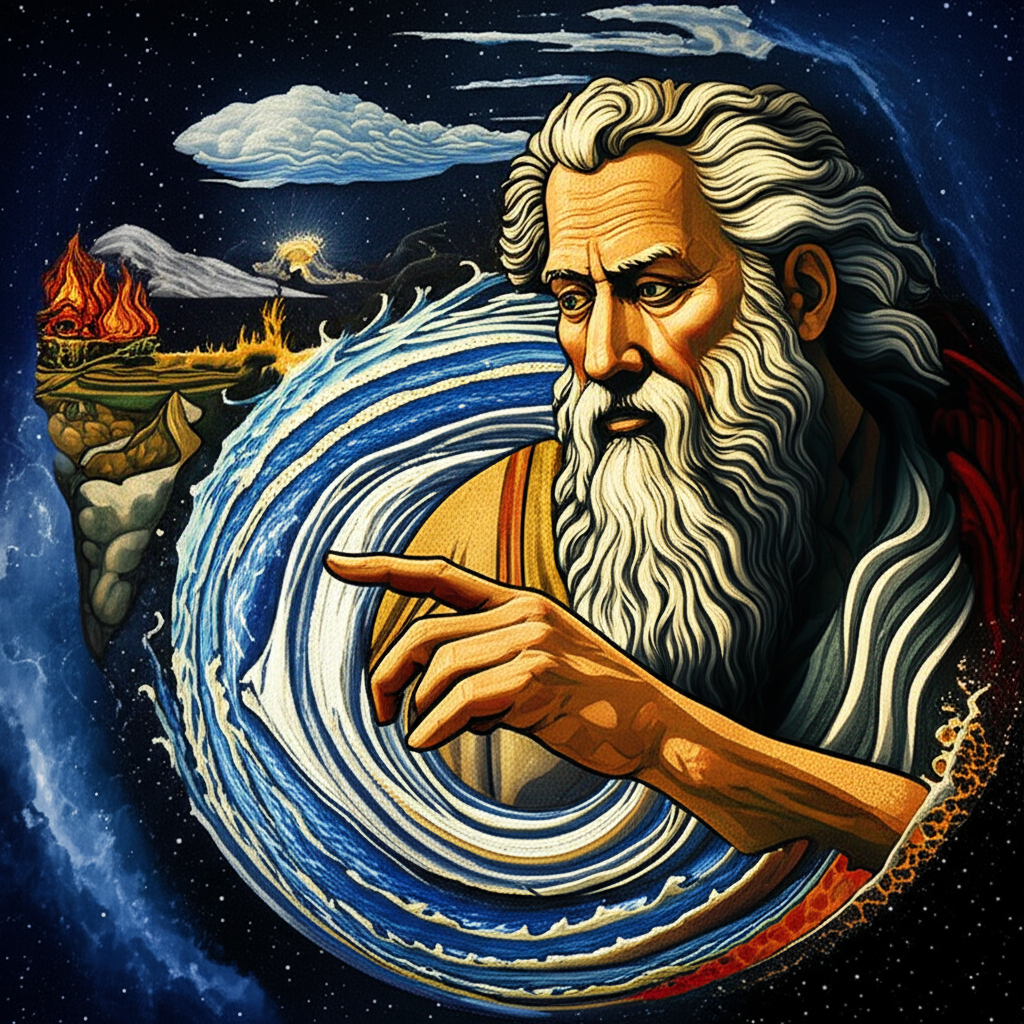
The Enduring Symbolism and Metaphysical Resonance
Beyond its role as a physical Element, water carried profound symbolic and metaphysical weight in ancient thought. It represented:
- Purity and Cleansing: Ritualistic washing and purification rites are ancient, reflecting water's perceived ability to cleanse both the body and the soul.
- Life and Fertility: Its association with generation and growth made it a symbol of fertility and the source of all life.
- Change and Flux: As Heraclitus noted, water's constant motion and transformative states mirrored the ever-changing Nature of reality.
- The Unconscious and Emotions: Later philosophical and psychological traditions would link water to the depths of the psyche, emotions, and the unconscious, drawing on its mysterious, flowing Nature.
The understanding of water, from a single primordial Element to a vital component in a complex elemental system, illustrates the evolution of ancient philosophical inquiry. It highlights the persistent human endeavor to comprehend the fundamental Physics and Nature of the World around us, a quest that began by looking at the most ubiquitous and life-sustaining substance on Earth.
Conclusion: The Unfolding Story of a Fundamental Element
From the bold assertion of Thales that all is water, to its structured place in Empedocles' four roots and the sophisticated cosmologies of Plato and Aristotle, water has consistently held a central position in humanity's attempt to define the Elements of the cosmos. Its perceived qualities—its fluidity, its life-giving properties, and its capacity for transformation—made it an irresistible candidate for the role of a foundational substance. The journey of understanding water, from a simple observation to a complex philosophical concept, mirrors the broader development of ancient Physics and our enduring fascination with the deep Nature of the World.
YouTube Video Suggestions:
- YouTube: "Thales of Miletus water philosophy explained"
- YouTube: "Plato Timaeus elements Aristotle cosmology"
📹 Related Video: What is Philosophy?
Video by: The School of Life
💡 Want different videos? Search YouTube for: "The Element of Water in Ancient Cosmology philosophy"