

The Primordial Fluid: Water as a Cornerstone of Ancient Cosmology
Ancient civilizations, peering into the mysteries of existence, often sought a fundamental principle, an element from which all else derived. Among the candidates for this primordial substance, water consistently emerged as a compelling and potent force. This article explores how water, in its various forms and symbolic capacities, shaped the understanding of the world's physics and the very essence of nature for some of history's most profound thinkers, drawing insights from the foundational texts of Western philosophy. From the Milesian monists to Plato's geometric forms, water's presence is a testament to its perceived power and universality.
The Arche of All: Thales and the Aqueous Beginning
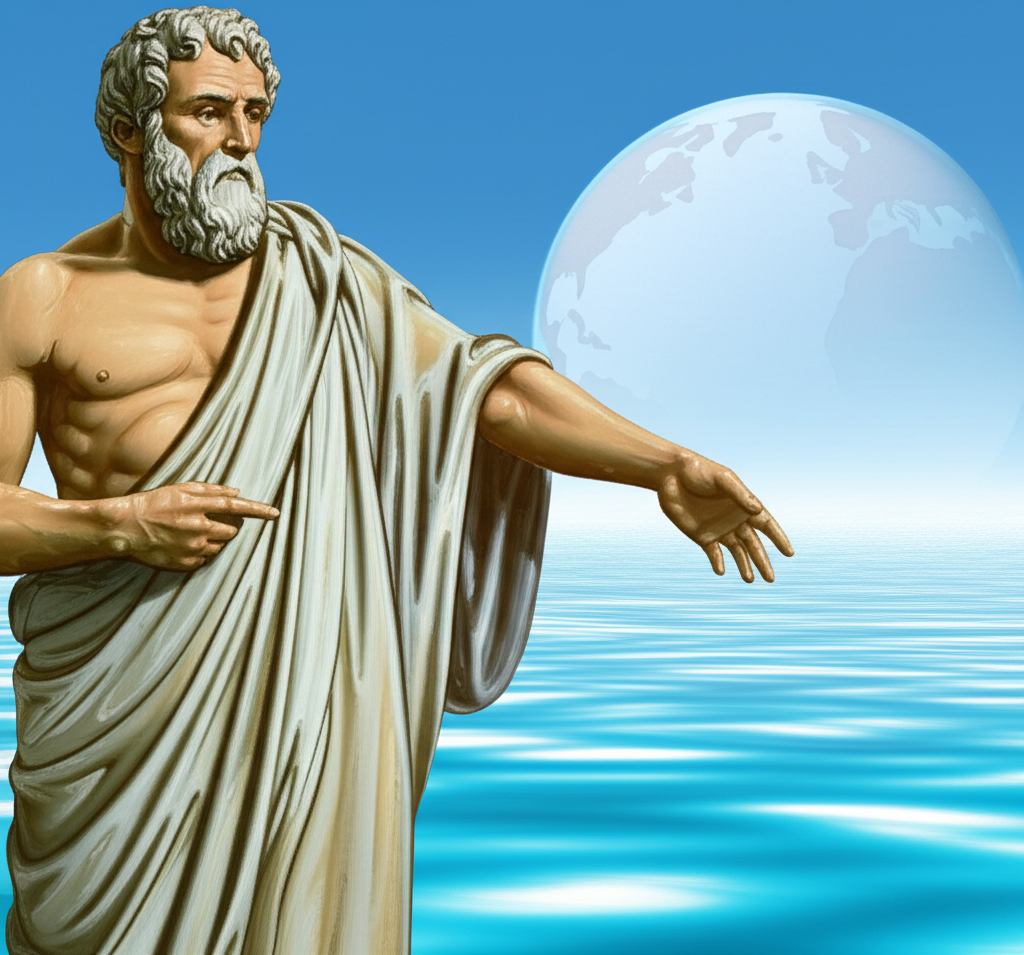
The earliest recorded philosophical speculation concerning the fundamental element of the cosmos comes from Thales of Miletus, often considered the first philosopher in the Western tradition. Thales famously posited that water is the arche – the origin, the first principle, the underlying substance of all things. This was not merely a poetic observation but a profound attempt at a unified theory of the world's physics.
- Observation-Based Theory: Thales likely observed that water is essential for life, that it can exist in solid (ice), liquid (water), and gaseous (vapor) states, and that it is present everywhere – in the sky, under the earth, and as the lifeblood of nature.
- The Earth Floats on Water: He is also credited with the idea that the Earth itself rests on water, implying a continuous, underlying aqueous layer that supports the terrestrial world.
- Moisture and Life: For Thales, the moistness of all living things, from plants to animals, pointed to water as their ultimate constituent. Without water, life withers and dies, suggesting its elemental necessity.
Thales's bold assertion marked a pivotal shift from mythological explanations to a more rational inquiry into the nature of reality, establishing water as a primary focus in early cosmological discussions.
Beyond Thales: Water's Evolving Role in Ancient Thought
While Thales laid the groundwork, subsequent philosophers continued to engage with water, either elevating it as a key element or integrating it into more complex cosmological models.
-
Heraclitus and the Flux of Water:
- For Heraclitus of Ephesus, famous for his doctrine of flux and change, water served as a powerful metaphor for the ever-changing nature of reality. His famous dictum, "You cannot step into the same river twice," perfectly encapsulates the ceaseless motion and transformation that he believed characterized the world. While fire was his primary element, water's constant flow underscored the dynamic physics of existence.
-
Empedocles and the Four Roots:
- Empedocles of Acragas moved beyond a single element theory, proposing four fundamental "roots" or elements: Fire, Air, Earth, and Water. These four, eternal and unchangeable, mingled and separated under the influence of two cosmic forces, Love (attraction) and Strife (repulsion), to form all the substances of the world. Water, in this framework, was an indispensable building block, contributing its unique qualities (cold and moist) to the physics of creation.
-
Plato's Timaeus: Geometric Forms and the Element of Water:
- In Plato's Timaeus, a foundational text for understanding ancient cosmology, the four Empedoclean elements are given a profound mathematical structure. Plato assigned specific regular polyhedra (Platonic solids) to each element, thereby linking the visible world to underlying geometric principles. Water was associated with the icosahedron, a twenty-sided figure composed of equilateral triangles. This mathematical precision offered a sophisticated explanation for the physics of how the elements interact and transform into one another, grounding the material world in ideal forms.
-
Aristotle's Terrestrial Element:
- Aristotle, building on Empedocles, also recognized four terrestrial elements: Earth, Water, Air, and Fire. For Aristotle, each element had a natural place and motion. Water's natural motion was downwards, towards the center of the universe (the Earth), and it was characterized by the qualities of cold and wet. It formed the liquid layer of the sublunar world, distinct from the ethereal fifth element (aether) that composed the celestial spheres. Aristotle's systematic approach to the physics of the elements profoundly influenced Western thought for centuries.
Summary of Key Philosophers and Water's Role:
| Philosopher | View of Water | Key Contribution to Cosmology |
|---|---|---|
| Thales of Miletus | The arche (first principle) of all things. | First rational, monistic explanation of the world's origin. |
| Heraclitus | Metaphor for constant change and flux in nature. | Emphasized dynamic processes in the physics of reality. |
| Empedocles | One of the four fundamental "roots" or elements. | Introduced a pluralistic element theory for the world. |
| Plato (Timaeus) | Associated with the icosahedron, a geometric form. | Linked elements to mathematical structures and ideal forms. |
| Aristotle | Terrestrial element (cold and wet), natural downward motion. | Systematized the physics of elements within a geocentric world view. |
Water's Enduring Symbolism in Ancient Nature
Beyond its role as a physical element, water held immense symbolic power in ancient cultures, reflecting its profound impact on human life and the nature of the world.
- Source of Life: As Thales noted, water is intrinsically linked to vitality and sustenance. All life depends on it.
- Purification and Renewal: Its cleansing properties made it central to rituals of purification, baptism, and spiritual renewal across diverse traditions.
- Chaos and Creation: The vast, undifferentiated primordial waters often symbolized chaos, yet from this chaos, many creation myths describe the emergence of order and the world.
- Boundary and Passage: Rivers and seas were seen as boundaries between realms, or as pathways for journeys, both physical and spiritual.
- Fertility and Abundance: Rain and rivers brought agricultural bounty, linking water to fertility gods and goddesses.
These symbolic layers enriched the philosophical understanding of water, making it not just a material substance but a profound metaphor for the cycles of existence, death, and rebirth within the grand tapestry of nature.
The Legacy of Water in the World's Philosophy
The ancient fascination with water as a fundamental element or a powerful symbol laid critical groundwork for subsequent philosophical and scientific inquiry. It demonstrated an early human impulse to seek underlying unity and rational explanations for the complexities of the world. While modern physics has moved far beyond the four-element theory, the ancient contemplation of water's role sparked the very questions that continue to drive our understanding of the cosmos and our place within its vast, intricate nature. The quest to identify the basic building blocks of reality, initiated by thinkers like Thales, remains a cornerstone of scientific and philosophical endeavor today.
YouTube Video Suggestions:
-
📹 Related Video: What is Philosophy?
Video by: The School of Life
💡 Want different videos? Search YouTube for: "Thales of Miletus water arche philosophy"
2. ## 📹 Related Video: PLATO ON: The Allegory of the Cave
Video by: The School of Life
💡 Want different videos? Search YouTube for: "Ancient Greek Four Elements Cosmology Plato Aristotle"