

The Aqueous Origins: Water as the Primal Element in Ancient Cosmology
A Clear Beginning: Water as the Arche
Ancient Greek philosophy, as chronicled in the Great Books of the Western World, embarked on a profound quest to understand the fundamental nature of the world. At the heart of this inquiry lay the search for the arche—the primary element or principle from which all things originated. Among the earliest and most influential propositions was the audacious claim that water, in its myriad forms, was this foundational substance. This article delves into the profound significance of water in ancient cosmology and physics, exploring its role as the primordial element, a principle of life and change, and its enduring legacy in shaping our understanding of the cosmos.
Thales' Liquid Logic: The World Born of Water
The intellectual journey often begins with Thales of Miletus, considered the first philosopher of the Western tradition. Thales, as recorded by Aristotle, famously asserted that water was the arche of all things. This wasn't merely a poetic observation; it was a radical departure from mythological explanations, representing an early attempt at rational physics. Why water? Consider its ubiquity and its life-sustaining properties. Water is essential for all living organisms, it can exist in solid (ice), liquid (water), and gaseous (steam) states, and it is observed to be the medium through which many processes of change occur.
- Ubiquity: The Earth, as Thales might have observed, seemed to float on water.
- Transformation: Water's ability to freeze, melt, and evaporate suggested a fundamental versatility.
- Life-Giving: All life, from plants to animals, is dependent on water.
For Thales, the world was not merely made of water, but somehow derived from it, implying a continuous process of generation and sustenance. This concept challenged contemporaries to look at the nature of reality through a singular, unifying element.
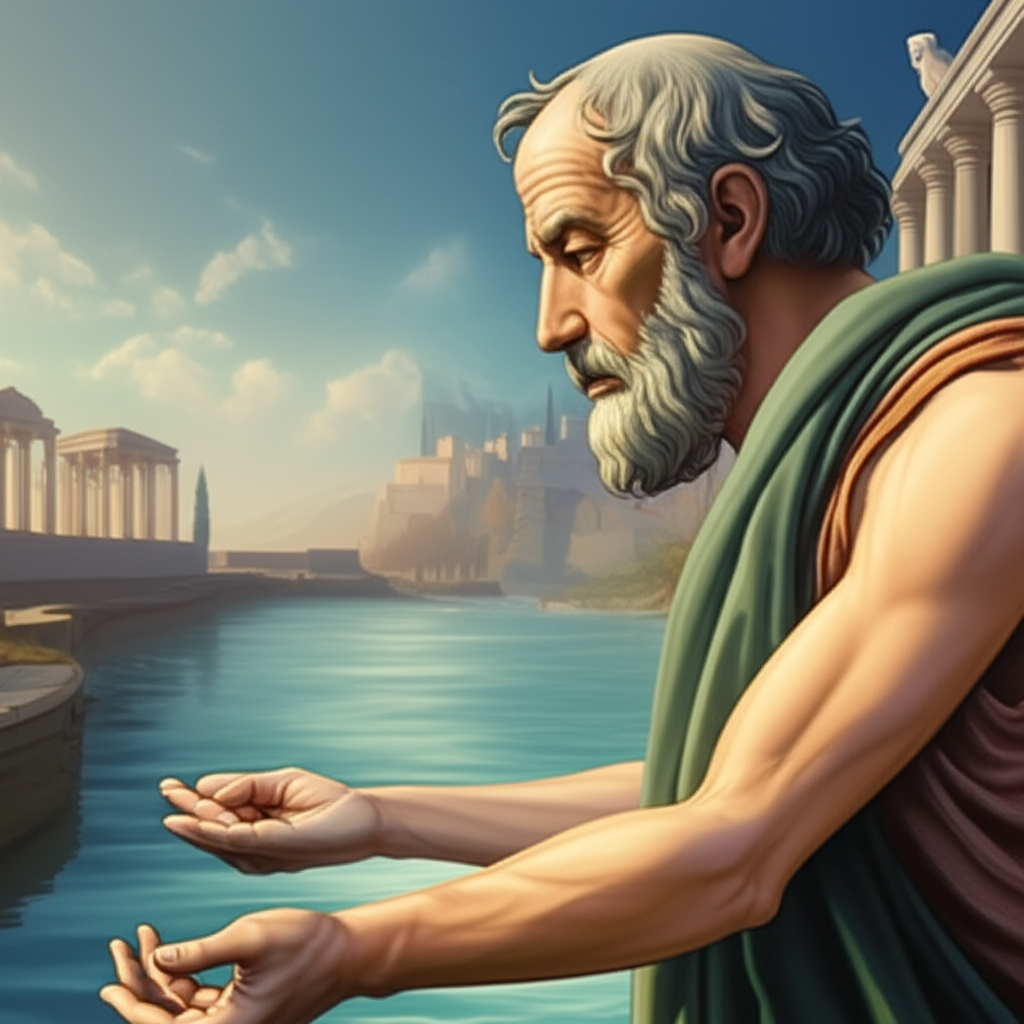
Beyond Monism: Water in the Pluralistic Cosmos
While Thales championed water as the sole element, other pre-Socratic thinkers engaged with its properties in different ways. Heraclitus, with his famous dictum "all things flow," echoed the fluid nature of water, using it as a metaphor for the constant change that defines existence. Though he posited fire as his primary element, the ceaseless flux inherent in his philosophy resonated deeply with the observed characteristics of water.
Later, Empedocles introduced the concept of four root-elements: earth, air, fire, and water. In his cosmology, these four fundamental substances mingled and separated under the forces of Love and Strife, forming the diverse phenomena of the world. Here, water ceased to be the sole arche but remained an indispensable building block, contributing its unique properties—coldness and wetness—to the composition of all things. This pluralistic view marked a significant evolution in ancient physics, providing a more complex framework for understanding the nature of matter.
Plato's Geometric Water: The Icosahedral Element
In Plato's Timaeus, the elements take on a sophisticated, geometric character. Plato, building upon Pythagorean thought, assigned specific regular polyhedra to each of the four Empedoclean elements, giving them a mathematical foundation. Water, in Plato's intricate cosmology, was associated with the icosahedron, a twenty-faced figure.
| Element | Platonic Solid | Number of Faces | Key Characteristic |
|---|---|---|---|
| Fire | Tetrahedron | 4 | Sharp, Mobile |
| Air | Octahedron | 8 | Smooth, Permeable |
| Water | Icosahedron | 20 | Fluid, Rolling |
| Earth | Cube | 6 | Stable, Solid |
This assignment was not arbitrary; the icosahedron, with its many faces, was thought to explain water's fluidity and its ability to roll and flow, contrasting with the more stable cube of earth or the sharp tetrahedron of fire. Plato's approach integrated geometry into physics, demonstrating how the nature of the element could be understood through its ideal form.
Aristotle's Empirical Element: Cold, Wet, and Essential
Aristotle, a towering figure in the Great Books of the Western World, further refined the understanding of the elements. In his Physics and On Generation and Corruption, he categorized the four elements based on combinations of primary qualities: hot, cold, wet, and dry.
- Water was defined by the qualities of cold and wet.
- Fire: Hot and Dry
- Air: Hot and Wet
- Earth: Cold and Dry
For Aristotle, these elements were not merely abstract components but observable realities that constituted the sublunary world—the realm below the moon. Water, with its inherent coldness and wetness, played a crucial role in the cycles of generation and corruption, influencing weather patterns, the growth of plants, and the very nature of living beings. His empirical approach grounded the discussion of elements in observable phenomena, solidifying water's place as a fundamental constituent of the physical world.
The Enduring Ripple: Water's Philosophical Legacy
From Thales' singular arche to Plato's geometric ideal and Aristotle's empirical qualities, water consistently held a central position in ancient cosmological discourse. It was not just a substance but a concept—a lens through which to understand the physics of creation, change, and the very nature of existence. The philosophical inquiries into water as an element laid the groundwork for later scientific investigations into matter and its properties, demonstrating the profound and lasting impact of these early thinkers on our intellectual heritage. The quest to define the fundamental element of the world began with a simple, yet profound, observation of the most common and vital substance: water.
📹 Related Video: KANT ON: What is Enlightenment?
Video by: The School of Life
💡 Want different videos? Search YouTube for: "Thales of Miletus water fundamental principle"
📹 Related Video: KANT ON: What is Enlightenment?
Video by: The School of Life
💡 Want different videos? Search YouTube for: "Ancient Greek elements cosmology"