

The Enduring Element of Force in Mechanics: A Philosophical Inquiry
Summary
The concept of force stands as a foundational element not just within the quantitative realm of mechanics and physics, but also as a profound philosophical idea that has shaped our understanding of causality, change, and the very fabric of the cosmos. From the ancient inquiries documented in the Great Books of the Western World to the precise mathematical formulations of modern science, force has served as the linchpin for explaining how objects interact, move, and transform, continually inviting us to ponder its deeper implications.
The Genesis of Force: From Ancient Physics to Modern Science
Our journey into the element of force begins not with equations, but with profound philosophical questions posed by the titans of antiquity. Before force was quantified, it was conceptualized as a primary agent of change, a necessary element for understanding why things move or stay still. The Great Books of the Western World offer an invaluable lens through which to trace this intellectual evolution.
Aristotle's Causal Impetus: In his Physics, Aristotle grappled with motion, distinguishing between natural motion (like a stone falling to earth, seeking its natural place) and violent motion (like throwing a stone). For violent motion, an external force – a "mover" – was always required and had to be continually applied for the motion to persist. This early understanding posited force as a direct and continuous cause of motion, a palpable element tied to agency.
The Renaissance Shift: Centuries later, thinkers like Galileo Galilei began to challenge these Aristotelian tenets. Through meticulous observation and nascent experimentation, Galileo laid the groundwork for a revolutionary understanding. He introduced the concept of inertia, suggesting that an object in motion would remain in motion unless acted upon by an external force. This was a crucial paradigm shift: force was no longer solely the cause of motion, but rather the cause of a change in motion, an element of acceleration rather than mere velocity.
Defining Force: The Mathematical Element of Mechanics
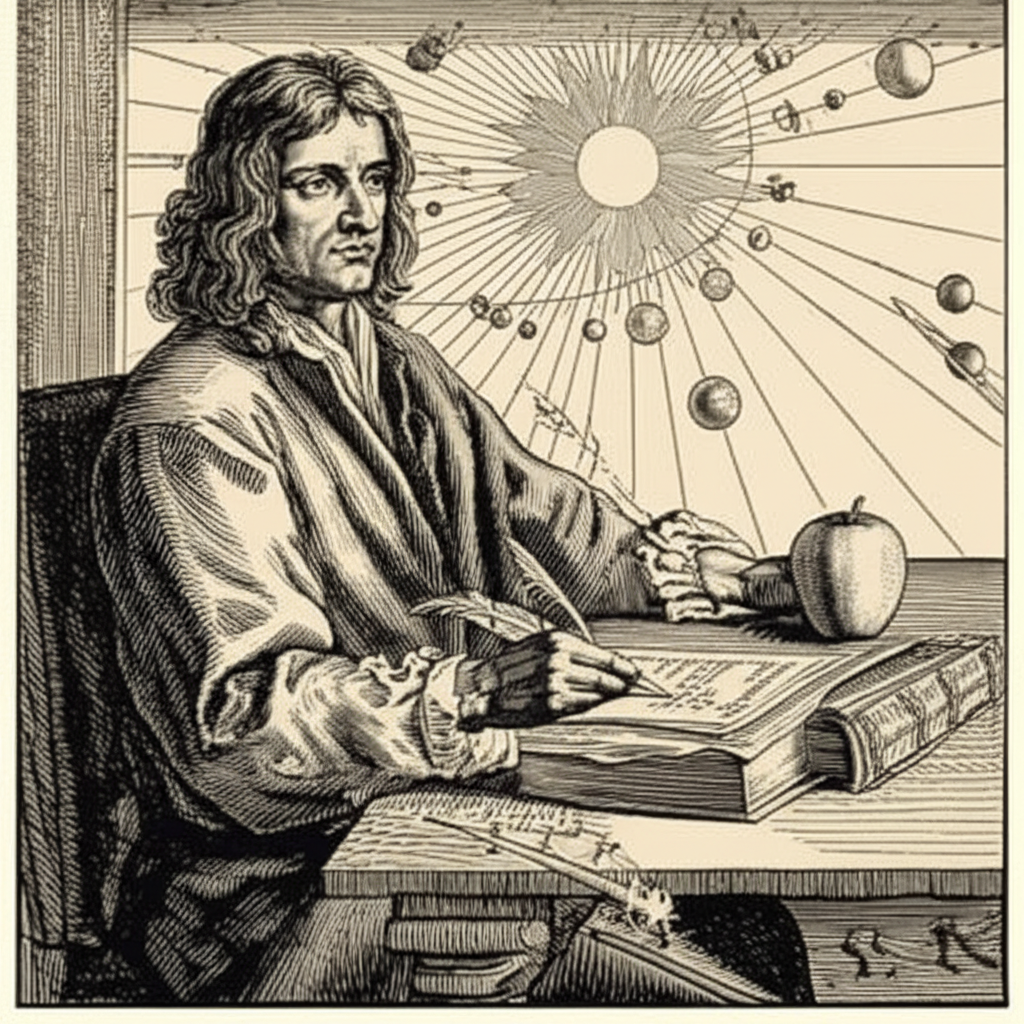
It was Isaac Newton, drawing heavily from Galileo's insights, who crystallized the concept of force into the precise mathematical language that would define classical mechanics for centuries. In his Principia Mathematica, Newton articulated laws that transformed force from an abstract philosophical idea into a measurable, predictable element of the physical world.
Newton's Laws of Motion:
- Inertia: An object at rest stays at rest and an object in motion stays in motion with the same speed and in the same direction unless acted upon by an unbalanced force. This reiterates Galileo's principle, elevating force to the sole arbiter of changes in state.
- Acceleration: The acceleration of an object as produced by a net force is directly proportional to the magnitude of the net force, in the same direction as the net force, and inversely proportional to the mass of the object (F=ma). Here, force is quantified as the product of mass and acceleration, making it a central, calculable element in physics.
- Action-Reaction: For every action, there is an equal and opposite reaction. This law establishes the relational nature of force, emphasizing that force always involves an interaction between two or more objects.
This Newtonian framework firmly established force as a vectorial quantity – possessing both magnitude and direction – making it the primary element for analyzing and predicting motion within the vast domain of mechanics.
The Philosophical Resonance of Force
Beyond its utility in engineering and scientific prediction, the element of force continues to provoke profound philosophical questions:
- Causality: Is force the ultimate cause of all physical events, or merely a description of the interaction? How does the concept of force relate to free will and determinism?
- Interaction: Force implies interaction. Does this mean nothing exists in absolute isolation? What does this say about the interconnectedness of the universe?
- Reality: Is force a fundamental property of reality, an element that truly exists independently, or is it a conceptual tool we use to model the world?
These inquiries, echoing through the ages from the pages of the Great Books to contemporary philosophical debates, underscore that force is much more than a scientific variable; it is a gateway to understanding the very nature of existence and change.
The Evolution of Understanding Force: A Comparative View
| Aspect | Aristotelian View (Pre-17th Century) | Newtonian View (17th Century Onward) |
|---|---|---|
| Nature of Force | External agent, continuous mover. | Interaction causing change in motion (acceleration). |
| Motion Without Force | Impossible for violent motion. | Possible (inertia) if no net force. |
| Quantification | Qualitative, observational. | Quantitative, mathematical (F=ma). |
| Role in Physics | Explanation of why things move. | Prediction and description of how things move. |
| Philosophical Focus | Teleology, natural vs. violent. | Causality, determinism, universal laws. |
Concluding Thoughts: The Indispensable Element
The element of force in mechanics and physics remains an indispensable concept, a fundamental building block of our scientific worldview. Yet, its journey from a philosophical speculation on agency to a precise mathematical descriptor reveals the dynamic interplay between human thought and the observable universe. As we continue to probe the depths of physics with theories like relativity and quantum mechanics, the essence of force continues to evolve, challenging us to refine our understanding of this most fundamental element that orchestrates the dance of the cosmos.
Further Exploration
📹 Related Video: What is Philosophy?
Video by: The School of Life
💡 Want different videos? Search YouTube for: "The Philosophy of Force: Causality and Determinism in Physics"
📹 Related Video: ARISTOTLE ON: The Nicomachean Ethics
Video by: The School of Life
💡 Want different videos? Search YouTube for: "From Aristotle to Newton: The Evolution of Mechanics and the Concept of Force"