

The Element of Force in Mechanics: A Philosophical Inquiry
The concept of force stands as a cornerstone in the edifice of mechanics, fundamentally shaping our understanding of how the world moves and interacts. Beyond its quantifiable definition in physics, force represents an underlying element of change, causality, and agency that has captivated thinkers from antiquity to the modern era. This article delves into the philosophical journey of force, tracing its evolution from an intrinsic property or teleological driver in ancient thought to a measurable interaction in classical mechanics, and finally, reflecting on its enduring implications for our perception of reality, drawing insights from the enduring wisdom found within the Great Books of the Western World.
The Ancient Element of Motion: A World Driven by Purpose
Before the advent of modern mechanics, the element of motion was often understood through a lens of inherent purpose or natural tendencies. For Aristotle, as explored in his Physics, objects moved not primarily due to external forces as we understand them, but according to their nature or their striving towards a natural place. A stone falls because its natural place is the earth; smoke rises because its natural place is the heavens. Violent motion, conversely, required a continuous mover. This perspective imbued the world with an organic, almost living quality, where the element of change was internal or teleological.
- Aristotelian View:
- Natural Motion: Objects move to their "proper place" (e.g., earth falls, fire rises).
- Violent Motion: Requires a continuous external agent; ceases when the agent stops.
- Prime Mover: The ultimate source of all motion, itself unmoved.
This early philosophical understanding of motion, though vastly different from Newtonian physics, highlights an attempt to grasp the fundamental element that causes things to happen, to change, to interact. It was a world where force was less about a push or a pull, and more about an inherent drive or a continuous, direct contact.
From Teleology to Mechanics: The Dawn of a New Paradigm
The transition from this teleological worldview to a mechanistic one marks one of the most significant intellectual shifts in Western thought. Figures like Galileo Galilei, through meticulous observation and experimentation, began to challenge Aristotelian notions. Galileo's work on inertia and falling bodies laid crucial groundwork, suggesting that objects do not necessarily require a continuous force to maintain motion, but rather to change it.
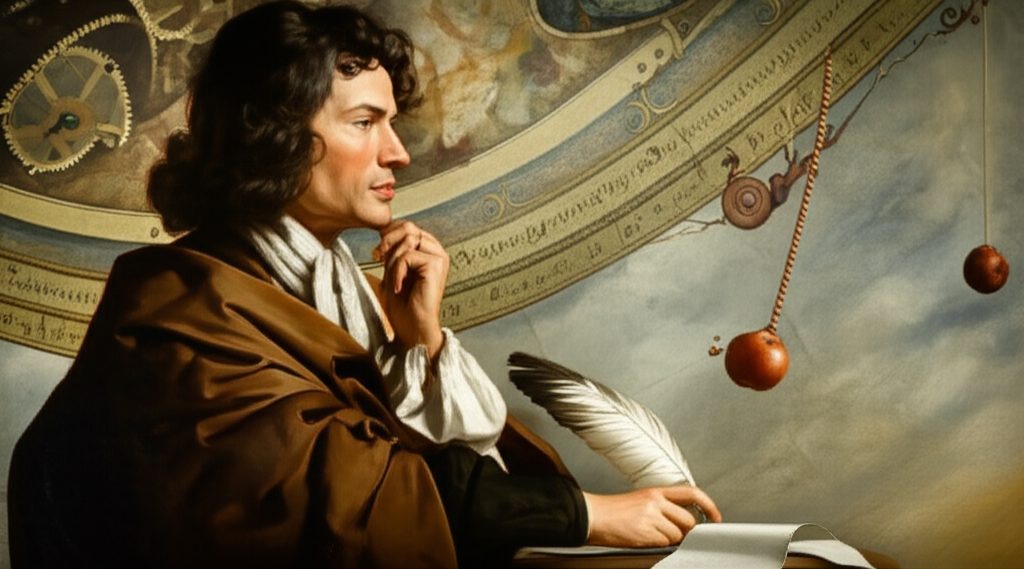
This intellectual revolution culminated with Sir Isaac Newton, whose Principia Mathematica provided the definitive framework for classical mechanics. Newton's three laws of motion fundamentally redefined force as a quantifiable interaction, an external agent capable of altering an object's state of motion.
Newton's Laws and the New Element of Force
- Law of Inertia: An object at rest stays at rest, and an object in motion stays in motion with the same speed and in the same direction unless acted upon by an unbalanced force.
- Law of Acceleration: The acceleration of an object as produced by a net force is directly proportional to the magnitude of the net force, in the same direction as the net force, and inversely proportional to the mass of the object (F=ma).
- Law of Action-Reaction: For every action, there is an equal and opposite reaction force.
This new understanding shifted the element of causality from intrinsic purpose to extrinsic interaction. Force became a universal element governing the celestial spheres and terrestrial phenomena alike, unifying the cosmos under a single set of physical laws.
The Philosophical Echoes of Force: Causality, Agency, and Reality
Beyond its utility in physics, Newton's concept of force resonated deeply within philosophy. It presented a world governed by deterministic laws, where every effect had a discernible cause. This raised profound questions:
- Causality: Is force the ultimate explanation for causality, or merely a description of its manifestation? What is the nature of this causal element?
- Agency: If all motion is governed by force, what room is left for free will or moral agency? Are humans merely complex machines subject to the same mechanics?
- The Nature of Reality: Is reality fundamentally mechanistic, a vast clockwork universe driven by impersonal forces? Or is there something more? Thinkers like David Hume questioned whether we truly perceive force or merely the constant conjunction of events, hinting at the limits of empirical observation.
The concept of force also fueled debates about the existence of God. While Newton himself saw the intricate mechanics of the universe as evidence of a divine creator, others began to see a self-sufficient, mechanistic universe that required no external intervention.
The Enduring Element: Force in Modern Thought
Even as physics has evolved beyond classical mechanics into relativity and quantum mechanics, the element of force remains central. Einstein's theory of general relativity reinterprets gravity not as a force in the Newtonian sense, but as a curvature of spacetime. Quantum mechanics introduces fundamental forces mediated by particles. Yet, in each iteration, the quest remains to understand the fundamental elements that drive change, interaction, and the very fabric of existence.
The philosophical inquiry into force continues to ask: What is its true nature? Is it an inherent property of matter, an emergent phenomenon, or merely a conceptual tool we use to describe interactions? The element of force in mechanics is not just a scientific concept; it is a gateway to contemplating the deepest questions about causality, determinism, and the very essence of reality itself.
YouTube Video Suggestions:
-
📹 Related Video: ARISTOTLE ON: The Nicomachean Ethics
Video by: The School of Life
💡 Want different videos? Search YouTube for: ""Aristotle Physics Natural Motion Violent Motion Explained""
-
📹 Related Video: ARISTOTLE ON: The Nicomachean Ethics
Video by: The School of Life
💡 Want different videos? Search YouTube for: ""Newton's Laws of Motion Philosophical Implications""