

The Indispensable Element: Force as the Prime Mover in Mechanics
Summary
This article explores the concept of force not merely as a quantitative measure in physics but as a fundamental element in our philosophical understanding of mechanics. Tracing its evolution from ancient Greek notions of causation to Newtonian mechanics, we examine how force shapes our perception of causality, agency, and the very fabric of reality, drawing insights from the Great Books of the Western World. We argue that force, in its various manifestations, serves as a crucial bridge between the observable universe and our intellectual attempts to comprehend its underlying principles.
The Unseen Architect of Change
From the simplest push of a hand to the grand ballet of celestial bodies, force is the unseen architect of change, the element that instigates motion, deformation, and interaction across the cosmos. In the realm of mechanics, force is the conceptual cornerstone upon which our understanding of the physical world is built. Yet, beyond its mathematical definitions and empirical applications in physics, force harbors a profound philosophical depth. What is this fundamental element? Is it a property of objects, an interaction, or a primary constituent of reality itself? To grapple with these questions is to embark on a journey that spans millennia of human thought, from the speculative inquiries of ancient Greece to the rigorous formulations of classical mechanics.
From Potentia to Vis Impressa: A Historical Trajectory
The concept of force, though not always articulated with the precision we associate with modern physics, has been central to humanity's attempt to explain the world. The Great Books of the Western World provide a rich tapestry of these early inquiries.
Aristotle and the Prime Mover
In his Physics and Metaphysics, Aristotle grappled with the nature of motion and causality. For him, every motion required a mover, and this chain of causation ultimately led to an unmoved mover. His understanding of motion was often qualitative, distinguishing between "natural" motions (like a stone falling) and "violent" motions (like throwing a stone), which required an external force or impetus. The concept of potentia (potentiality) and actus (actuality) was crucial; things moved from a state of potentiality to actuality, driven by a cause. While not defining force quantitatively, Aristotle laid the philosophical groundwork for understanding motion as a consequence of an element of active influence.
Galileo's Challenge and the Dawn of Modern Mechanics
Centuries later, figures like Galileo Galilei began to challenge Aristotelian physics. Galileo's experiments on inclined planes and falling bodies, detailed in his Discourses and Mathematical Demonstrations Relating to Two New Sciences, were instrumental in developing the concept of inertia. This radical idea – that an object in motion would remain in motion unless acted upon by an external force – profoundly shifted the understanding of mechanics. It began to isolate force as a distinct, external element responsible for changes in motion, rather than motion itself.
Newton's Synthesis: The Quantification of Force
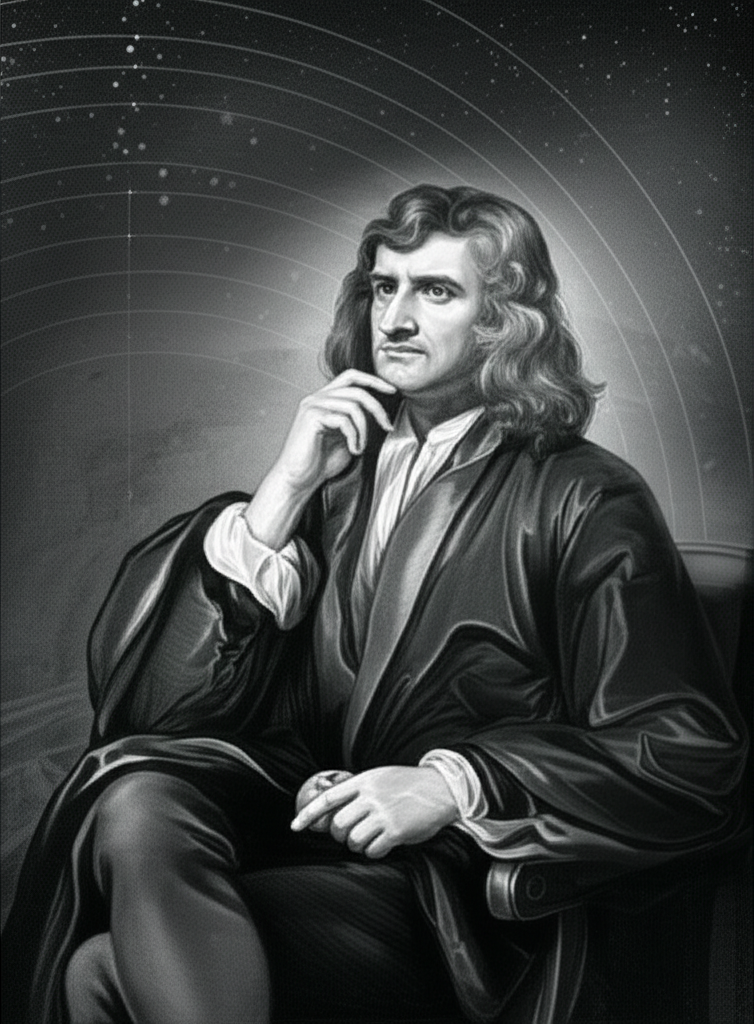
The true revolution in understanding force came with Sir Isaac Newton. His monumental work, Philosophiæ Naturalis Principia Mathematica (Mathematical Principles of Natural Philosophy), published in the Great Books, provided a comprehensive and quantitative framework for mechanics.
Newton's Laws and the Universal Element
Newton articulated three laws of motion that fundamentally defined force:
- Law of Inertia: An object at rest stays at rest, and an object in motion stays in motion with the same speed and in the same direction unless acted upon by an unbalanced force. This formalizes Galileo's insight.
- Law of Acceleration: The acceleration of an object as produced by a net force is directly proportional to the magnitude of the net force, in the same direction as the net force, and inversely proportional to the mass of the object (
F = ma). This is the iconic quantification of force, making it a measurable element in physics. - Law of Action-Reaction: For every action, there is an equal and opposite reaction. This highlights force as an interaction, an element of reciprocity between bodies.
Newton also introduced the concept of universal gravitation, demonstrating that the same force that causes an apple to fall also governs the orbits of planets. This established force as a universal element, an inherent property of mass and distance, fundamentally shaping the cosmos.
The Philosophical Implications of Force
Beyond its utility in physics and mechanics, the concept of force carries profound philosophical weight.
Causality and Determinism
Newtonian mechanics, with its precise definition of force, led to a highly deterministic view of the universe. If all forces acting on all particles could be known at any given moment, the future state of the universe could, in principle, be predicted. This raised questions about free will and predestination, as explored by philosophers like Pierre-Simon Laplace. Is force the ultimate element of causality, or merely a description of interactions whose true cause lies elsewhere? David Hume, in his A Treatise of Human Nature, famously critiqued the notion of necessary connection in causation, suggesting we only observe constant conjunction, not an inherent force compelling one event from another.
Force as an Epistemological Element
Is force an ontological element of reality, existing independently of our observation, or is it an epistemological construct, a useful tool for understanding and predicting phenomena? The success of physics in describing the world through forces might suggest the former, yet the elusive nature of force itself — often defined by its effects rather than its intrinsic essence — keeps the philosophical debate alive. It stands as a fundamental element in our models, whether or not it is a fundamental element of reality itself.
The Element of Interaction
Force is inherently relational. It describes an interaction between two or more bodies. This shifts our philosophical focus from isolated objects to systems and their interdependencies. The universe, seen through the lens of force, is a dynamic web of interactions, where every element influences every other.
Conclusion: Force as a Primal Element of Understanding
The element of force in mechanics is far more than a simple variable in a physical equation. It is a concept that has evolved from ancient philosophical inquiries into the nature of motion and causation, culminating in the precise, predictive power of modern physics. Force, as articulated by Newton, provided a universal language for describing the mechanics of the cosmos, profoundly shaping our understanding of causality, determinism, and the very structure of reality.
As we continue to explore the universe, from quantum fluctuations to the vastness of cosmic structures, the concept of force remains a primal element in our intellectual toolkit. It compels us to ask not just "how" things move, but "why," connecting the empirical observations of physics with the enduring philosophical questions about the fundamental nature of existence.
YouTube Video Suggestions:
-
📹 Related Video: What is Philosophy?
Video by: The School of Life
💡 Want different videos? Search YouTube for: ""The Philosophy of Force and Causation""
-
📹 Related Video: ARISTOTLE ON: The Nicomachean Ethics
Video by: The School of Life
💡 Want different videos? Search YouTube for: ""Aristotle, Newton, and the Evolution of Mechanics""