

The Fiery Heart of Ancient Thought: Exploring Fire as a Fundamental Element in Philosophy and Nature
In the grand tapestry of ancient philosophy, few concepts held as much transformative power and symbolic weight as the element of fire. Far from being merely a physical phenomenon, fire was conceived as a fundamental constituent of the cosmos, a dynamic force shaping nature, and a profound metaphor for change, intellect, and divine order. From the pre-Socratic musings on cosmic flux to Plato's geometric solids and Aristotle's detailed physics of the terrestrial realm, fire consistently illuminated the deepest inquiries into existence, matter, and the very essence of being. This article delves into the multifaceted role of fire, examining its significance in the intellectual landscape of antiquity, drawing insights from the foundational texts that shaped Western thought.
The Primacy of Fire: Heraclitus and the Ever-Living Flux
Perhaps no ancient philosopher is more intimately associated with fire than Heraclitus of Ephesus. For Heraclitus, fire was not merely one element among others; it was the arche, the primordial principle, the very logos that governed the universe. His famous dictum, "The cosmos, an ever-living fire, kindling in measures and going out in measures," encapsulates this profound insight.
- Fire as the Universal Principle of Change: Heraclitus saw fire as the embodiment of constant transformation and flux, a ceaseless process of becoming and perishing. Unlike the static being proposed by Parmenides, Heraclitus's world was a dynamic interplay of opposites, eternally reconciled by the fiery logos.
- Order in Chaos: Despite its destructive potential, fire for Heraclitus represented an underlying order. The "measures" in which it kindled and went out suggested a cosmic balance, a rational arrangement within the apparent chaos of change. This was a radical departure, suggesting that nature's deepest physics was not static, but inherently dynamic.
Key Heraclitean Aspects of Fire:
| Aspect | Description | Philosophical Implication |
|---|---|---|
| Flux | Constant change, burning, transformation. | Reality is not static; everything is in motion. |
| Logos | The rational principle, order, and measure within change. | Change is not arbitrary but follows a discernible pattern. |
| Strife | The dynamic tension of opposites (e.g., hot/cold, wet/dry). | Conflict is essential for existence and generates harmony. |
| Ever-Living | Not created or destroyed, but eternally present and self-sustaining. | The cosmos is an eternal, self-regulating entity, a vibrant element. |
Fire Among the Four: Empedocles, Plato, and Aristotle's Contributions
While Heraclitus elevated fire to a supreme position, later philosophers integrated it into more complex cosmological models, solidifying its place as one of the fundamental elements of nature.
Empedocles' Four Roots
Empedocles of Acragas introduced the concept of four "roots" – fire, air, water, and earth – which he believed were eternal and unchangeable. These roots were mixed and separated by the cosmic forces of Love (attraction) and Strife (repulsion), creating the diverse phenomena of the world. For Empedocles, fire was a distinct, active root, contributing its unique qualities to the formation of all things. This was a crucial step in formalizing the multi-element theory that would dominate ancient physics.
Plato's Geometric Fire in the Timaeus
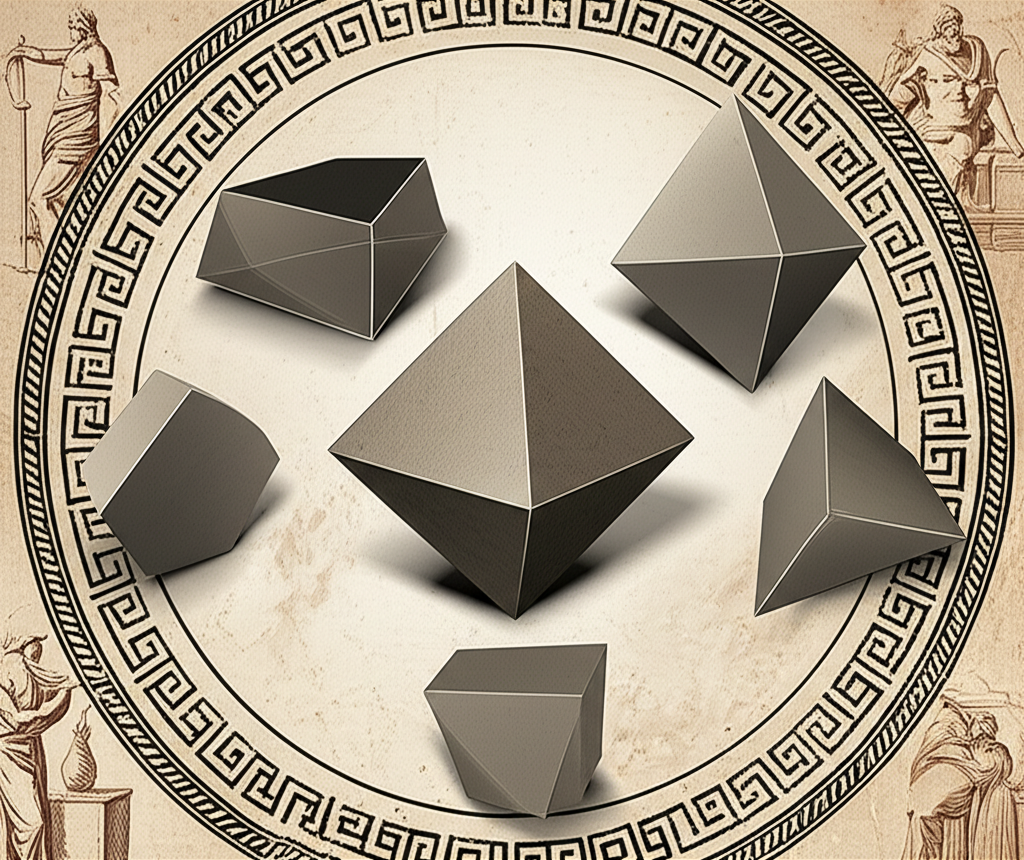
In his seminal dialogue, the Timaeus, Plato offers a profound and intricate account of the creation of the cosmos, where the elements are assigned specific geometric forms. Fire, being the most active and penetrating, is associated with the tetrahedron, the simplest and sharpest of the Platonic solids.
- The Sharpness of Fire: Plato reasoned that the tetrahedron, with its acute angles and sharp points, best explained fire's ability to cut, pierce, and dissolve other substances. This geometric precision provided a mathematical foundation for understanding the physics of how fire interacted with the world.
- Lightness and Mobility: The tetrahedron, having the fewest faces, was also considered the lightest and most mobile, correlating with fire's observed qualities of rising and spreading rapidly. This mathematical grounding elevated the element beyond mere observation into a realm of ideal forms.
Aristotle's Terrestrial Fire and Its Qualities
Aristotle, building upon earlier theories, systematized the concept of the four elements (fire, air, water, earth) and their inherent qualities. For him, each element was defined by a pair of primary qualities:
- Fire: Hot and Dry
- Air: Hot and Wet
- Water: Cold and Wet
- Earth: Cold and Dry
Aristotle further posited that these elements had natural places in the cosmos. Fire, being the lightest and hottest, naturally ascended to the sublunary sphere, just below the celestial bodies, explaining phenomena like flames rising. This detailed physics of the elements provided a comprehensive framework for understanding nature that would endure for centuries.
Aristotle's Elemental Qualities:
| Element | Primary Quality 1 | Primary Quality 2 | Natural Motion |
|---|---|---|---|
| Fire | Hot | Dry | Upwards |
| Air | Hot | Wet | Upwards |
| Water | Cold | Wet | Downwards |
| Earth | Cold | Dry | Downwards |
The Enduring Symbolism and Philosophical Legacy
Beyond its role as a literal element in physics, fire held profound symbolic meaning throughout ancient philosophy, reflecting deeper truths about human experience and the cosmos.
- Purification and Destruction: Fire was seen as an agent of both destruction and purification, consuming the old to make way for the new. This symbolic duality resonated with concepts of moral cleansing and the cyclical nature of existence.
- Light and Knowledge: As a source of light, fire was often linked to knowledge, reason, and enlightenment. The Promethean myth, where fire is stolen from the gods and given to humanity, underscores its connection to civilization, craft, and intellectual progress.
- The Divine Spark: In some philosophical traditions, fire represented the divine or vital spark within living beings, an animating force that connected individuals to the cosmic whole.
The ancient philosophers, through their rigorous inquiry into the element of fire, laid the groundwork for understanding not just the physics of the world, but also the very nature of change, knowledge, and existence. Their insights, preserved in the Great Books of the Western World, continue to ignite philosophical discourse, reminding us of the profound connections between the material world and the realm of ideas.
Further Exploration
For those eager to delve deeper into the fiery heart of ancient thought, consider these resources:
-
📹 Related Video: What is Philosophy?
Video by: The School of Life
💡 Want different videos? Search YouTube for: "Heraclitus Philosophy "All is Flux""
-
📹 Related Video: PLATO ON: The Allegory of the Cave
Video by: The School of Life
💡 Want different videos? Search YouTube for: "Plato Timaeus Elements Geometry"