

The Element of Fire in Ancient Philosophy: A Spark of Cosmic Insight
From the flickering hearth to the destructive blaze, fire has always held a profound grip on the human imagination. But for the ancient philosophers, fire was far more than a mere physical phenomenon; it was a fundamental Element, a dynamic force, and a potent symbol deeply woven into the fabric of Philosophy, Physics, and the very Nature of existence itself. This article delves into how the sages of antiquity grappled with fire, seeing in its transformative power a key to understanding the cosmos, human nature, and the ceaseless dance of change that defines our world, ideas eloquently preserved within the volumes of the Great Books of the Western World.
The Primal Force: Fire as the Arche
Before the systematic categorisation of elements, fire often stood as the arche – the primordial beginning or fundamental principle – for some of the earliest thinkers. It wasn't just a substance; it was the essence of activity, change, and life itself.
Heraclitus: The Ever-Living Fire of Change
Perhaps no philosopher is more famously associated with fire than Heraclitus of Ephesus. For him, fire was the ultimate metaphor for the ceaseless flux of reality. He famously stated, "All things are an exchange for fire, and fire for all things, as goods for gold and gold for goods."
- Constant Change: Fire consumes, transforms, and is never static, mirroring Heraclitus's view that "You cannot step into the same river twice."
- Cosmic Order (Logos): Despite its apparent chaos, fire also represented a rational order, the logos, governing the universe. It was the principle of tension and balance, where opposites converge and diverge.
- Destruction and Creation: Fire's duality—its capacity to both destroy and purify, to forge and to annihilate—made it the perfect symbol for the eternal becoming of the cosmos.
The Four Roots: Fire in the Elemental Quartet
With philosophers like Empedocles, fire took its place alongside earth, air, and water as one of the four fundamental Elements, the irreducible "roots" from which all matter was composed. This model profoundly influenced subsequent Greek thought, including Plato and Aristotle.
Empedocles: Love, Strife, and the Elemental Mix
Empedocles proposed that the universe was made of these four immutable roots, which were eternally mixed and separated by two cosmic forces: Love (attraction) and Strife (separation). Fire, with its inherent dynamism, played a crucial role in these cycles:
- Active Principle: Fire was often associated with the hot and dry qualities, making it an active and energetic component in the creation and dissolution of all things.
- Cosmic Cycles: Its presence was essential for the aggregation of elements under Love and their dispersal under Strife, driving the grand cosmic rotations.
Plato and Aristotle: Form, Motion, and Qualities
The later, more systematic philosophies of Plato and Aristotle further refined the understanding of fire, integrating it into their comprehensive cosmologies and Physics.
Plato: The Geometric Perfection of Fire
In Plato's Timaeus, the four elements are assigned specific geometric forms, reflecting their essential qualities and roles in the sensible world.
- The Tetrahedron: Fire, being the sharpest and most penetrating element, was assigned the form of the tetrahedron—the simplest regular solid, composed of four equilateral triangles. This mathematical precision underscored fire's role in the creation of the cosmos.
- Sensory Experience: Plato linked fire's sharp edges to the sensation of burning and its light to vision, connecting the Element's physical properties to human perception.
Aristotle: Terrestrial Fire and Natural Motion
Aristotle, building on the elemental theory, provided a more empirical and systematic account in works like Physics and On Generation and Corruption.
| Aspect | Aristotle's View of Fire |
|---|---|
| Qualities | Hot and Dry |
| Natural Motion | Upwards (towards the periphery of the terrestrial sphere) |
| Location | The innermost sphere of the cosmos, just below the moon |
| Role | Active principle in generation and corruption of substances |
For Aristotle, fire was unequivocally a terrestrial Element, distinct from the ethereal fifth Element (Aether) that composed the unchanging heavens. Its natural tendency to move upwards was a key aspect of his Physics, explaining phenomena like flames rising.
The Stoics: Cosmic Conflagration and Rational Fire
The Stoic philosophers, deeply influenced by Heraclitus, also placed fire at the heart of their worldview, but with a more pronounced emphasis on its rational and divine aspects.
- Pneuma: For the Stoics, fire was often conceived as pneuma, a fiery breath or spirit that permeated the entire cosmos. This was not just physical fire but a rational, intelligent fire—the divine logos itself.
- Ekpyrosis (Conflagration): They believed in cyclical destruction and renewal, where the universe would periodically dissolve into a primal fiery state (ekpyrosis), only to be reborn again, perfectly mirroring the previous cycle. This was not a chaotic end but a rational, purifying return to the original fiery Nature.
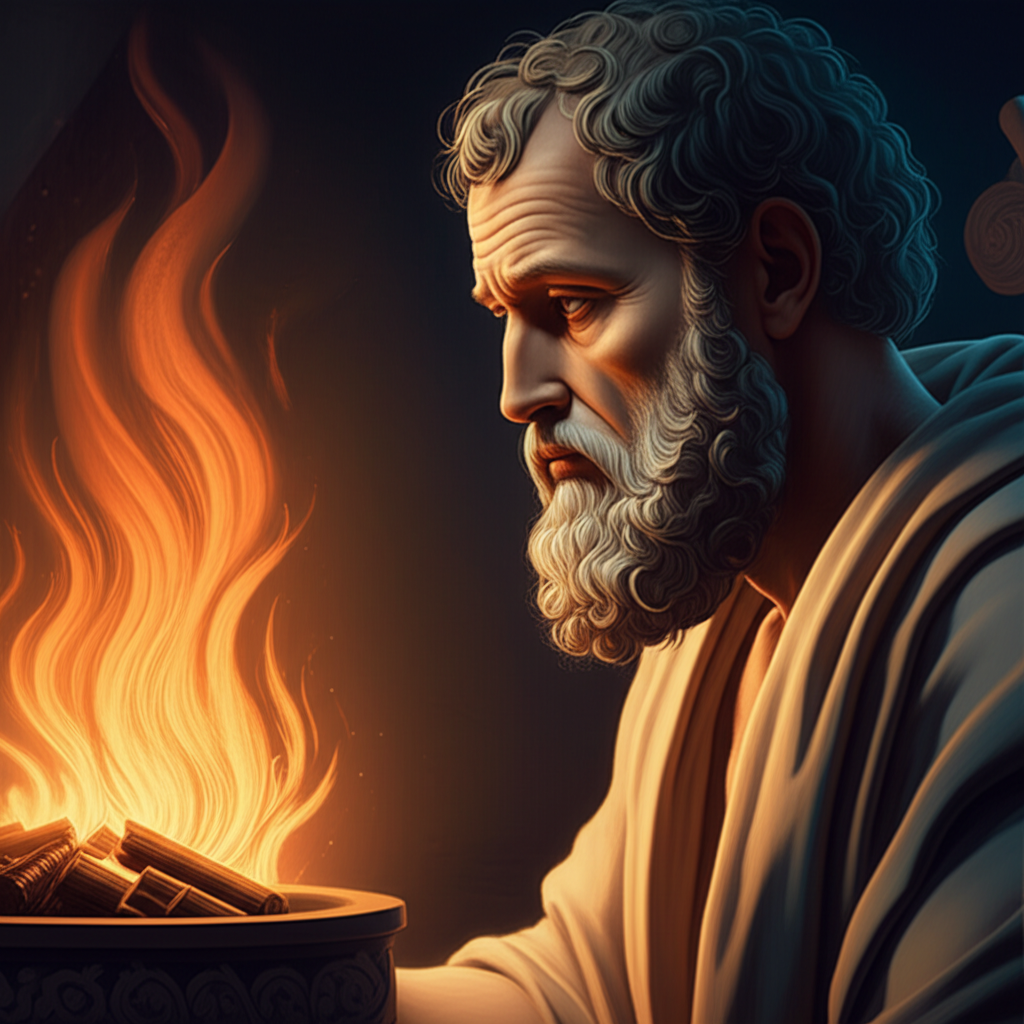
The Enduring Legacy: Fire as Metaphor and Reality
The ancient philosophical engagement with fire reveals a profound quest to understand the fundamental constituents and dynamics of reality. From a metaphor for ceaseless change to a geometric form, a primary root, or a cosmic rational principle, fire illuminated crucial aspects of the ancient understanding of Nature and the universe. Its dual capacity for destruction and creation, its light and its heat, made it an indispensable lens through which to ponder existence itself. These ancient insights continue to spark contemplation, reminding us that the elemental forces around us are not just physical phenomena but profound philosophical teachers.
📹 Related Video: What is Philosophy?
Video by: The School of Life
💡 Want different videos? Search YouTube for: ""Heraclitus Fire Philosophy Explained""
📹 Related Video: PLATO ON: The Allegory of the Cave
Video by: The School of Life
💡 Want different videos? Search YouTube for: ""Ancient Greek Elements: Earth, Air, Fire, Water Explained""