

The Fiery Core of Ancient Thought: Fire as a Fundamental Element in Philosophy
In the grand tapestry of ancient Philosophy, few concepts burned as brightly or held as much profound significance as the Element of fire. Far more than mere combustion, fire represented for many ancient thinkers a fundamental principle of existence, a dynamic force intertwined with the very fabric of Nature and the nascent understanding of Physics. From the chaotic flux of Heraclitus to the structured cosmos of Plato and Aristotle, fire was consistently invoked as a primary constituent of the world, a symbol of change, purification, and divine energy. This article delves into the multifaceted interpretations of fire, exploring its pivotal role in shaping early philosophical and scientific inquiry, as illuminated by the foundational texts within the Great Books of the Western World.
Fire's Dawn: The Pre-Socratic Incandescence
The earliest Greek philosophers, grappling with the fundamental stuff of the cosmos, often turned to fire as a primary candidate for the arche – the origin or first principle.
-
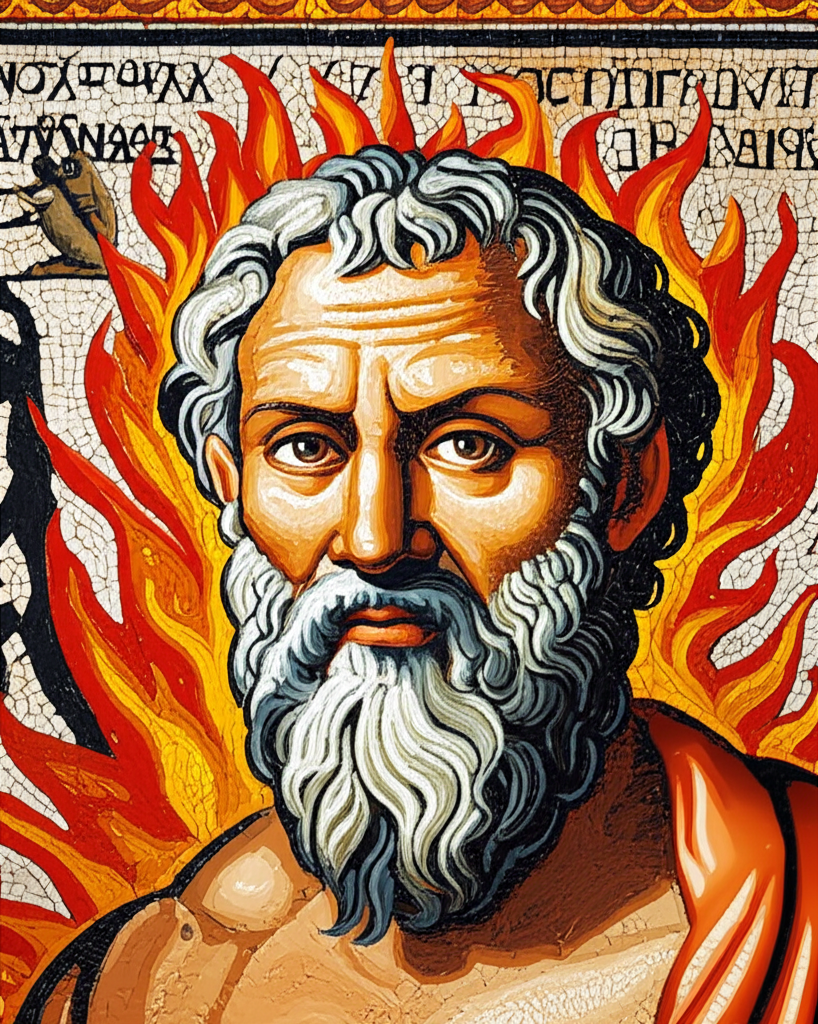
Heraclitus of Ephesus (c. 535 – c. 475 BC): For Heraclitus, fire was not merely an element but the very essence of change and the logos that governed the universe. He famously declared, "All things are an exchange for fire, and fire for all things, as goods for gold and gold for goods." (From fragments, as interpreted in "Great Books"). Fire symbolized the eternal flux, the constant becoming and passing away that characterized Nature. It was the active, transformative agent, perpetually consuming and being consumed, thereby maintaining a dynamic equilibrium. His Physics was a Philosophy of ceaseless transformation, with fire as its energetic heart.
-
Empedocles of Acragas (c. 494 – c. 434 BC): Empedocles introduced the concept of four "roots" or Elements – fire, air, earth, and water – which, through the forces of Love and Strife, mixed and separated to form all things. Fire, for Empedocles, possessed the qualities of hot and dry, and its presence was crucial for life and sensation. It was a material component, alongside the others, forming the building blocks of the physical world.
-
Anaximenes of Miletus (c. 585 – c. 528 BC): While Anaximenes posited air as the primary substance, he described how air, through rarefaction, could become fire, and through condensation, wind, cloud, water, and earth. This demonstrated an early understanding of phase transitions and the interconnectedness of the Elements, with fire representing the most rarefied, energetic state.
Platonic Forms and Aristotelian Elements: Fire in the Classical Age
The classical period saw fire's role further elaborated, moving from a singular arche to an integral part of more complex cosmological systems.
-
Plato (c. 428 – c. 348 BC): In his dialogue Timaeus, Plato assigns fire a foundational role in the creation of the cosmos. He associates each of the four Elements with a specific regular polyhedra (Platonic solid). Fire, being the sharpest and most penetrating, was assigned the tetrahedron – the simplest and lightest of the solids. This geometric rendering of the Elements provided a mathematical basis for Physics and the structure of Nature. Fire was essential for sight, providing light, and its heat played a role in sensation and the body's functions. It was a bridge between the intelligible Forms and the sensible world, a primary constituent of the visible universe.
-
Aristotle (384 – 322 BC): Aristotle, in works such as Physics, On the Heavens, and On Generation and Corruption, systematized the understanding of the four terrestrial Elements: earth, water, air, and fire.
- Qualities: Fire was characterized by the primary qualities of hot and dry.
- Natural Motion: Its natural tendency was to move upwards, towards the celestial sphere, which explained phenomena like flames rising. This natural motion was a key aspect of Aristotelian Physics.
- Place in the Cosmos: Fire occupied the highest sublunary sphere, just beneath the celestial realm of the unchanging aether.
- Role in Change: Aristotle viewed fire as an active agent in processes of generation and corruption, facilitating transformations within Nature. It was essential for life, warmth, and the processes of digestion and metabolism.
Table 1: Ancient Philosophical Views on Fire
| Philosopher | Primary Role of Fire | Key Concepts | Source (Great Books Context) |
|---|---|---|---|
| Heraclitus | The ultimate arche, principle of constant change | Logos, eternal flux, "all things are an exchange for fire" | Fragments attributed in historical accounts (e.g., Simplicius, Plutarch) and later philosophical analyses. |
| Empedocles | One of four fundamental "roots" or Elements | Love & Strife, material constituent, qualities of hot and dry | Fragments quoted by Aristotle and others (e.g., in Physics). |
| Plato | Geometric solid (tetrahedron), cosmic constituent | Timaeus, Forms, mathematical structure of Nature, light, heat | Timaeus |
| Aristotle | One of four terrestrial Elements, hot and dry | Natural motion (upwards), sublunary sphere, agent of change, Physics | Physics, On the Heavens, On Generation and Corruption |
| Stoics | Cosmic fire (pneuma), divine reason, cyclical renewal | Logos spermatikos, ekpyrosis (cosmic conflagration), rational universe | Fragments from Zeno, Cleanthes, Chrysippus; later Roman Stoics (e.g., Seneca, Marcus Aurelius in Meditations). |
The Stoic Conflagration: Fire as Cosmic Reason
Beyond the physical Element, fire took on a profound theological and metaphysical dimension with the Stoics. They conceived of a cosmic fire or pneuma (breath/spirit) as the animating principle of the universe. This rational, divine fire, the logos spermatikos (seminal reason), permeated all Nature, shaping and guiding it. The Stoics believed in a cyclical universe, where a periodic conflagration (ekpyrosis) would consume all things in fire, only for the cosmos to be reborn and reconstituted in an endless cycle. Fire, in this Philosophy, was not just a physical component but the very mind of God, an intelligent and provident force that ordered the world.
Enduring Embers: Fire's Legacy in Philosophy and Physics
The ancient understanding of fire, while superseded by modern chemistry and Physics, laid crucial groundwork for scientific inquiry. It established the idea of fundamental Elements, the concept of inherent qualities, and the role of dynamic forces in shaping Nature. The philosophical interpretations of fire – as change, as reason, as a divine spark – continue to resonate, reminding us of the deep connections forged between the physical world and metaphysical speculation in the dawn of Western thought. The Element of fire remains a potent symbol of transformation, creation, and destruction, forever etched into the intellectual history of humanity.
Further Illumination:
📹 Related Video: What is Philosophy?
Video by: The School of Life
💡 Want different videos? Search YouTube for: ""Heraclitus Philosophy of Fire and Flux Explained""
📹 Related Video: ARISTOTLE ON: The Nicomachean Ethics
Video by: The School of Life
💡 Want different videos? Search YouTube for: ""Aristotle's Four Elements and Natural Motion""