

The Ever-Burning Truth: Fire's Enduring Element in Ancient Philosophy
From the flickering warmth of a hearth to the destructive inferno, fire has always captivated humanity. Yet, for the ancient philosophers, fire was far more than a mere physical phenomenon; it was a profound Element, a fundamental principle that illuminated their understanding of the cosmos, the nature of change, and the very essence of being. This article delves into how fire, with its dynamic and transformative qualities, became a cornerstone in the early development of Western Philosophy and Physics, shaping theories about the natural world and our place within it.
The Primal Spark: Fire as a Foundational Principle
Ancient thinkers, grappling with the bewildering complexity of Nature, sought underlying principles, or archai, that could explain existence. Among these, fire emerged as a potent candidate, embodying both creation and destruction, change and constancy. Its unique properties — its luminosity, heat, and ability to transform matter — made it an irresistible subject for philosophical inquiry.
Heraclitus and the Logos of Fire
Perhaps no philosopher is more famously associated with fire than the pre-Socratic Heraclitus of Ephesus. For Heraclitus, fire was not just one Element among many; it was the ultimate arche, the very principle of ceaseless change and flux that governed the universe.
- "All things are an exchange for fire, and fire for all things, as gold for wares and wares for gold." This famous dictum encapsulates his view that fire is the universal medium of exchange, the underlying reality through which all things transform.
- The Ever-Living Fire: Heraclitus conceived of fire as an ever-living fire, kindling in measures and going out in measures. This wasn't a static substance but a dynamic, intelligent force, a logos that ordered the cosmos through conflict and harmony. The world, he argued, is in a state of perpetual becoming, much like a flame that is constantly consuming and regenerating itself. For Heraclitus, understanding fire was to understand the very Physics of existence.
Empedocles' Four Roots and the Dance of Fire
Later, Empedocles of Acragas refined the concept of elemental principles by proposing four "roots" — earth, air, fire, and water — as the unchangeable, eternal substances that constitute all matter. These roots, acted upon by the opposing forces of Love (attraction) and Strife (repulsion), combined and separated to form the diverse objects of the world.
- Fire's Role: In Empedocles' scheme, fire was crucial for its active, mobile, and subtle qualities. It contributed to the warmth, light, and transformative aspects of Nature. Its presence was essential for the generation of living beings and the various compounds found in the world.
Plato's Geometrical Fire in the Timaeus
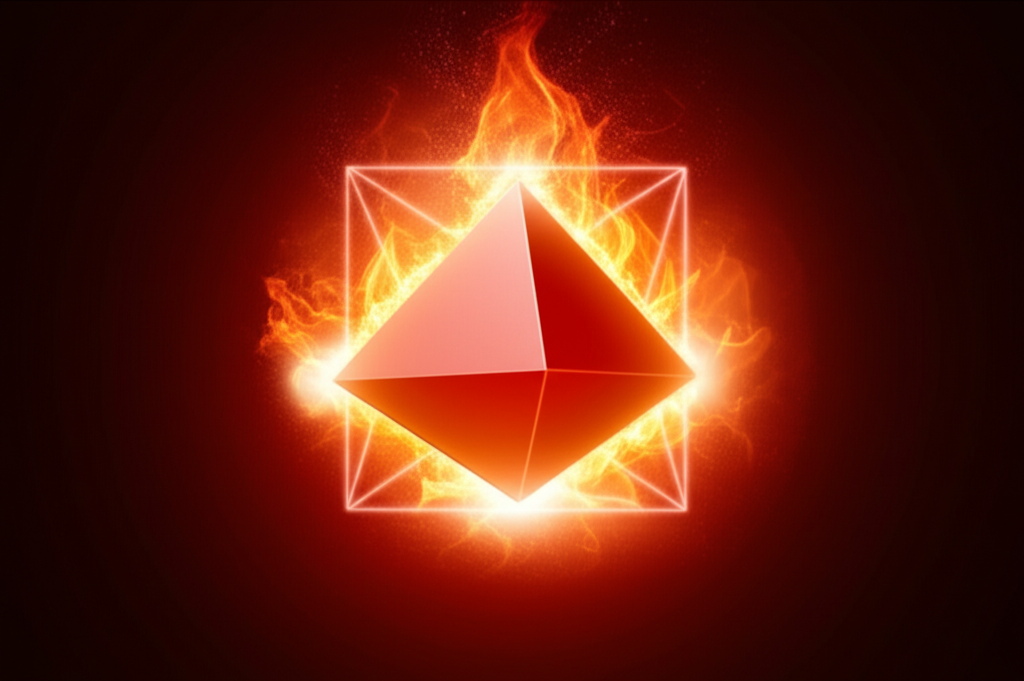
Plato, in his dialogue Timaeus, offered a more abstract and mathematical conception of the Elements. He posited that the four primary elements were composed of specific regular polyhedra (Platonic solids), which, in turn, were built from two types of elementary triangles.
- The Tetrahedron of Fire: Plato assigned the tetrahedron, the simplest of the regular solids, to fire. Its sharp, pointed vertices and small volume were seen as fitting properties for the Element that is most mobile, penetrating, and capable of cutting. This geometric approach attempted to derive the physical properties of fire from its fundamental structure, linking Physics to pure mathematics.
- The Visible World: For Plato, these elemental forms were the building blocks of the visible, material world, an imperfect reflection of the eternal Forms. Fire, as the tetrahedron, played its part in shaping the sensory experience of the cosmos.
Aristotle's Sublunary Fire and Natural Motion
Aristotle, in his comprehensive system of Physics and cosmology, also placed fire as a fundamental terrestrial Element. Unlike Plato's abstract geometry, Aristotle's elements possessed inherent qualities and natural motions.
- Qualities of Fire: Aristotle characterized fire as hot and dry, contrasting it with earth (cold and dry), water (cold and wet), and air (hot and wet). These qualities determined the interactions and transformations between the elements.
- Natural Motion: Crucially, Aristotle posited that each Element had a natural place in the cosmos and tended to move towards it. Fire's natural motion was upwards, towards the outermost sphere of the sublunary realm, below the celestial spheres. This explained why flames rise and why hot air ascends.
- Role in Change: Within the sublunary world, fire was an active agent of change and generation, contributing to the processes of heating, drying, and transformation. It was a vital component in the cycle of growth and decay observed in Nature.
The Enduring Legacy of Fire in Philosophical Thought
Beyond its literal interpretation as a physical Element, fire also served as a powerful metaphor in ancient Philosophy.
- Purification and Revelation: Fire symbolized purification, burning away impurities to reveal truth, much like the alchemical process. It was also associated with divine presence and revelation, illuminating knowledge and understanding.
- The Inner Fire: Some philosophical traditions spoke of an "inner fire" or vital heat, connecting fire to life force, passion, and the human spirit.
Table: Ancient Philosophers and Their Views on Fire
| Philosopher | Key Concept of Fire | Role in Cosmos/Nature | Related Works (Great Books) |
|---|---|---|---|
| Heraclitus | Arche, Ever-living Fire, Logos | Principle of ceaseless change and flux, universal exchange medium | Fragments (e.g., On Nature) |
| Empedocles | One of Four "Roots" | Constituent of all matter, interacts with Love and Strife | Fragments (e.g., On Nature) |
| Plato | Tetrahedron | Geometric building block of the visible world, sharp and mobile | Timaeus |
| Aristotle | Hot and Dry Element | Natural upward motion, agent of change in sublunary realm | Physics, On Generation and Corruption |
Conclusion: The Elemental Flame of Inquiry
The Element of fire, with its paradoxes of destruction and creation, its dynamic energy, and its profound impact on human experience, proved to be an indispensable concept for ancient philosophers. From Heraclitus's cosmic flux to Plato's geometric solids and Aristotle's terrestrial Physics, fire ignited countless inquiries into the fundamental Nature of reality. Its persistent presence in these diverse philosophical systems underscores its enduring power as a symbol of transformation, knowledge, and the very essence of existence, continuing to spark intellectual curiosity even today.
YouTube Suggestions:
-
📹 Related Video: What is Philosophy?
Video by: The School of Life
💡 Want different videos? Search YouTube for: "Heraclitus Fire Philosophy Explained"
-
📹 Related Video: PLATO ON: The Allegory of the Cave
Video by: The School of Life
💡 Want different videos? Search YouTube for: "Plato Timaeus Elements Explained Aristotle Physics Fire"