

The Fiery Core: Exploring the Element of Fire in Ancient Philosophy
Fire, that captivating dance of light and heat, held a primordial place in the minds of ancient philosophers. Far more than a mere physical phenomenon, it was a central element—a fundamental building block and an active principle—that illuminated their understanding of the cosmos, the nature of change, and the very fabric of existence. From the ever-fluxing physics of Heraclitus to Aristotle's terrestrial element, fire provided a potent lens through which the ancients sought to grasp the world. This article delves into the profound significance of fire, exploring its diverse interpretations within ancient philosophy, drawing insights from the enduring wisdom contained within the Great Books of the Western World.
Ignis Aeternus: Fire as the Primordial Principle
The fascination with fire stems from its unique characteristics: it consumes, transforms, gives light, and destroys. These dualities made it an ideal candidate for a foundational element in early cosmological theories.
Heraclitus: The Ever-Living Fire of Change
Perhaps no philosopher is more famously associated with fire than Heraclitus of Ephesus. For him, fire was not just one element among others, but the very logos of the universe—the underlying principle of order and change.
- Panta Rhei: Heraclitus famously asserted, "All things flow" or "Everything changes." Fire, with its ceaseless motion, its constant becoming and perishing, perfectly embodied this dynamic reality. It was the visible manifestation of flux, a perpetual struggle that maintained cosmic balance.
- The Cosmic Fire: Heraclitus envisioned a cosmic fire that periodically consumed and recreated the world, a process of "conflagration" and "re-ignition." This was not chaotic destruction but an ordered transformation, guided by an inherent law. His philosophy saw fire as both the raw material and the governing force, a master of physics for the entire nature of reality.
Fire Among the Four Roots: Empedocles' Synthesis
Later, Empedocles of Acragas introduced his theory of the Four Roots—Fire, Air, Water, and Earth—which would profoundly influence Western thought for centuries.
| Element | Characteristics | Role in Empedocles' Philosophy |
|---|---|---|
| Fire | Hot, Dry, Active | Principle of separation, light, and change |
| Air | Hot, Wet, Active | Principle of growth, breath |
| Water | Cold, Wet, Passive | Principle of cohesion, fluidity |
| Earth | Cold, Dry, Passive | Principle of solidity, stability |
For Empedocles, these four indestructible elements combined and separated under the influence of two cosmic forces: Love (attraction) and Strife (repulsion). Fire, being inherently active and transformative, played a crucial role in the processes of generation and decay, demonstrating its fundamental importance in the physics of the natural world.
Plato's Geometric Fire: The Timaeus and Elemental Forms
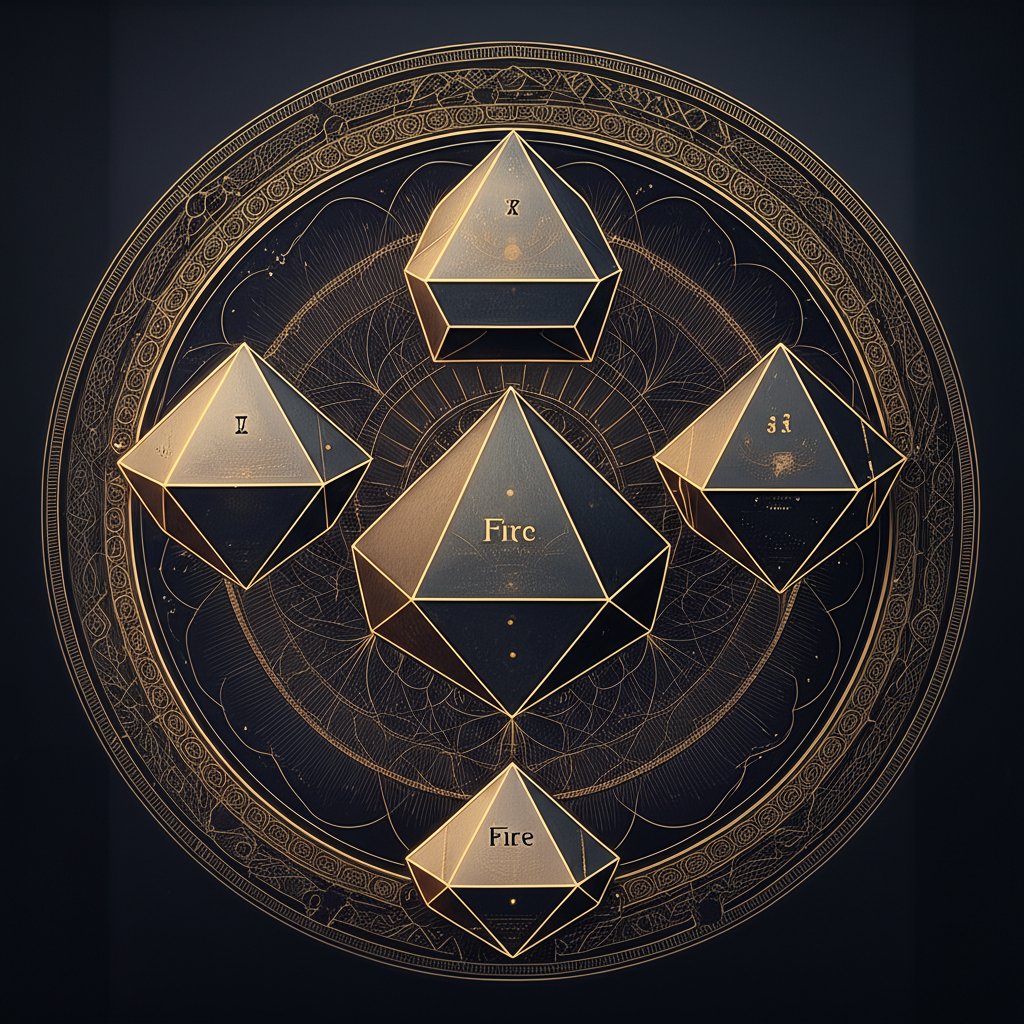
In Plato's cosmological dialogue, the Timaeus, the elements are given a sophisticated mathematical and geometric structure. Plato assigns specific regular polyhedra (Platonic Solids) to each element, linking their physical properties to their shapes.
- The Tetrahedron: Fire, the sharpest and most penetrating of the elements, is assigned the tetrahedron—the simplest regular solid with the fewest faces. This geometric configuration, with its acute angles, perfectly explains fire's ability to cut, to move swiftly, and to disintegrate other substances. This move elevated the discussion of nature's components from mere observation to a profound exercise in mathematical physics and philosophy.
Aristotle's Terrestrial Fire: Natural Motion and Cosmic Order
Aristotle, in his seminal works on physics and cosmology, refined the concept of the elements and their place in the universe. For him, the four terrestrial elements—Earth, Water, Air, and Fire—each possessed a natural place and a natural motion.
- Natural Motion: Fire, being light, naturally moves upwards, away from the center of the Earth (the natural place of Earth). This intrinsic tendency explained phenomena like flames rising. This aspect of his philosophy was a foundational principle of ancient physics, describing the inherent behaviors of substances in nature.
- Celestial vs. Terrestrial: Aristotle distinguished between the corruptible, changing terrestrial realm (composed of the four elements) and the incorruptible, unchanging celestial realm (composed of a fifth element, aether). Fire, despite its upward motion, remained firmly within the terrestrial sphere, signifying its role in the processes of change and decay observed on Earth.
The Stoics and the Cosmic Conflagration
The Stoics, a later school of philosophy, also placed fire at the heart of their cosmology and ethics. They conceived of fire not merely as a physical element but as an intelligent, active, and provident principle—the pneuma or "breath"—that pervaded and ordered the universe.
- Rational Fire: For the Stoics, the entire cosmos was a living, rational being, and its animating principle was a kind of rational fire. This divine fire was the source of all things, including the human soul.
- Ecpyrosis: Similar to Heraclitus, the Stoics believed in a periodic "cosmic conflagration" (ecpyrosis) where the universe would be consumed by fire and then reborn, a cycle of destruction and renewal. This cyclical view of nature underscored their belief in an ordered, rational universe governed by fate.
Conclusion: The Enduring Flame of Ancient Thought
From the primordial flux of Heraclitus to the geometric precision of Plato and the natural physics of Aristotle, fire was consistently more than just an element. It was a symbol of change, a principle of order, a building block of nature, and a profound subject of philosophy. The ancient world's engagement with fire reveals a deep quest to understand the fundamental forces that shape existence, a quest whose echoes still resonate in our modern scientific and philosophical inquiries. The Great Books of the Western World continue to offer a blazing testament to fire's enduring power as a concept, illuminating the intellectual landscape of antiquity.
YouTube Video Suggestions:
-
📹 Related Video: What is Philosophy?
Video by: The School of Life
💡 Want different videos? Search YouTube for: ""Heraclitus Fire Philosophy Explained""
2. ## 📹 Related Video: PLATO ON: The Allegory of the Cave
Video by: The School of Life
💡 Want different videos? Search YouTube for: ""Plato's Timaeus Elements Explained""