

The Cosmic Dice Roll: Unpacking Chance in Astronomy
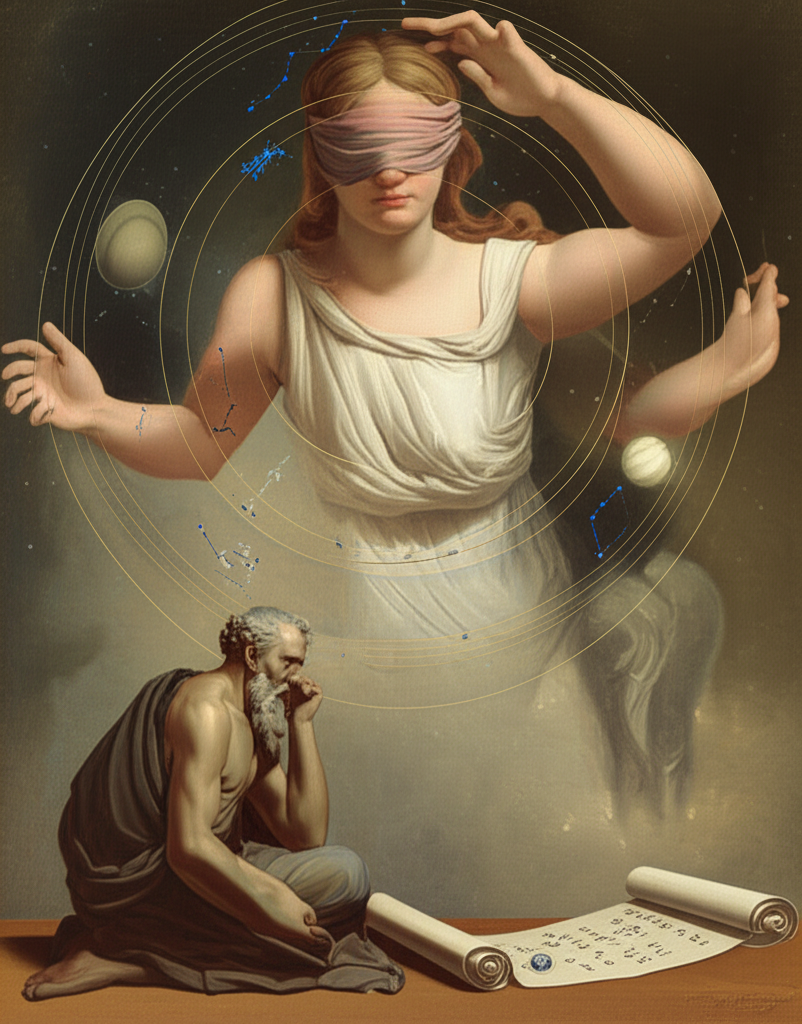
The universe, in its vast and awe-inspiring complexity, often appears to us as a grand, deterministic clockwork, governed by immutable laws of physics. Yet, beneath this veneer of cosmic order lies a profound and often unsettling element: chance. From the unpredictable dance of celestial bodies to the serendipitous formation of habitable worlds, the role of random events and contingent circumstances is not merely an observational curiosity but a fundamental philosophical challenge, forcing us to reconsider our understanding of causality, predictability, and our place within the cosmos. This article delves into how chance weaves its way through the fabric of Astronomy, challenging the neat equations of Physics and echoing ancient philosophical debates found within the Great Books of the Western World.
The Unpredictable Tapestry of the Cosmos
When we gaze upon the night sky, we are often struck by its apparent regularity – the predictable orbits of planets, the steady glow of stars. However, a deeper look reveals a universe teeming with events where the outcome could have been, and often was, profoundly different. This isn't just about our lack of knowledge; it speaks to an intrinsic unpredictability that shapes everything from galactic collisions to the emergence of life.
I. Stellar Birth, Life, and Catastrophe: Where Chance Intervenes
The life cycle of stars, while broadly understood through Physics, is not entirely immune to the caprices of chance.
- Initial Conditions: The precise distribution of gas and dust in a nebula, the slight gravitational perturbations from nearby stars, or even the shockwave from a distant supernova can dictate whether a pocket of matter collapses to form a star, and if so, what kind. These initial conditions, often chaotic and highly sensitive, set the stage.
- Supernovae: While we understand the physics leading to a supernova, the exact timing and direction of the explosive shockwave, or whether a star collapses into a neutron star or a black hole, can be influenced by subtle asymmetries and chaotic processes within the dying star's core. These events, though governed by laws, have an element of unpredictability in their precise manifestation.
- Binary and Multiple Star Systems: The gravitational dance in these systems is often complex and can lead to highly unstable orbits. The "chance" encounter with another star or a gas cloud can perturb these systems, leading to stellar ejections or even collisions, altering the evolutionary path of entire stellar families.
II. Planetary Formation: A Roll of the Cosmic Dice
The formation of planets, especially Earth-like worlds, appears to be a delicate balance of specific conditions, where chance plays a significant role.
- Accretion and Collisions: Planets grow from countless collisions of smaller particles. The exact sequence and angle of these impacts can have profound consequences. For instance, the prevailing theory for the Moon's formation involves a colossal, chance impact early in Earth's history – an event without which our world might be drastically different, or even uninhabitable.
- Orbital Migration: Giant planets like Jupiter are thought to have migrated significantly in the early solar system. This migration, driven by gravitational interactions with the protoplanetary disk, could have been influenced by subtle variations in the disk's density or other chance encounters, ultimately affecting the orbits and survival of inner planets.
- Habitable Zone Definition: While the concept of a "habitable zone" relies on stable stellar radiation, the actual presence of a planet within it, with the right mass, atmospheric composition, and geological activity, is a testament to a series of fortuitous events. The chance delivery of water by comets or asteroids, for example, is critical for life as we know it.
III. Galactic Evolution and Cosmic Collisions: Grand Scale Contingency
On the grandest scales, chance continues to shape the universe.
- Galaxy Mergers: Galaxies frequently collide and merge. While driven by gravity, the exact trajectories, impact parameters, and subsequent restructuring are highly complex and sensitive to initial conditions. Our own Milky Way is on a collision course with Andromeda, an event whose precise outcome is subject to intricate gravitational dynamics and, in a sense, cosmic chance.
- Gamma-Ray Bursts: These incredibly powerful explosions are thought to be caused by the collapse of massive stars or the merger of neutron stars. Their occurrence is sporadic and seemingly random in space and time, with their beams being highly directional. Whether a GRB's beam happens to sweep across our world is a matter of pure chance, with potentially devastating consequences.
Physics, Philosophy, and the Nature of Chance
The presence of chance in Astronomy compels us to confront its nature from a philosophical standpoint. Is it merely a reflection of our incomplete knowledge (epistemic uncertainty), or is it an intrinsic feature of reality (ontological chance)?
- Classical Physics and Determinism: Historically, Physics, particularly Newtonian mechanics, painted a picture of a deterministic universe where every event is the inevitable consequence of prior causes. As Laplace famously articulated, a sufficiently powerful intellect knowing all forces and positions could predict the future. In this view, chance is merely a symptom of ignorance.
- Quantum Mechanics and Inherent Randomness: The advent of quantum Physics introduced a radical shift. At the subatomic level, phenomena often appear truly random, with outcomes described by probabilities rather than certainties. While the direct application of quantum randomness to macroscopic astronomical events is complex, it opens the door to the idea that fundamental chance might indeed be woven into the fabric of the world.
- The Great Books Perspective: Ancient philosophers, long before modern Physics, grappled with tyche (chance or fortune) and ananke (necessity). Aristotle, for example, distinguished between events that happen "always or for the most part" and those that happen "by chance." Lucretius, in De Rerum Natura, introduced the concept of the "swerve" (clinamen) of atoms – a tiny, unpredictable deviation from their deterministic paths, necessary to explain free will and the formation of complex structures in a materialist world. This philosophical legacy reminds us that the tension between order and randomness is an enduring human inquiry.
Key Facets of Chance in Astronomy:
- Sensitivity to Initial Conditions: Small variations lead to vastly different outcomes (e.g., chaotic systems).
- Unpredictable External Perturbations: "Rogue" events from outside a system (e.g., a passing star).
- Quantum Indeterminacy: Fundamental randomness at the subatomic level, potentially influencing macro events.
- Probabilistic Outcomes: Events where multiple outcomes are possible, each with a calculable likelihood, but the actualization of one is not strictly determined.
Our Place in a Chancy Universe
Understanding the role of chance in Astronomy has profound implications for how we view existence. If our world, with all its unique properties conducive to life, is partly a product of cosmic chance, does it diminish its significance, or perhaps enhance it?
The "fine-tuning" argument suggests that the universe's fundamental constants and initial conditions are so precisely set for life that it implies design. However, the element of chance offers an alternative perspective: perhaps within an unimaginably vast multiverse, or simply through the sheer number of possibilities, our particular configuration arose by chance. This doesn't negate the wonder, but shifts its interpretation from preordained necessity to a remarkable, improbable occurrence.
Ultimately, the element of chance in Astronomy is not merely a scientific detail; it is a philosophical frontier. It challenges our desire for a fully predictable world, inviting us to embrace the contingency that underpins the magnificent cosmic drama unfolding around us. It forces us to confront the idea that while Physics provides the rules, chance often deals the cards, shaping the universe in ways both beautiful and terrifyingly unpredictable.
**## 📹 Related Video: What is Philosophy?
Video by: The School of Life
💡 Want different videos? Search YouTube for: "Philosophy of Chance and Determinism"**
**## 📹 Related Video: KANT ON: What is Enlightenment?
Video by: The School of Life
💡 Want different videos? Search YouTube for: "Cosmic Fine-Tuning Debate"**