

The Primal Element: Navigating Being and Non-Being
At the very bedrock of philosophical inquiry, particularly within the vast domain of Metaphysics, lies the profound and often perplexing Element of Being and Non-Being. This article explores how this fundamental Opposition has shaped Western thought, from the Presocratics to modern philosophy, revealing it not merely as an abstract dichotomy, but as the pulsating heart of reality and consciousness itself. We will trace its evolution, highlighting its critical role in understanding existence, change, and the very nature of what is and what is not.
The Genesis of an Opposition: Parmenides and Heraclitus
The earliest philosophical explorations into Being and Non-Being emerged from the ancient Greek world, establishing an Opposition that would echo through millennia.
-
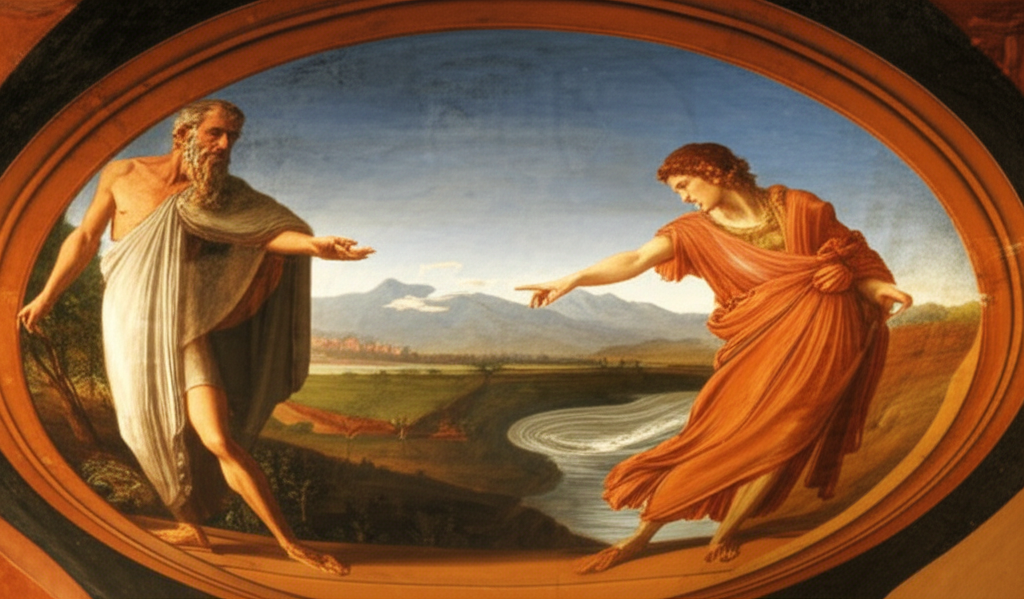
Parmenides of Elea posited that Being is, and Non-Being is not. For Parmenides, Being is eternal, unchangeable, indivisible, and complete. Any notion of change, movement, or multiplicity was deemed an illusion, a deception of the senses, because it would necessitate Non-Being – a logical impossibility. His powerful, albeit stark, assertion established Being as a singular, immutable Element of reality.
-
In stark contrast, Heraclitus of Ephesus declared that "everything flows" (panta rhei). For Heraclitus, change was the only constant, the fundamental Element of existence. He saw the world as a dynamic interplay of opposites, a perpetual flux where things are constantly becoming and ceasing to be. This perspective implicitly embraced a form of Non-Being – not as absolute nothingness, but as the process of perishing, of not-yet-being, or of no-longer-being, which is essential for the continuous creation and transformation of the cosmos.
The tension between these two titans – Parmenides' static Being and Heraclitus' dynamic Becoming – laid the groundwork for all subsequent philosophical attempts to reconcile the apparent stability of existence with the undeniable reality of change.
Plato's Synthesis: Forms, Participation, and Otherness
Plato, a student of Socrates, grappled intensely with this foundational Opposition. His theory of Forms can be seen as an attempt to bridge the chasm between Parmenides' eternal Being and Heraclitus' ceaseless change.
- The Forms: For Plato, true Being resides in the transcendent, immutable Forms (e.g., the Form of Beauty, the Form of Justice). These Forms are eternal, perfect, and unchanging, embodying the Parmenidean ideal of Being.
- The Sensible World: The world we perceive through our senses, however, is a realm of change, impermanence, and imperfection. Objects in this world participate in the Forms, but they are not the Forms themselves. They are a blend of Being and Non-Being, constantly coming into existence and passing away.
- Non-Being as Otherness: In his dialogue Sophist, Plato directly addresses the problem of Non-Being. He argues against the Parmenidean absolute denial of Non-Being, suggesting that Non-Being isn't utter nothingness but rather "otherness" or "difference." When we say something is not X, we mean it is different from X. This nuanced understanding allows for predication, distinction, and the very possibility of knowledge itself, without collapsing into a void of non-existence. This was a critical step in making Non-Being intelligible as a concept, not just an absence.
Aristotle's Act and Potency: The Dynamic Element
Aristotle, Plato's most famous student, offered a different, more immanent solution to the problem of Being and Non-Being, particularly focusing on the Element of change.
- Potency (Dynamis) and Act (Energeia): Aristotle introduced the concepts of potency and act to explain how things change without violating the principle that something cannot come from absolute nothingness.
- Potency represents the capacity or potential for something to be. For example, an acorn has the potency to become an oak tree. This isn't absolute Non-Being, but rather a specific kind of not-yet-Being.
- Act is the actualization of that potential, the state of something being fully what it can be. The oak tree is the acorn in act.
- Matter and Form: Similarly, matter is the potential, the substratum that can take on different forms, while form is the actualization, the specific organization that gives something its identity. Through these concepts, Aristotle integrated change into the very structure of Being, making Non-Being (as potency) an essential, dynamic Element within the process of actualization.
The Dialectical Opposition: Hegel's Becoming
Centuries later, Georg Wilhelm Friedrich Hegel provided one of the most radical and influential interpretations of the Opposition between Being and Non-Being. For Hegel, this Opposition is not a static problem to be solved, but a dynamic, dialectical process that drives thought and reality.
- Being and Nothing: In his Science of Logic, Hegel begins with the purest, most abstract concept: Being. But pure Being, stripped of all determination, is indistinguishable from pure Nothing (Non-Being).
- Becoming: This immediate identity and difference between Being and Nothing gives rise to a third concept: Becoming. Becoming is the truth of both Being and Nothing, their restless unity. It is the continuous process of coming-to-be and ceasing-to-be, the very movement of thought and reality itself. For Hegel, this dialectical interplay is the fundamental Element of existence, a constant unfolding and self-realization.
Modern Echoes: Existentialism and the Void
In the 20th century, existentialist philosophers like Martin Heidegger and Jean-Paul Sartre revisited the Element of Non-Being with a focus on human existence.
- Heidegger's Dasein and Nothingness: Heidegger argued that the question of Being could only be understood through Dasein (human existence), which is characterized by its finitude and its encounter with Nothingness. The experience of dread (Angst) reveals Nothingness, not as a mere absence, but as an active presence that defines the boundaries and possibilities of Being.
- Sartre's Non-Being and Freedom: Sartre famously declared that "man is a useless passion" and that consciousness is "a being for itself" (pour-soi) which is characterized by its capacity to negate. Consciousness is not a thing; it is the Element of Non-Being that introduces freedom and possibility into the world. Our freedom stems from our capacity to say "no," to transcend our present state, to project ourselves into the future – all acts of negation, of introducing Non-Being into the fabric of Being.
Conclusion: The Enduring Element of Inquiry
The Element of Being and Non-Being remains a cornerstone of Metaphysics and philosophical inquiry. From the ancient Greeks grappling with the fundamental nature of reality to modern thinkers exploring the depths of human existence, the Opposition between what is and what is not has proven to be an inexhaustible source of profound questions. It forces us to confront the nature of existence, change, identity, and even our own freedom. Understanding this dynamic interplay is not merely an academic exercise; it is an essential step toward comprehending the very fabric of our reality and our place within it.
📹 Related Video: KANT ON: What is Enlightenment?
Video by: The School of Life
💡 Want different videos? Search YouTube for: ""Parmenides vs Heraclitus: The Battle for Reality" and "Hegel's Dialectic: Being, Nothing, Becoming Explained""