

The Unseen Hand: How Emotion Shapes Judgment
Summary: The intricate dance between emotion and judgment has captivated philosophers for millennia. Far from being mere background noise, our feelings exert a powerful, often subconscious, influence on how we perceive the world, interpret information, and ultimately make decisions. This article delves into the rich philosophical tradition, from ancient Greece to the Enlightenment, to explore how the mind of man grapples with the pervasive effects of emotion on sound judgment, revealing that true wisdom often lies in understanding, rather than merely suppressing, the heart's compelling voice.
The Perennial Philosophical Question: Reason vs. Passion
From the earliest inquiries into the human condition, philosophers have wrestled with the tension between our rational faculties and our emotional impulses. Is emotion a reliable guide, a source of profound insight, or a dangerous impediment to clear judgment? The Great Books of the Western World offer a diverse tapestry of perspectives, each seeking to define the proper relationship between these fundamental aspects of the mind of man.
Ancient Insights: The Charioteer and the Virtuous Soul
Plato, in his Phaedrus, famously depicts the soul as a charioteer (reason) guiding two winged horses: one noble and spirited (thumos, positive emotions like courage), and the other unruly and appetitive (epithumia, desires and base passions). For Plato, true wisdom and just judgment require the charioteer to maintain firm control over the horses, ensuring that reason dictates the path, rather than being swayed by the chaotic impulses of emotion. Unchecked emotion, he argues, leads to folly and injustice.
Aristotle, while acknowledging the potential for emotion to cloud judgment, offered a more nuanced view in his Nicomachean Ethics. He understood that emotions are not inherently bad; rather, they are integral to the human experience. The virtuous man is not one devoid of emotion, but one whose emotions are appropriate, felt at the right time, towards the right objects, for the right reason, and in the right manner. Judgment, therefore, involves training our emotions to align with reason, achieving a state of phronesis, or practical wisdom.
The Stoic Pursuit of Apatheia
For the Stoics, the ideal state of the mind was apatheia – not apathy in the modern sense, but freedom from disruptive passions (pathos). They believed that intense emotion, particularly those arising from external events beyond our control, fundamentally corrupts rational judgment. The wise man, through rigorous self-discipline and logical reasoning, learns to distinguish between what he can control (his thoughts and reactions) and what he cannot (external circumstances), thus preventing emotion from dictating his actions or clouding his judgment.
The Modern Mind: Passions, Understanding, and Moral Law
The Enlightenment brought new perspectives, as philosophers grappled with the mechanisms by which emotion influences the mind and judgment.
Descartes and the Passions of the Soul
René Descartes, in The Passions of the Soul, viewed emotions as "perceptions, feelings, or commotions of the soul which are referred specially to the soul itself, and are caused, maintained, and strengthened by some movement of the spirits." While acknowledging their physiological basis, Descartes believed that reason could, and should, control these passions. Sound judgment for man required the mind to exert its will over the body's emotional responses.
Spinoza's Path to Freedom
Baruch Spinoza, in his Ethics, offered a profound and intricate system where emotions (affects) are understood as modifications of the body and mind, driven by our striving for self-preservation (conatus). He distinguished between passive affects (where we are acted upon by external causes) and active affects (arising from our own understanding). For Spinoza, true freedom and clarity of judgment come from understanding the causes of our emotions through reason. By transforming passive affects into active ones, man can gain control over his emotional life and make more rational judgments.
Hume's Radical Reversal
David Hume famously challenged the primacy of reason, asserting in A Treatise of Human Nature: "Reason is, and ought only to be the slave of the passions, and can never pretend to any other office than to serve and obey them." For Hume, emotion (or sentiment) is the ultimate motivator of human action and moral judgment. Reason's role is merely to discover the most effective means to achieve the ends dictated by our passions. This perspective radically shifts the traditional understanding, suggesting that judgment is intrinsically tied to, and perhaps even derived from, our emotional responses.
Kant and the Categorical Imperative
Immanuel Kant, in stark contrast to Hume, emphasized the supremacy of pure practical reason in moral judgment. For Kant, moral actions must be performed out of duty, in accordance with the categorical imperative, rather than inclination or emotion. While emotions like sympathy might prompt good deeds, they do not, in themselves, confer moral worth. True moral judgment for man must be unclouded by subjective feelings, relying instead on universalizable principles of reason.
The Mechanisms of Emotional Influence on Judgment
How precisely does emotion impact our judgment? The mind is a complex arena where these forces constantly interact.
- Cognitive Bias: Emotions can introduce biases, leading us to selectively interpret information that confirms our existing feelings or beliefs. Fear, for instance, might amplify perceived threats, while desire might downplay risks.
- Narrowed Focus: Intense emotions can narrow our attention, making us overlook crucial details or alternative perspectives. An angry man might focus solely on the perceived slight, missing the broader context.
- Impulsivity: Strong emotions often lead to hasty decisions, bypassing careful deliberation. This can be seen in moments of anger, fear, or overwhelming desire, where immediate gratification or reaction supersedes long-term consequences.
- Altered Risk Perception: Emotions can significantly alter how we perceive risk. Optimism might lead to underestimating dangers, while anxiety might exaggerate them.
Table: Philosophical Views on Emotion and Judgment
| Philosopher | Primary Stance on Emotion's Effect on Judgment | Key Concept/Work |
|---|---|---|
| Plato | Emotion (especially base passions) hinders rational judgment; must be controlled. | Charioteer Analogy (Phaedrus) |
| Aristotle | Emotions are integral; virtuous judgment requires emotions to be appropriate/trained. | Practical Wisdom (Nicomachean Ethics) |
| Stoics | Emotions (passions) disturb the mind; freedom from them (apatheia) is ideal. | Apatheia |
| Descartes | Emotions are bodily commotions; reason must exert control for sound judgment. | The Passions of the Soul |
| Spinoza | Emotions (affects) can be understood and transformed by reason for freedom. | Passive vs. Active Affects (Ethics) |
| Hume | Reason is "slave of the passions"; emotions are primary motivators for judgment. | A Treatise of Human Nature |
| Kant | Moral judgment must be based on pure reason and duty, unclouded by emotion. | Categorical Imperative (Groundwork of the Metaphysics of Morals) |
Cultivating Balanced Judgment: A Path for Man
Given the profound and undeniable influence of emotion on judgment, the question for man becomes: how can we navigate this complex landscape to achieve greater wisdom and make more sound decisions?
- Self-Awareness: The first step is to recognize and acknowledge our own emotional states. Understanding why we feel a certain way can help us discern if our emotions are legitimate responses or potential biases.
- Reflective Pause: Before making significant judgments, particularly when emotions run high, a conscious pause for reflection can create space for reason to re-engage.
- Empathy and Perspective-Taking: Understanding the emotional states of others can broaden our own perspective and lead to more compassionate and balanced judgment.
- Cultivation of Virtues: As Aristotle suggested, developing virtues like courage, temperance, and justice helps align our emotions with reason, allowing them to support, rather than undermine, good judgment.
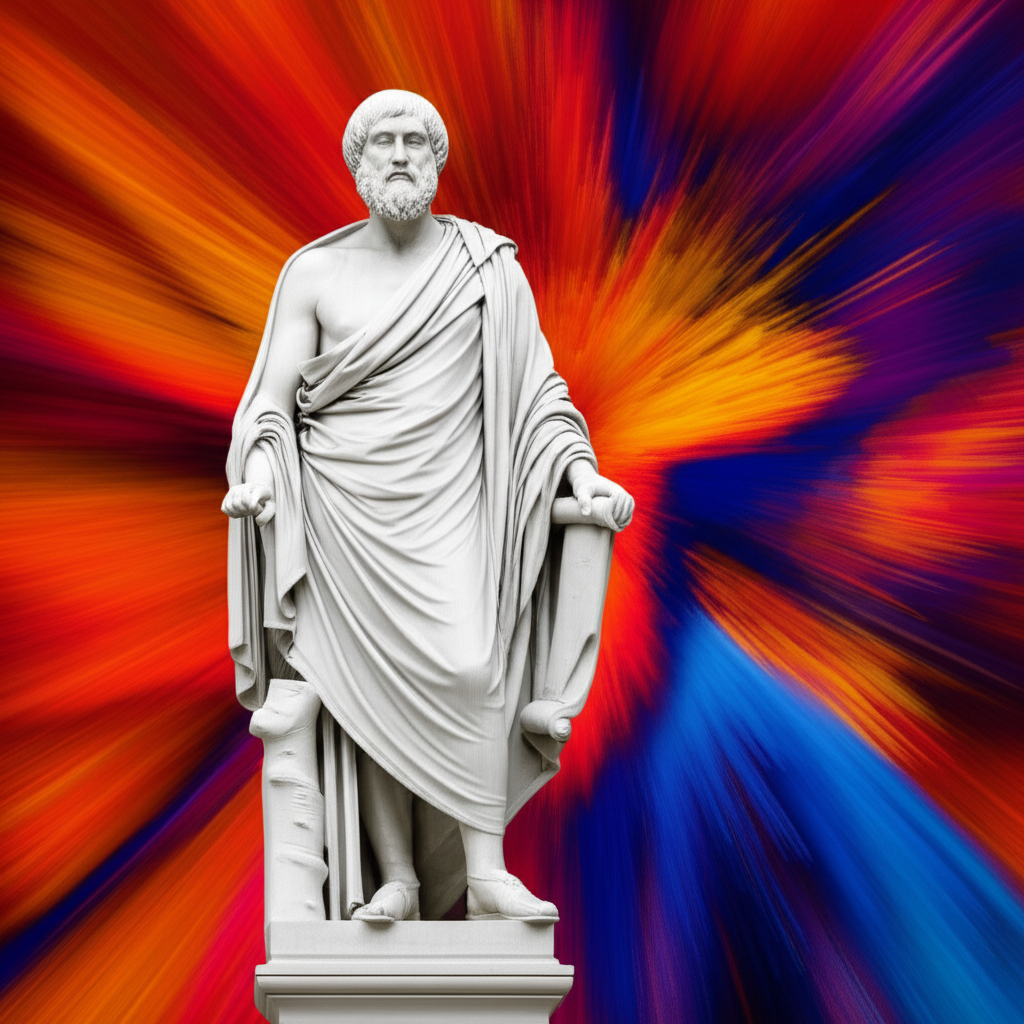 appears to be pushing against the serene figure, yet not quite overwhelming it. The contrast highlights the struggle and balance between logic and feeling.)
Conclusion: The Enduring Quest for Wisdom
The philosophical journey through the Great Books of the Western World reveals that the effect of emotion on judgment is not a simple equation. It is a dynamic interplay, a constant negotiation within the mind of man. While emotions can undoubtedly distort our perceptions and lead us astray, they are also an indispensable part of what it means to be human, providing motivation, insight, and depth to our experience. The enduring quest for wisdom lies not in eradicating emotion, but in understanding its power, integrating it thoughtfully with reason, and thereby cultivating a more profound and balanced capacity for judgment.
YouTube Video Suggestions:
-
📹 Related Video: PLATO ON: The Allegory of the Cave
Video by: The School of Life
💡 Want different videos? Search YouTube for: "Plato Charioteer Allegory explained"
2. ## 📹 Related Video: KANT ON: What is Enlightenment?
Video by: The School of Life
💡 Want different videos? Search YouTube for: "Hume Reason Slave of Passions explained"