

The Enduring Dance: Change and Opposition as Nature's Core Logic
The universe, in its boundless complexity, often presents itself as a tapestry of stable forms and predictable cycles. Yet, beneath this perceived constancy lies a restless, ceaseless motion—a fundamental truth articulated by philosophers millennia ago. This article explores how change and opposition are not mere incidental features of nature, but rather its very essence, driving its evolution from the smallest atomic interactions to the grandest cosmic phenomena. We will delve into how these ancient philosophical insights, rooted in the Great Books of the Western World, find echoes in modern physics, revealing a profound and unifying principle of existence.
The Ever-Flowing River: Heraclitus on Flux and Strife
One cannot embark on a discussion of change without invoking the enigmatic figure of Heraclitus of Ephesus. His famous dictum, "You cannot step twice into the same river; for other waters are ever flowing on to you," encapsulates the pervasive nature of flux. For Heraclitus, reality was not static being but dynamic becoming. This constant motion was not chaotic but governed by a Logos—an underlying principle of order that manifested through the tension of opposites.
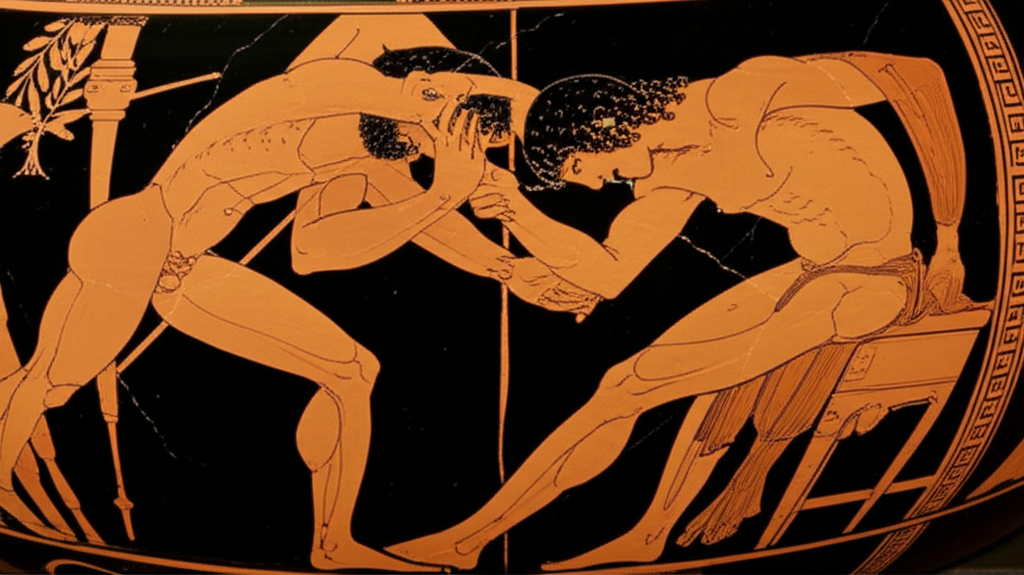
Heraclitus famously declared, "War is the father of all and king of all; some he has shown forth as gods and others as men, some he has made slaves and others free." This seemingly bellicose statement points to the creative power of opposition. It is through the struggle of contraries—hot and cold, day and night, life and death—that the world is sustained and given its particular character. Without this inherent tension, there would be no movement, no differentiation, and ultimately, no existence as we know it. The very fabric of nature is woven from these opposing forces.
Aristotle's Framework: Potency, Act, and the Role of Contraries
Building upon earlier Presocratic thought, Aristotle, in his Physics and Metaphysics, provided a more systematic account of change. For Aristotle, change (or kinesis) was the actualization of what is potential, the movement from potency to actuality. A seed has the potency to become a tree, and through a series of changes, it actualizes that potential.
Crucially, Aristotle also recognized the vital role of opposition in this process. Change often involves a transition between contraries. Something hot becomes cold, something wet becomes dry, something healthy becomes sick. The subject of change (e.g., the water that cools) persists, but its accidental qualities transform through the influence of an agent that possesses the opposing quality.
- Key Aristotelian Concepts in Understanding Change:
- Substance: The underlying thing that persists through change.
- Privation: The absence of a form that a substance might acquire (e.g., a cold object is "deprived" of heat).
- Form: The quality or characteristic that is acquired (e.g., heat).
- Contraries: Opposing qualities (e.g., hot/cold, light/dark) that often define the start and end points of a change.
This framework allowed for a sophisticated understanding of how things come to be, pass away, and transform, highlighting that change is not random, but follows intelligible patterns within nature.
The Dialectic of Nature: Opposition as a Creative Force
Beyond the specific philosophical systems, the principle of opposition as a driver of change resonates throughout nature. It's a fundamental dialectic where tension begets transformation. Consider:
- Geological Processes: The opposing forces of erosion (wearing down) and deposition (building up) sculpt landscapes. Tectonic plates move due to opposing pressures, leading to earthquakes, volcanic activity, and mountain formation.
- Biological Evolution: The constant struggle for existence, the interplay between predator and prey, competition for resources—these are all forms of opposition that drive adaptation and speciation. Life itself thrives on the dynamic balance of anabolic (building up) and catabolic (breaking down) processes.
- Celestial Mechanics: The gravitational pull (attraction) countered by centrifugal force (repulsion) keeps planets in orbit around stars, and stars within galaxies. Without this delicate balance of opposing forces, cosmic structures would either collapse or fly apart.
This isn't just about static balance, but an active equilibrium where opposing forces are constantly interacting, leading to dynamic stability and continuous change.
From Philosophical Inquiry to Modern Physics: Quantifying Change and Opposition
The ancient philosophical intuitions about change and opposition find remarkable parallels in modern physics. While the language has shifted from metaphysical terms to mathematical equations, the underlying principles remain strikingly similar.
- Newton's Laws of Motion: Isaac Newton's third law states, "For every action, there is an equal and opposite reaction." This is a direct articulation of opposition at the mechanical level. Forces never exist in isolation; they always come in pairs, pushing and pulling against each other, driving all physical change and motion.
- Electromagnetism: Electric and magnetic fields are intrinsically linked, manifesting as opposing polarities (positive/negative, north/south). Their dynamic interplay generates electromagnetic waves, the very medium of light and energy transfer.
- Thermodynamics: The second law of thermodynamics, which describes the increase of entropy (disorder) in a closed system, highlights a fundamental directionality of change. This movement towards disorder is often countered by local processes that create order, showing a constant battle between opposing tendencies within nature.
- Quantum Mechanics: At the subatomic level, particles exhibit wave-particle duality, a profound opposition that challenges classical intuition. The very act of observation can influence the state of a quantum system, underscoring the dynamic and interactive nature of reality.
Modern physics provides the quantitative tools to describe how these changes and oppositions occur, offering a scientific validation of the deep philosophical insights into the fundamental workings of nature.
Conclusion: The Unifying Principle
From the ancient Greek contemplation of the ever-flowing river to the complex equations of quantum field theory, the concepts of change and opposition remain central to our understanding of the cosmos. They are not merely descriptive terms but active, constitutive principles that govern the very fabric of existence. Nature is not a static tableau but an unfolding drama, perpetually shaped by the dynamic tension between forces, forms, and states. To grasp this inherent dialectic is to move closer to comprehending the profound and beautiful logic that orchestrates all that is.
📹 Related Video: What is Philosophy?
Video by: The School of Life
💡 Want different videos? Search YouTube for: ""Heraclitus philosophy of change and flux""
📹 Related Video: ARISTOTLE ON: The Nicomachean Ethics
Video by: The School of Life
💡 Want different videos? Search YouTube for: ""Aristotle on motion and the four causes""