

The Indispensable Distinction: Opinion and Truth
The landscape of human thought is often a bewildering terrain, where personal beliefs, unsubstantiated claims, and rigorously verified facts intermingle. To navigate this complexity effectively, a fundamental philosophical tool is required: the clear distinction between opinion and truth. This article explores why differentiating between what we merely believe and what can be demonstrably known is not just an academic exercise, but a cornerstone of intellectual integrity, critical thinking, and the pursuit of genuine knowledge. Drawing upon the insights of the Great Books of the Western World, we will illuminate the defining characteristics of each, highlighting their distinct origins, justifications, and implications for our understanding of reality.
Navigating the Labyrinth of Belief: Why the Distinction Matters
In an age saturated with information and diverse perspectives, the ability to discern mere assertion from verifiable fact has never been more critical. Without a firm grasp of the difference, we risk mistaking personal preference for universal principle, or subjective feeling for objective reality. This intellectual blurring can lead to a fragmented understanding of the world, hindering progress in science, ethics, and social discourse. Philosophers throughout history, from Plato to Kant, have grappled with this very challenge, seeking to establish a rigorous framework for what constitutes genuine understanding.
The Elusive Nature of Opinion
An opinion can be understood as a belief or judgment that rests on grounds insufficient to produce complete certainty. It is often subjective, reflecting personal perspectives, feelings, cultural biases, or interpretations of limited evidence.
- Subjectivity: Opinions are inherently personal. What one individual considers a good piece of art, a just policy, or an effective strategy is often rooted in their unique experiences and values.
- Lack of Universal Agreement: While opinions can be widely shared, they do not demand universal assent. There can be multiple, equally valid (from a subjective standpoint) opinions on a given matter.
- Varying Degrees of Justification: An opinion might be held passionately, but its justification can range from mere intuition to a reasoned interpretation of incomplete data. However, it typically lacks the conclusive evidence or logical necessity required for truth.
- Changeability: Opinions are often fluid. As new information emerges, or as personal perspectives evolve, opinions can change.
Consider the statement, "Vanilla ice cream is the best flavor." This is a quintessential opinion. It's a personal preference, not a claim that can be objectively proven or disproven. It reflects taste, not an inherent quality of vanilla itself that demands universal agreement.
The Enduring Quest for Truth
Truth, in contrast, refers to a statement or proposition that corresponds to reality, is objectively verifiable, or is logically necessary. It aims for universality and independence from individual perspectives.
- Objectivity: Truth exists independently of individual minds. Its validity does not rely on whether someone believes it or not.
- Universal Validity: A truth, once established, is universally applicable. If "2 + 2 = 4" is true, it is true for everyone, everywhere.
- Evidence and Justification: Truth is typically supported by compelling evidence, logical coherence, or empirical verification. Its justification is robust and publicly accessible.
- Immutability (in many contexts): While our understanding of truth can evolve, fundamental truths (e.g., mathematical axioms, laws of physics) are often considered immutable within their given frameworks.
The statement, "The Earth revolves around the Sun," is a truth (within our current scientific understanding). It is supported by overwhelming empirical evidence, mathematical models, and astronomical observations, making it objectively verifiable and universally accepted by those who examine the evidence.
Opinion vs. Truth: A Fundamental Distinction
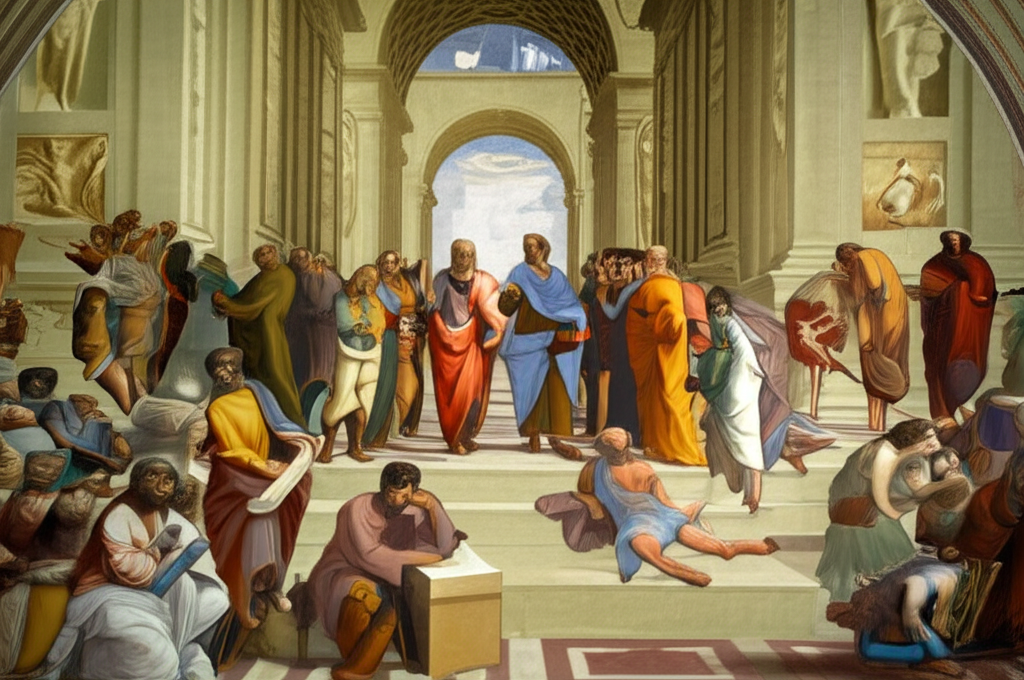
The profound difference between opinion and truth is a recurring theme in the Great Books. Plato, through Socrates, famously distinguishes between the shifting shadows of the cave (opinions, appearances) and the illuminated objects outside (Forms, Truth, Knowledge). Aristotle, too, differentiated between doxa (opinion) and episteme (scientific knowledge or understanding of necessary truths).
| Feature | Opinion | Truth |
|---|---|---|
| Nature | Subjective, personal belief | Objective, verifiable reality |
| Basis | Feelings, interpretations, limited evidence | Evidence, logic, empirical verification |
| Validity | Relative, personal | Universal, independent of belief |
| Justification | Often weak or unstated | Strong, demonstrable, publicly accessible |
| Goal | Expressing preference or belief | Describing reality accurately |
| Relationship to Knowledge | Can be a starting point, but not knowledge itself | A prerequisite for genuine knowledge and understanding |
The Perils of Conflation
Failing to uphold this distinction carries significant risks. When opinions are elevated to the status of truth without sufficient evidence, we enter the realm of misinformation, propaganda, and intellectual relativism. This erodes the very foundations of reasoned discourse and collective progress. If all statements are merely "my truth" versus "your truth," then any basis for shared understanding, scientific inquiry, or ethical consensus dissolves. The pursuit of knowledge becomes impossible if we cannot agree on what constitutes a verifiable fact.
Cultivating a Discerning Mind
Developing the ability to differentiate between opinion and truth is central to critical thinking. It requires a commitment to intellectual rigor and an openness to questioning one's own beliefs.
- Demand Evidence: Before accepting a claim as true, ask: What evidence supports this? Is the evidence reliable and sufficient?
- Examine Justification: Understand why a statement is being made. Is it based on personal feeling, expert consensus, scientific data, or logical deduction?
- Consider Objectivity: Can this statement be independently verified by others? Would a reasonable, unbiased observer come to the same conclusion?
- Embrace Nuance: Recognize that some areas, particularly in ethics or aesthetics, may involve a blend of objective principles and subjective interpretation. The goal is not to eliminate opinion, but to understand its proper place.
The Socratic method, as depicted in Plato's dialogues, is a powerful example of this pursuit. Through relentless questioning, Socrates sought to expose the flimsy foundations of mere opinion, guiding his interlocutors towards a more rigorous understanding and the pursuit of genuine knowledge.
Conclusion: The Cornerstone of Intellectual Integrity
The distinction between opinion and truth is not merely a philosophical nicety; it is the bedrock upon which genuine knowledge is built. To conflate the two is to abandon the pursuit of understanding, to invite intellectual chaos, and to undermine the very possibility of rational discourse. As Benjamin Richmond, I urge you to cultivate this crucial discernment. By rigorously questioning, seeking evidence, and understanding the differing natures of belief and reality, we empower ourselves to navigate the complexities of the world with greater clarity, purpose, and intellectual honesty.
YouTube Video Suggestions:
-
📹 Related Video: PLATO ON: The Allegory of the Cave
Video by: The School of Life
💡 Want different videos? Search YouTube for: "Plato's Allegory of the Cave explained"
-
📹 Related Video: What is Philosophy?
Video by: The School of Life
💡 Want different videos? Search YouTube for: "Epistemology introduction truth knowledge belief"