

The Distinction Between Opinion and Sense: Navigating the Labyrinth of Belief and Perception
In the grand tapestry of philosophical inquiry, few distinctions are as foundational and enduring as that between opinion and sense. This article seeks to illuminate this crucial difference, exploring how each functions in our understanding of the world, and how both relate to the ultimate pursuit of knowledge. While sense provides the raw, immediate data of experience, opinion represents our subjective interpretations and beliefs about that data. Understanding this distinction is not merely an academic exercise; it is a vital tool for critical thinking, allowing us to discern the ephemeral from the immediate, and to build a firmer foundation for genuine understanding.
I. The Immediate Grasp of Sense: Raw Data and the World's Touch
Let us first turn our attention to Sense. In philosophical terms, "sense" (often related to the Greek aisthesis) refers to the immediate apprehension of the world through our sensory organs. It is the raw, unmediated data received from our sight, hearing, touch, taste, and smell.
Characteristics of Sensory Experience:
- Direct and Immediate: Sense perception is our primary, unadulterated encounter with phenomena. A direct experience of warmth, the visual perception of a red apple, the sound of a bell—these are instances of sense.
- Foundational: For many empiricist traditions, sense experience is the bedrock of all our ideas and understanding. Thinkers like John Locke, whose ideas resonate throughout the Great Books of the Western World, posited that the mind is a tabula rasa (blank slate) upon which sensory experiences write.
- Particular and Concrete: Sense deals with specific instances: this particular apple, that specific sound. It does not inherently provide universal truths or abstract concepts.
- Passive Reception: In its purest form, sense is often considered a passive reception of external stimuli, rather than an active judgment or interpretation.
While sense provides invaluable data, it is not without its limitations. Our senses can be deceived (e.g., optical illusions), and they only ever provide information about the phenomenal world, not necessarily its underlying essence or universal principles.
II. The Realm of Opinion: Subjectivity, Interpretation, and Belief
In contrast to the immediacy of sense, Opinion (from the Greek doxa) resides in the domain of judgment, belief, and interpretation. An opinion is a view or judgment formed about something, not necessarily based on fact or knowledge. It is a subjective assertion, a personal take on reality that may or may not withstand rigorous scrutiny.
Defining Features of Opinion:
- Subjective and Personal: Opinions are inherently tied to the individual forming them. My opinion on a piece of art may differ wildly from yours.
- Changeable and Transient: Opinions are often susceptible to change, influenced by new information, persuasion, or shifts in perspective. What one believes today, one might disavow tomorrow.
- Lacks Certainty and Justification: Unlike true knowledge, opinion often lacks the rigorous justification, logical coherence, or empirical verification required for universal acceptance. It is a belief, but not necessarily a warranted belief.
- Prone to Error: Because opinions are not necessarily grounded in certainty, they carry a significant risk of being incorrect or flawed.
- Influenced by Rhetoric and Persuasion: Opinions are often shaped by social pressures, emotional appeals, and the art of persuasion, rather than purely rational deliberation. Plato, a towering figure in the Great Books, famously critiqued the sophists for their ability to sway public opinion without regard for truth.
Opinion, while a natural and often necessary part of human interaction, occupies a lower rung on the ladder of understanding than knowledge. It represents a belief about something, rather than a direct apprehension of its truth.
III. The Crucial Distinction: Where They Diverge and Converge
The distinction between opinion and sense becomes clearer when we consider their respective roles and limitations. Sense provides the raw material; opinion processes, interprets, and makes judgments about that material.
Consider the act of observing a distant object. Your eyes (sense) report a small, indistinct shape. Your mind then forms an opinion: "That's probably a bird," or "It looks like a distant tree." The sensory input is factual (a small, indistinct shape); the opinion is an interpretation, a hypothesis that could be wrong.
A Comparative Overview: Opinion, Sense, and Knowledge
| Feature | Sense (Aisthesis) | Opinion (Doxa) | Knowledge (Episteme) |
|---|---|---|---|
| Nature | Immediate, raw perception | Subjective belief, judgment, interpretation | Justified, true belief; understanding of causes |
| Source | Sensory organs, direct experience | Mind's interpretation, belief, often unverified | Reason, evidence, logic, understanding, verification |
| Certainty | High for immediate experience, but limited scope | Low, prone to error, changeable | High, aims for universality and necessity |
| Scope | Particulars, specifics, phenomenal world | Generalizations, evaluations, personal views | Universals, principles, causes, objective reality |
| Relation to Truth | Provides data that can lead to truth | May or may not align with truth, often accidental | Necessarily aims at and is grounded in truth |
| Example | Seeing a red object | Believing "that red object is beautiful" | Understanding the physics of light that makes the object appear red |
IV. Beyond Opinion and Sense: Towards Knowledge
Neither raw sense data nor mere opinion, on their own, constitutes true Knowledge. Knowledge, as understood by many philosophers from Plato and Aristotle to modern epistemologists featured in the Great Books, demands more. It requires:
- Truth: What is known must actually be true.
- Belief: One must believe that which is true.
- Justification: Crucially, that true belief must be adequately justified, supported by reason, evidence, or sound argumentation.
To move from the shadows of opinion, as Plato famously depicted in his Allegory of the Cave, or from the fleeting impressions of sense, requires the arduous work of reason. It involves critical examination, logical inference, testing hypotheses, and seeking out the underlying causes and principles that govern phenomena. Aristotle, another titan of the Great Books, emphasized the importance of understanding why things are the way they are, not just what they are. This pursuit elevates us beyond mere belief to genuine understanding.
V. Why This Distinction Matters: A Foundation for Truth and Understanding
The ability to distinguish between opinion and sense is paramount for several reasons:
- Critical Thinking: It enables us to critically evaluate information, question assumptions, and avoid being swayed by rhetoric or superficial appearances.
- Avoiding Dogmatism: By recognizing the subjective nature of opinion, we foster intellectual humility and an openness to revising our beliefs in light of new evidence.
- Informed Decision-Making: In both personal and public life, basing decisions on justified knowledge rather than mere opinion leads to more robust and effective outcomes.
- The Pursuit of Truth: Ultimately, this distinction is a fundamental step in the philosophical quest for truth, urging us to move beyond the immediate and the subjective towards a more profound and reliable grasp of reality.
Conclusion: The Architectonics of Understanding
The distinction between opinion and sense is a cornerstone of philosophical inquiry, a conceptual tool bequeathed to us by centuries of rigorous thought, largely documented within the Great Books of the Western World. Sense provides the vivid, immediate brushstrokes of experience, while opinion offers our initial, often unrefined, interpretations. Yet, true knowledge demands more: a disciplined application of reason to scrutinize both the raw data of sense and the subjective claims of opinion, forging a path towards justified, objective understanding. To grasp this distinction is to begin building the architectonics of a truly informed mind.
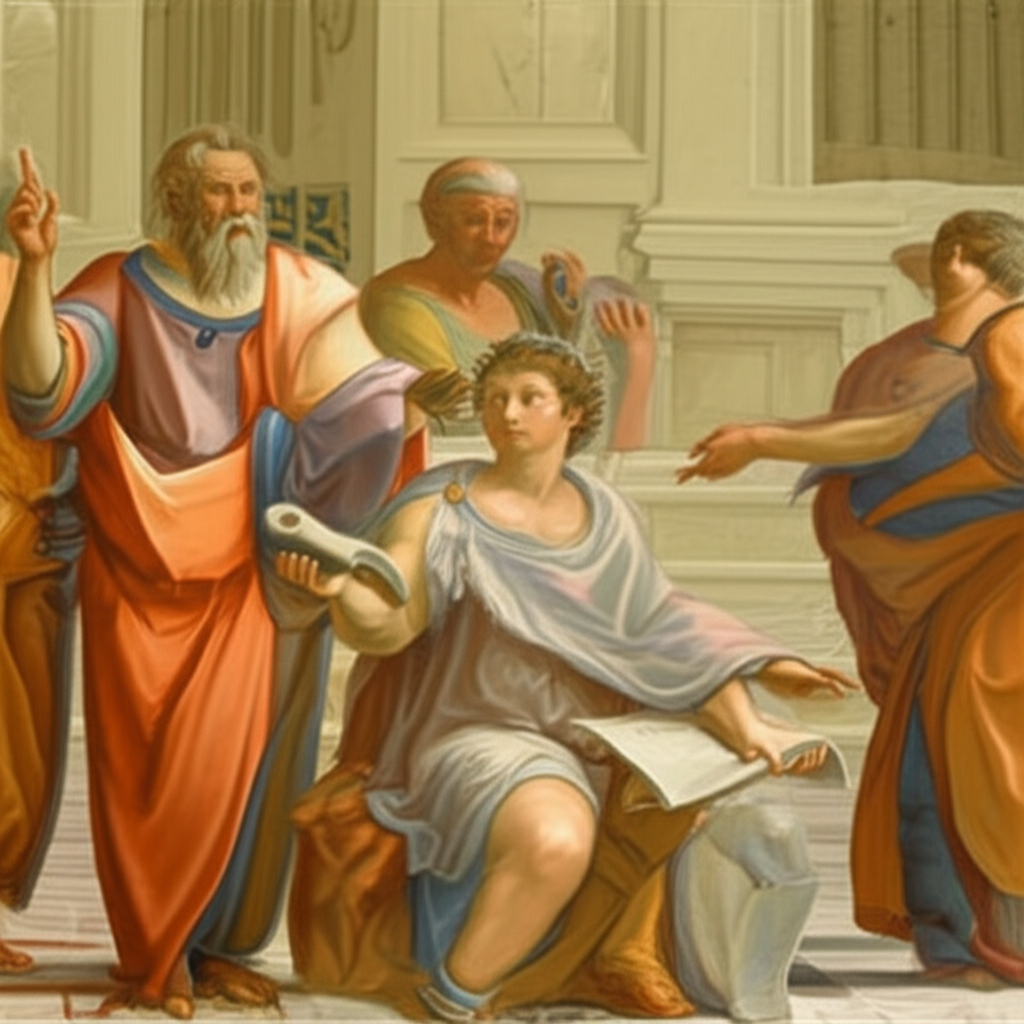
📹 Related Video: PLATO ON: The Allegory of the Cave
Video by: The School of Life
💡 Want different videos? Search YouTube for: ""Plato Allegory of the Cave explained"
YouTube: "Empiricism vs Rationalism philosophy""