

Beyond Mere Impressions: The Enduring Distinction Between Opinion and Sense
In the grand tapestry of philosophical inquiry, few distinctions are as fundamental, yet frequently muddled, as that between sense and opinion. At its core, this differentiation is an exploration of how we interact with the world, how we form beliefs about it, and ultimately, how we might ascend to genuine knowledge. While our senses provide the raw data of existence, our opinions are the interpretations, judgments, and conclusions we draw from that data. This article will delve into this crucial philosophical distinction, tracing its significance from ancient Greece to modern thought, and illuminating why understanding this difference is paramount for intellectual rigor and the pursuit of truth.
The Primacy of Sense: Our Window to Reality
Our journey into understanding begins with sense. This refers to the immediate, unmediated data received through our five senses: sight, sound, touch, taste, and smell. It is the raw, empirical input from the world around us. When we feel the warmth of the sun, hear the chirping of a bird, or see the vibrant hue of a rose, we are engaging with sense experience.
- Direct and Immediate: Sense data is our primary, most direct contact with reality. It is the initial impression.
- Passive Reception: In many ways, our senses are passive receivers, absorbing stimuli from the environment.
- Foundation of Experience: As thinkers from Aristotle to Locke have argued, all our ideas and understanding begin, in some form, with sense experience. Without it, our minds would be a blank slate.
However, the immediacy of sense does not equate to understanding or truth. It merely provides the building blocks.
The Subjectivity of Opinion: Interpretations and Beliefs
From the raw material of sense, we begin to construct opinions. An opinion is a belief, judgment, or view about something, often based on interpretation of sensory input, personal experience, or insufficient evidence. It is the mind's attempt to make sense of the world, but without necessarily having undergone rigorous justification or critical examination.
Consider the example of seeing a shadow. The sense data is the visual perception of a dark shape. The opinion might be "that shadow is a monster," or "that shadow is cast by a tree." One opinion is clearly unfounded, while the other might be closer to the truth, but both are still interpretations.
Key Characteristics of Opinion:
- Subjective: Opinions are often deeply personal and vary from individual to individual.
- Fallible: They can be, and often are, mistaken or incomplete.
- Lacking Justification: Unlike knowledge, an opinion may not be supported by sufficient evidence, reason, or logical coherence.
- Fluid: Opinions can change easily, influenced by new information, emotions, or social pressures.
The distinction here is critical: sense provides the 'what,' while opinion attempts to explain the 'why' or 'what it means,' often prematurely.
The Crucial Distinction: Why it Matters
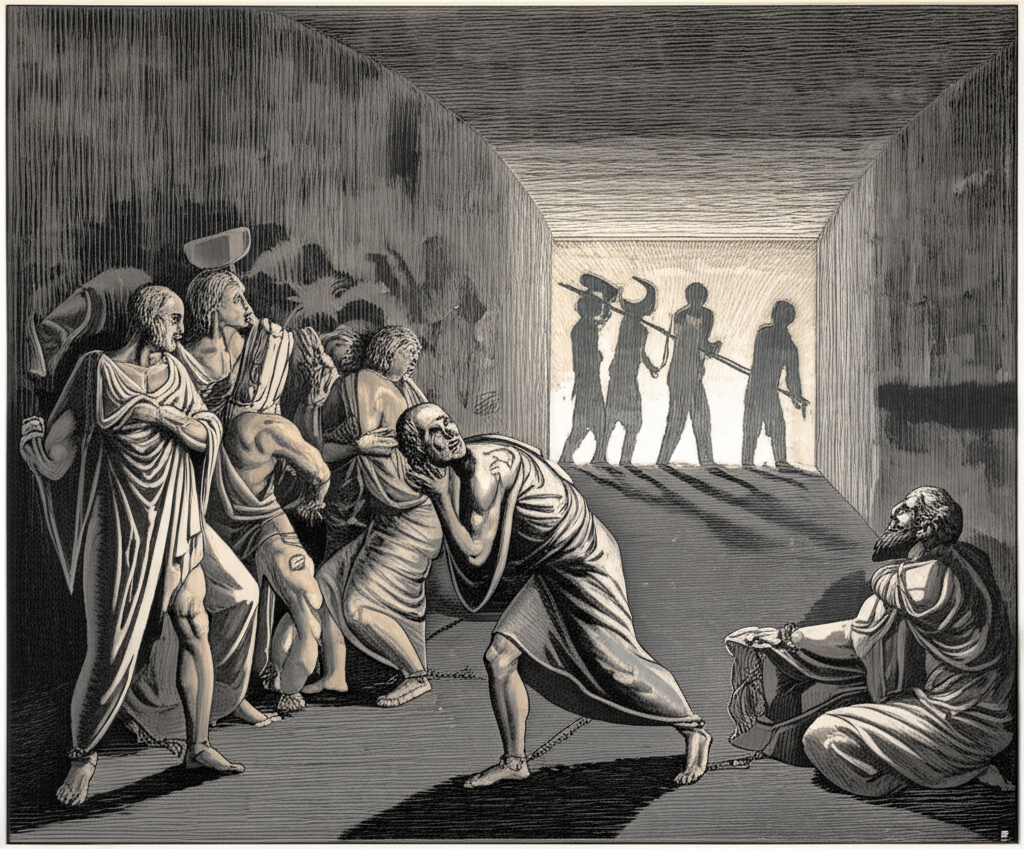
The philosophical tradition, particularly within the Great Books of the Western World, has long grappled with this distinction. Plato, in his allegory of the cave, vividly illustrates how people can confuse the shadows (akin to sense impressions) with reality, forming opinions based solely on these fleeting images, rather than seeking the true Forms (representing knowledge). For Plato, opinion (doxa) is inferior to knowledge (episteme), which is grounded in immutable truth and reason.
Aristotle, while emphasizing the importance of sense experience as the starting point for all knowledge, understood that mere sensation was not enough. True knowledge required reason and an understanding of causes and principles, moving beyond individual perceptions to universal truths.
Later, Enlightenment thinkers like John Locke recognized that while all our ideas originate from sense and reflection, the formation of sound knowledge requires careful observation, experimentation, and rational deduction to move beyond mere opinion. David Hume, with his profound skepticism, further highlighted the challenge of moving from sense impressions to justified knowledge, questioning the very foundations of how we form beliefs about cause and effect.
From Sense and Opinion to Knowledge: The Path Forward
The goal of philosophy, and indeed much of human endeavor, is to transcend mere opinion and achieve knowledge. This transition is not automatic; it requires intellectual discipline and a commitment to critical inquiry.
| Feature | Sense | Opinion | Knowledge |
|---|---|---|---|
| Nature | Raw, immediate data | Belief, judgment, interpretation | Justified true belief, understanding of causes |
| Source | Sensory perception | Interpretation of sense, personal bias | Reason, evidence, critical inquiry |
| Accuracy | Direct, but uninterpreted | Often fallible, subjective | Reliable, objective, verifiable |
| Justification | None required (it just is) | Weak or absent | Strong, logical, evidential |
| Example | Seeing a dark shape | Believing the shape is a monster | Understanding the shape is a shadow of a tree |
Moving from sense and opinion to knowledge involves:
- Critical Examination: Questioning the basis of our opinions and the reliability of our sense data.
- Reason and Logic: Applying logical thought to evaluate evidence and construct coherent arguments.
- Evidence and Justification: Demanding empirical or rational support for our beliefs.
- Openness to Revision: Being willing to change our opinions in the face of new evidence or superior arguments.
This arduous yet rewarding process is what distinguishes genuine inquiry from uncritical acceptance. It is the bedrock upon which meaningful understanding and progress are built.
Conclusion: Embracing the Distinction
The distinction between sense and opinion is more than an academic exercise; it is a vital tool for navigating the complexities of information in our modern world. In an age saturated with data and conflicting viewpoints, the ability to discern raw sense input from subjective opinion, and to strive towards rigorously justified knowledge, is an indispensable skill. By understanding these categories, we empower ourselves to think more clearly, reason more effectively, and ultimately, to approach truth with greater humility and intellectual honesty, echoing the wisdom gleaned from the timeless pages of the Great Books.
📹 Related Video: PLATO ON: The Allegory of the Cave
Video by: The School of Life
💡 Want different videos? Search YouTube for: "Plato's Allegory of the Cave Explained"
📹 Related Video: What is Philosophy?
Video by: The School of Life
💡 Want different videos? Search YouTube for: "Empiricism vs Rationalism in Philosophy"