

The Elusive Divide: Unpacking the Distinction Between Opinion and Sense
In the grand tapestry of philosophical inquiry, few distinctions are as fundamental, yet often blurred, as that between opinion and sense. At first glance, the two might seem intertwined, even synonymous. We often speak of "making sense" of an opinion, or having a "gut sense" about a particular viewpoint. However, a deeper dive, guided by the wisdom found in the Great Books of the Western World, reveals a chasm separating the two – a chasm crucial for the pursuit of genuine knowledge. This article aims to illuminate this critical divide, demonstrating why recognizing it is not merely an academic exercise, but a vital tool for navigating truth in an increasingly complex world.
The Ancient Roots of the Distinction: From Doxa to Episteme
The philosophical journey to separate opinion from a more grounded understanding begins with the ancients. Plato, a towering figure whose works form a cornerstone of the Great Books, famously articulated this distinction through his concepts of doxa (opinion) and episteme (knowledge or understanding). For Plato, doxa was tied to the ever-changing world of appearances, the realm of the senses where things are in constant flux. It is subjective, often unexamined, and susceptible to persuasion rather than logical necessity.
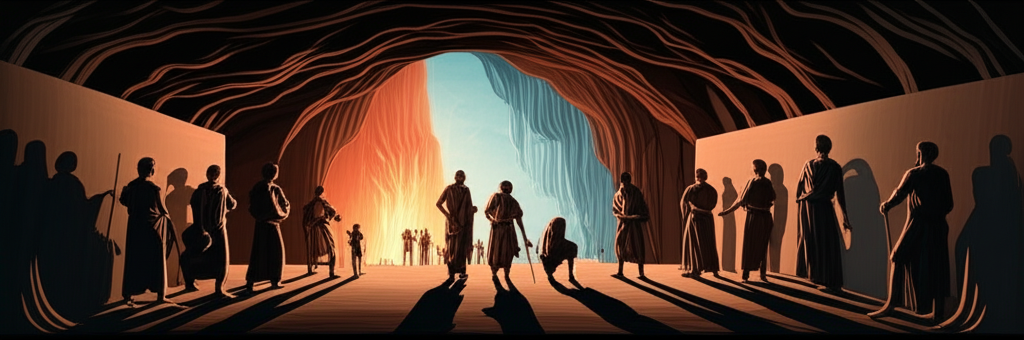
Consider the shadows in Plato's Allegory of the Cave. The prisoners, mistaking fleeting images for reality, are firmly entrenched in the realm of doxa. Their beliefs are opinions, born of limited perception and uncritical acceptance. Episteme, on the other hand, was the apprehension of the Forms – eternal, unchanging truths accessible only through reason and intellectual insight. It is here that true knowledge resides, stable and verifiable, transcending the vagaries of individual perception.
Aristotle, while differing from Plato on the nature of the Forms, also emphasized the need to move beyond mere belief. For him, knowledge (episteme) involved understanding causes and principles, achieved through rigorous observation, logical deduction, and empirical investigation. This stands in stark contrast to opinion (doxa), which might be true but lacks the necessary justification or understanding of why it is true.
Sense as the Foundation of Knowledge: Beyond Mere Perception
When we speak of "sense" in this philosophical context, we are not merely referring to the five bodily senses, though they play a crucial role. Rather, "sense" encompasses both the faculty of perception that grounds us in reality and the intellectual capacity to make coherent meaning from those perceptions. It is the ability to discern, to understand the logical coherence of an argument, or to grasp the empirical reality of a situation.
- Sensory Input: Our senses provide the raw data of experience. We see a tree, hear a bird, feel the warmth of the sun. These are direct perceptions, forming the initial layer of our interaction with the world.
- Common Sense: Beyond raw data, "common sense" refers to a basic, practical understanding of the world, often derived from shared human experience and a rudimentary grasp of cause and effect. While not always infallible, it provides a baseline for navigating daily life.
- Intellectual Sense/Reason: The most profound aspect of "sense" is our capacity for reason – the ability to organize, analyze, and synthesize sensory data and abstract concepts into a coherent, justifiable framework. This is where knowledge begins to solidify.
The Nature of Opinion: The Perils of Unexamined Belief
Opinion stands in stark contrast to this grounded understanding. It is characterized by:
- Subjectivity: Opinions are often deeply personal, reflecting individual biases, emotions, and limited experiences. "I like blue" is an opinion; it doesn't assert a universal truth about the color blue.
- Lack of Justification: While an opinion can be true, its truth is often accidental or unproven. The holder of an opinion may not be able to provide sound reasons or evidence for their belief.
- Changeability: Opinions are notoriously fickle. They can shift with mood, new social trends, or persuasive rhetoric, without necessarily being based on a deeper change in understanding or evidence.
- Resistance to Evidence: Ironically, strongly held opinions can sometimes be impervious to contradictory evidence, leading to confirmation bias.
The danger of mistaking opinion for knowledge is profound. It can lead to dogma, intolerance, and an inability to adapt one's beliefs in the face of compelling evidence. Society's progress often hinges on its capacity to critically examine prevailing opinions and replace them with empirically supported or logically sound knowledge.
The Crucial Distinction: Opinion vs. Knowledge (or Grounded Sense)
To truly appreciate the distinction, let's summarize the key differences:
| Feature | Opinion | Knowledge (Grounded Sense) |
|---|---|---|
| Foundation | Belief, feeling, limited experience, hearsay | Reason, evidence, logical demonstration, systematic inquiry |
| Truth Value | May or may not be true; truth is accidental | Necessarily true (within its domain) or highly probable |
| Justification | Lacks robust justification or explanation | Supported by reasons, evidence, or logical necessity |
| Stability | Fickle, easily changed, open to persuasion | Stable, enduring, resistant to superficial challenges |
| Scope | Subjective, individual, context-dependent | Objective, universal (within its domain), verifiable |
| Goal | To express a viewpoint | To understand, explain, predict, and control |
The Pursuit of Knowledge: Moving Beyond the Shadows
The journey from the realm of opinion to that of knowledge is the very essence of philosophical and scientific endeavor. It demands:
- Critical Self-Reflection: Examining our own beliefs and biases.
- Skepticism: Questioning assumptions, including our own.
- Empirical Investigation: Seeking evidence from the world.
- Logical Reasoning: Constructing sound arguments and identifying fallacies.
- Openness to Revision: Being willing to change our minds when presented with superior evidence or reasoning.
This pursuit, advocated by thinkers from Socrates to Descartes, and enshrined in the texts of the Great Books, is not about dismissing all opinions. Rather, it is about understanding their nature and not confusing them with the hard-won insights of knowledge. It is about striving for a sense of the world that is robust, coherent, and justifiable, rather than merely convenient or comfortable. Only then can we truly build a foundation for understanding ourselves and the cosmos.
📹 Related Video: PLATO ON: The Allegory of the Cave
Video by: The School of Life
💡 Want different videos? Search YouTube for: "Plato Allegory of the Cave explained"
📹 Related Video: What is Philosophy?
Video by: The School of Life
💡 Want different videos? Search YouTube for: "Epistemology introduction opinion vs knowledge"