

The Indispensable Divide: Unpacking the Distinction Between Matter and Quantity
In the grand tapestry of philosophical inquiry, certain concepts appear deceptively simple until one attempts to unravel their true essence. Among these foundational ideas are matter and quantity. While often conflated in casual discourse, a rigorous definition reveals them as distinct pillars of our understanding of reality. This article will delve into this crucial philosophical distinction, exploring why separating the 'stuff' of existence from its measurable attributes is not merely an academic exercise, but a pathway to clearer thought in both philosophy and physics.
A Clear-Eyed Summary
At its core, matter refers to the fundamental substratum, the 'what-ness' or potentiality that underlies all physical things, devoid of specific form or measure until it receives them. Quantity, conversely, is an attribute of existing things, describing their measurable aspects—how much, how big, how many. It is the extension, magnitude, or number that a given instance of matter occupies or possesses. Understanding this distinction is vital for comprehending the nature of reality, from ancient metaphysics to modern physics.
Unpacking the Fundamentals: Matter's Elusive Essence
When we speak of matter, we're grappling with one of philosophy's oldest and most profound questions: what is the world made of? Drawing from the wisdom of the Great Books of the Western World, particularly Aristotle, matter can be understood as the underlying "stuff" or "potentiality" that receives form. It is not, in itself, any particular thing, but rather that out of which particular things come to be.
Consider for a moment the concept of prime matter in Aristotelian thought. It's a pure potential, a substratum that has no qualities of its own, no specific shape, size, or location. It's the ultimate 'that which can become.' Later, philosophers like John Locke would speak of a "substratum" that supports primary and secondary qualities, though its true nature remains unknown to us. René Descartes, on the other hand, equated the essence of matter with extension itself, blurring the lines in a different way, yet still pointing to a fundamental substance.
- Matter: The indeterminate "stuff," the raw potential, the substratum that underlies all physical existence. It is the 'what' of a thing before it takes on specific attributes. It is that which is extended, not the extension itself.
The Measure of Existence: Understanding Quantity
If matter is the 'what,' then quantity addresses the 'how much,' 'how big,' or 'how many.' It is one of Aristotle's ten categories of being, describing the measurable aspects of a substance. Quantity is not the substance itself, but an attribute of the substance.
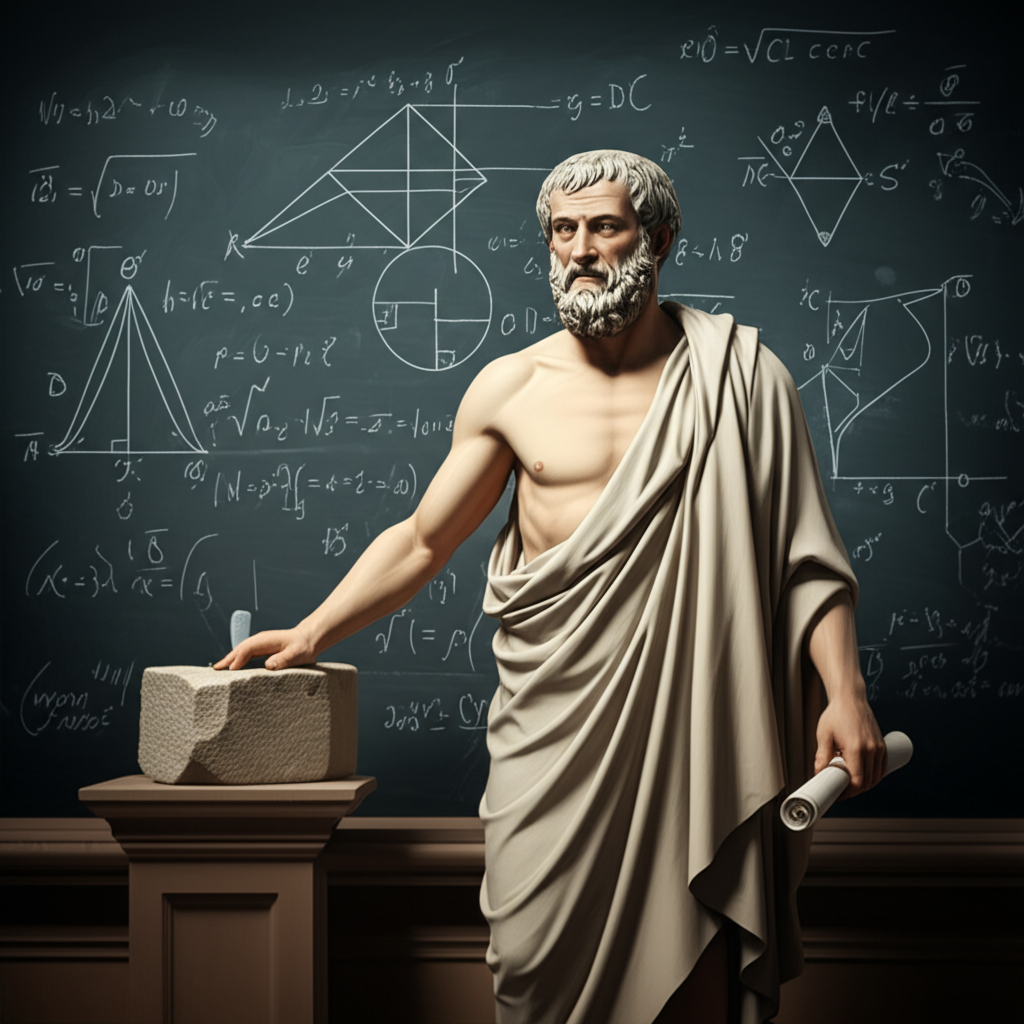
In the realm of physics, quantity is paramount. We measure mass, volume, length, time, and energy—all forms of quantity. A block of marble has a certain mass (a quantity), occupies a certain volume (another quantity), and has a specific length, width, and height (spatial quantities). These are all ways of describing how much of the marble's underlying matter is present and how it is distributed in space.
- Quantity: A measurable attribute of a substance, describing its magnitude, number, or extension. It answers questions like "how much?" or "how big?" It is the form or measure that matter takes on.
The Crucial Divide: Why the Distinction Matters
The subtle but profound difference between matter and quantity is not merely semantic; it shapes our entire philosophical framework for understanding the world. To conflate them is to misunderstand the very fabric of reality.
Here's a breakdown of their key differences:
| Feature | Matter | Quantity |
|---|---|---|
| Nature | The underlying substratum, potentiality | An attribute, a measurable characteristic |
| Question | What is it made of? | How much of it is there? How big is it? |
| Independence | Can exist without specific quantity (as potential) | Requires matter (or a substance) to be quantified |
| Variability | Conceptually constant (the 'stuff') | Highly variable (can be more or less) |
| Role | The subject that has attributes | An attribute of a subject |
| Example | Clay, wood, fundamental particles | Weight, volume, length, number of particles |
The definition of matter as potentiality helps us understand change—the same matter can take on different forms and quantities. The clay (matter) can be molded into a small pot (less quantity) or a large statue (more quantity), yet it remains fundamentally clay.
Philosophical Echoes and Modern Insights
Throughout the Great Books, this distinction, or the struggle to define it, permeates philosophical discourse. Aristotle's hylomorphism directly addresses it, positing that every physical object is a composite of matter (the potential) and form (the actuality, which includes its specific quantity and qualities). Descartes, in identifying matter solely with extension, effectively made quantity (spatial extension) the very essence of matter, a bold move that had profound implications for modern physics.
In contemporary physics, while the concept of a pure, formless prime matter has largely given way to fields and fundamental particles, the distinction persists. We speak of the "stuff" of the universe (quarks, leptons, bosons) and then measure their quantities: mass, charge, spin, energy. These quantities are properties of the fundamental particles or fields, not the particles or fields themselves as pure substratum. The "Standard Model" of particle physics, for instance, describes the fundamental constituents (matter) and the forces acting between them, which are quantified in terms of energy, momentum, and other measurable attributes.
Conclusion
The distinction between matter and quantity is more than a philosophical nuance; it's a cornerstone for clear thinking. By recognizing matter as the underlying 'stuff' and quantity as its measurable attributes, we gain a more precise language to describe the world, bridging ancient philosophical insights with the rigorous demands of modern physics. It reminds us that while the universe is filled with things we can measure, there is also a deeper, more fundamental reality that gives rise to those very measurements.
📹 Related Video: ARISTOTLE ON: The Nicomachean Ethics
Video by: The School of Life
💡 Want different videos? Search YouTube for: ""Aristotle Matter and Form Explained""
📹 Related Video: KANT ON: What is Enlightenment?
Video by: The School of Life
💡 Want different videos? Search YouTube for: ""Descartes on Extension and Substance""