

The Indispensable Divide: Unpacking the Distinction Between Matter and Quantity
A Foundational Summary
The distinction between matter and quantity is a cornerstone of Western philosophy, deeply explored by thinkers whose insights are preserved in the Great Books of the Western World. While often conflated in common discourse, matter refers to the indeterminate substratum—the raw potentiality or "stuff" of which things are made. Quantity, conversely, describes the measurable aspects of that matter, such as its size, number, extent, or duration. Grasping this crucial definition is not merely an academic exercise; it is fundamental to understanding how physical reality is structured, how objects change, and how ancient metaphysics informs modern physics.
The Ancient Roots of a Modern Understanding
For millennia, philosophers have grappled with the fundamental components of existence. From the pre-Socratics seeking the arche—the primary substance—to Plato's Forms and Aristotle's hylomorphism, the quest to understand reality's basic constituents has been relentless. It is in this rich intellectual landscape, particularly within the works of Aristotle, that the distinction between matter and quantity truly crystallizes, offering a profound lens through which to view the world. As we delve into the Great Books, we find repeated attempts to articulate what things are and how they are measured.
Defining Matter: The Stuff of Being
When we speak of Matter, we are referring to something more profound than simply "physical stuff" in the modern scientific sense. In philosophical terms, especially as articulated by Aristotle, matter is the potentiality of a thing. It is the indeterminate substratum that underlies change and receives form.
- Indeterminate Substratum: Matter itself, in its purest philosophical sense (prime matter), is without specific qualities or forms. It is the "that out of which" something comes to be.
- Potentiality: A block of marble, for example, is matter for a statue. It has the potential to become a statue, but it is not yet one. The raw elements of the universe are matter for all existing things.
- Receptacle of Form: Matter needs form to become actualized. A tree's matter (wood, leaves, roots) takes the form of a tree. Without form, matter is merely potential, unmanifested.
In the realm of physics, this classical understanding can be seen as a conceptual precursor to the idea of fundamental particles or energy fields that constitute all observable phenomena, even if the precise definition has evolved dramatically.
Defining Quantity: The Measurable Attributes
Quantity, on the other hand, is an accidental predicate or attribute of a substance. It describes the measurable aspects of a thing, its "how much" or "how many." It is one of Aristotle's ten categories of being, describing the inherent extensiveness or numerability of a substance.
- Extension: This refers to continuous quantity, such as length, width, depth, or duration. A stick has a certain length; a moment has a certain duration.
- Number: This refers to discrete quantity, the count of individual units. A flock of birds has a certain number of birds; a collection of books has a specific count.
- Measure: Quantity is inherently linked to measurement. We quantify things to understand their scale, their proportion, and their relationship to other things.
Without quantity, the abstract concept of matter would be ungraspable in the physical world. It is through quantitative attributes that we encounter and interact with matter.
The Crucial Distinction: Why It Matters
The separation of matter and quantity is not a mere semantic quibble; it's a fundamental insight into the nature of reality. It allows us to differentiate between what a thing is (its underlying potential, its matter) and what attributes it possesses (its size, number, duration, its quantity).
| Feature | Matter | Quantity |
|---|---|---|
| Nature | Indeterminate substratum, pure potentiality | Measurable attribute, extension, number |
| Role | That of which a thing is made | That by which a thing is measured or counted |
| Change | Undergoes change, receives form | Describes the extent of change or current state |
| Existence | A prerequisite for concrete existence | A characteristic of existing things |
| Definition | The underlying "stuff," prime constituent | The "how much" or "how many" |
| Relation | Requires form to be actualized; passive recipient | Describes the formed entity; active descriptor |
| Philosophical | Focus of metaphysics (what is being?) | Focus of mathematics and descriptive physics |
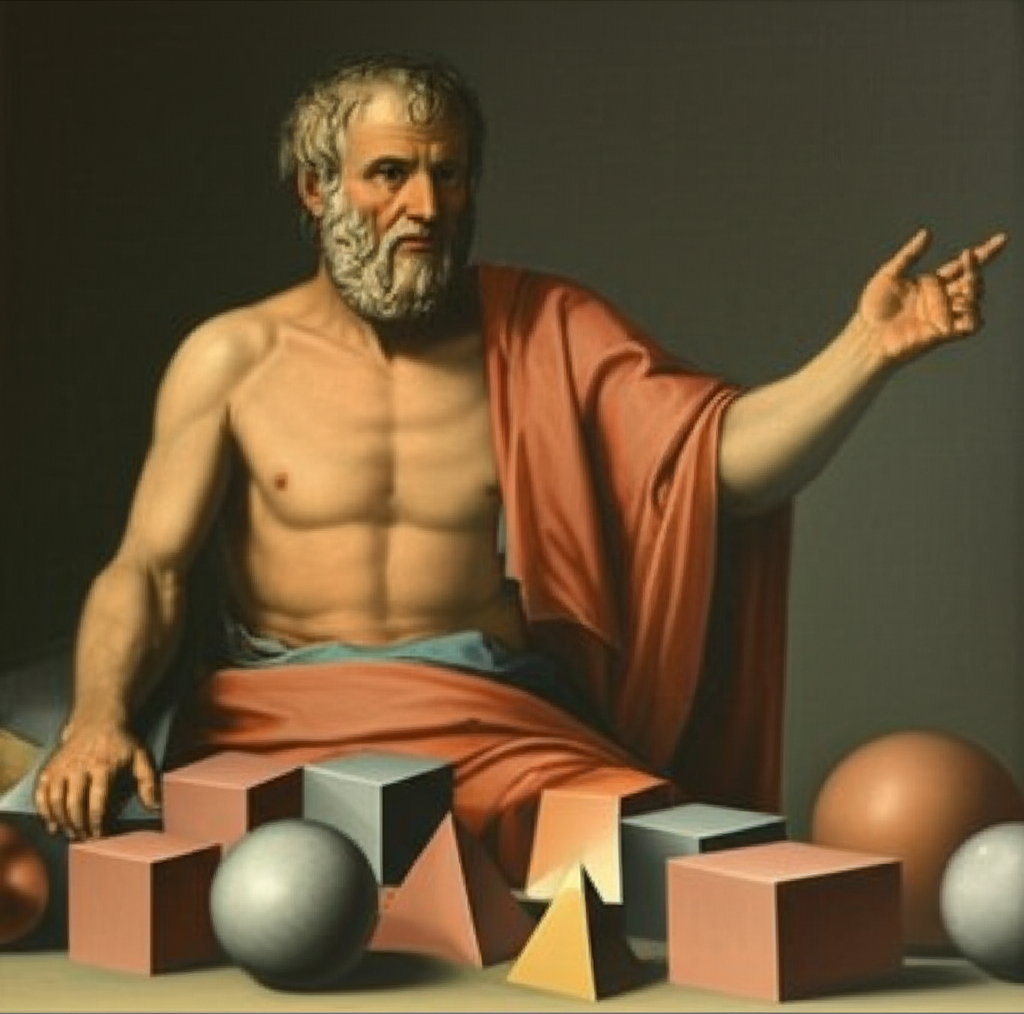 laid out on a table, while in the background, a swirling, unformed mass of clay or primordial elements suggests the concept of indeterminate matter. The contrast highlights the philosophical act of imposing order and measurement (quantity) upon raw potentiality (matter).)
Philosophical and Scientific Implications
This distinction has profound implications across philosophy and science:
- Metaphysics: It helps us understand substance and accident, potentiality and actuality. A substance (like a human being) has matter (flesh and bone) and form (the soul or essence), and also possesses various quantities (height, weight, age).
- Epistemology: How do we know things? We perceive matter through its qualities and quantities. We measure its extent, count its parts, and observe its duration.
- Physics: While modern physics has moved beyond classical hylomorphism, the underlying conceptual separation remains relevant. Physicists study the fundamental matter (particles, fields) and precisely quantify their properties (mass, charge, spin, energy, wavelength, velocity). The very fabric of experimental physics relies on accurate measurement—on understanding quantity. The universe's constituents (matter) are described by their measurable characteristics (quantity).
Conclusion: A Timeless Insight
The careful definition and separation of matter and quantity represent a monumental achievement in philosophical thought, deeply embedded in the legacy of the Great Books of the Western World. It provides a robust framework for understanding the composite nature of reality, bridging the abstract with the observable. To truly grasp the world, one must not only consider what things are made of but also how they extend, how they count, and how they endure. This fundamental distinction remains as vital today for informed philosophical inquiry as it was for the ancient Greeks.
📹 Related Video: ARISTOTLE ON: The Nicomachean Ethics
Video by: The School of Life
💡 Want different videos? Search YouTube for: "Aristotle Metaphysics Matter and Form"
📹 Related Video: What is Philosophy?
Video by: The School of Life
💡 Want different videos? Search YouTube for: "What is Quantity in Philosophy"