

The Enduring Dance of Thought: Unpacking the Distinction Between Logic and Dialectic
For anyone venturing into the rich landscapes of philosophy, understanding the fundamental tools we use to navigate truth is paramount. Among these, Logic and Dialectic stand out as two venerable, yet distinct, methods of reasoning. While both aim to bring clarity and understanding, their approaches, scope, and ultimate goals diverge in fascinating ways. This article will untangle these differences, illuminating why appreciating this distinction enriches our philosophical journey.
A Clear Path Forward: Summary of the Distinction
At its core, Logic is the study of valid inference and sound argumentation, focusing on the form of reasoning and the preservation of truth from premises to conclusions. It seeks certainty and consistency within a defined system. Dialectic, on the other hand, is a method of inquiry and discourse, often involving a dialogue between opposing viewpoints, aiming to uncover truth through the critical examination and synthesis of ideas. It embraces contradiction and evolution in understanding. Together, they form the bedrock of robust philosophy.
The Foundation of Truth: Exploring Logic
When we speak of Logic in philosophy, we are referring to the systematic study of valid inference. It's the discipline that equips us with the principles for distinguishing good arguments from bad ones. From the foundational works of Aristotle in his Organon (a cornerstone of the Great Books of the Western World), to the intricate symbolic systems of modern mathematical logic, the pursuit has always been to establish rules for correct reasoning.
What is Logic?
- Formal Validity: Logic primarily concerns itself with the structure of an argument. A logically valid argument is one where, if the premises are true, the conclusion must also be true, regardless of the actual content.
- Truth Preservation: Its goal is to ensure that truth, once established in premises, is preserved through the inferential steps to the conclusion.
- Consistency: Logic abhors contradiction. A logical system strives for internal consistency, where no statement can be both true and false simultaneously.
- Deduction and Induction: While deductive logic guarantees truth preservation (e.g., "All men are mortal; Socrates is a man; therefore, Socrates is mortal"), inductive logic offers probable conclusions based on evidence (e.g., "Every swan I've seen is white; therefore, all swans are probably white").
Logic provides the bedrock for intellectual precision. It's the meticulous architect ensuring that our intellectual structures don't crumble under scrutiny. It's about building sound arguments, step-by-step, with undeniable links.
The Art of Intellectual Engagement: Unpacking Dialectic
Where Logic builds with precision, Dialectic engages in a dynamic exploration. Often associated with figures like Socrates and Plato, and later transformed by Hegel, Dialectic is a method of philosophical inquiry that proceeds through a systematic exchange of ideas. It's less about proving a point and more about arriving at a deeper understanding through critical interaction.
What is Dialectic?
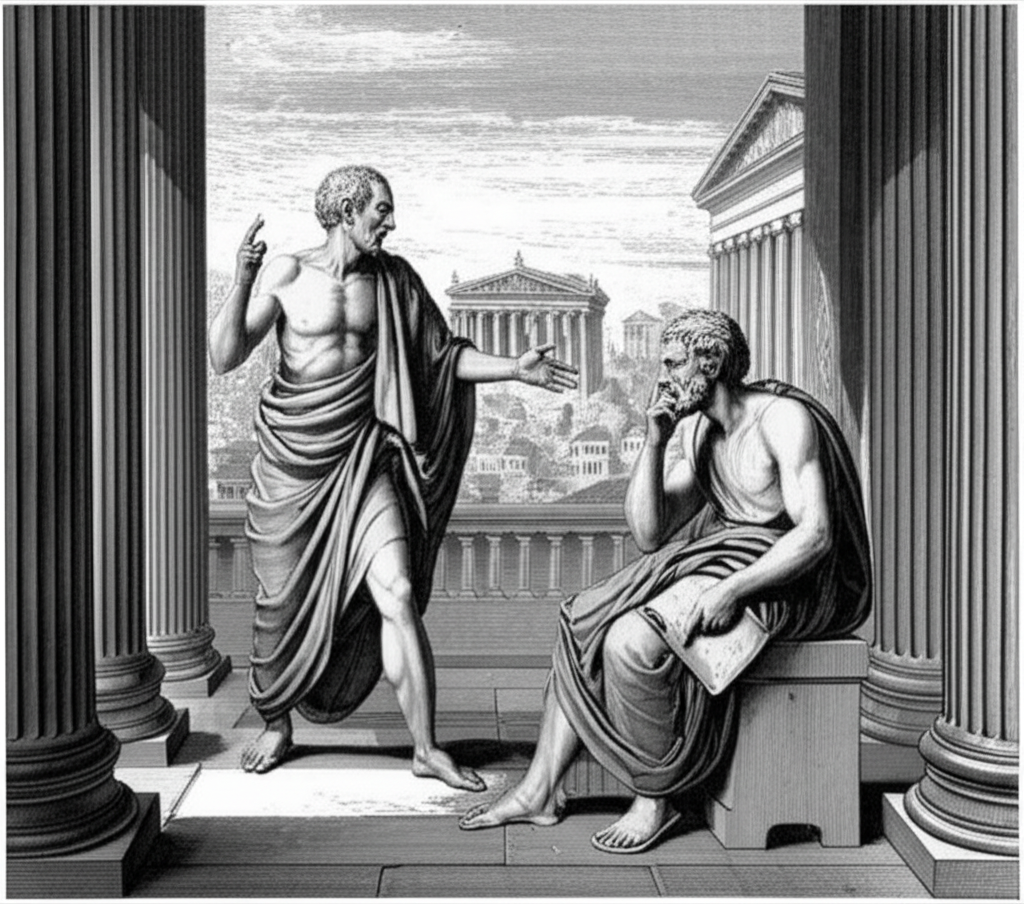
- Dialogue and Discourse: Dialectic typically involves a conversation or debate between two or more people with differing views. Think of Plato's Socratic dialogues, where Socrates, through a series of questions (the elenchus), helps his interlocutors expose contradictions in their own beliefs.
- Thesis, Antithesis, Synthesis: In its Hegelian form, Dialectic posits an initial idea (thesis), which gives rise to its opposite (antithesis), and through their conflict, a new, more comprehensive idea emerges (synthesis). This synthesis then becomes a new thesis, continuing the process of evolving understanding.
- Uncovering Truth: The goal isn't necessarily to "win" an argument, but to refine ideas, expose assumptions, and progressively move towards a more complete or nuanced truth. It acknowledges that initial perspectives might be incomplete or flawed.
- Embracing Contradiction: Unlike Logic, which seeks to eliminate contradiction, Dialectic often uses the tension between opposing ideas as a fertile ground for intellectual growth.
Dialectic is the dynamic sculptor, shaping understanding through the friction of ideas, constantly refining and evolving the form until a more profound truth is revealed. It's the method of critical inquiry that pushes the boundaries of our initial assumptions.
The Interplay: Why the Distinction Matters
While both Logic and Dialectic are indispensable tools for reasoning in philosophy, understanding their distinct roles is crucial. They are not mutually exclusive but rather complementary aspects of intellectual pursuit.
Key Differences Summarized:
| Feature | Logic | Dialectic |
|---|---|---|
| Primary Focus | Validity of inference, truth preservation | Inquiry, critical discussion, evolving understanding |
| Methodology | Formal rules, systematic deduction/induction | Dialogue, questioning, critique, synthesis |
| Goal | Certainty, consistency, sound arguments | Deeper understanding, refined concepts, new insights |
| Stance on Contradiction | Avoids and resolves contradictions | Uses contradictions as a driver for progress |
| Scope | Primarily concerned with argument structure | Broader, encompassing conceptual development and ethical inquiry |
| Nature | Analytical, formal, foundational | Exploratory, dynamic, transformative |
Logic provides the rigor. It ensures that once we've arrived at a conclusion, whether through dialectical exploration or other means, our arguments for it are sound and consistent. It's the quality control for our reasoning. Dialectic, on the other hand, provides the impetus for discovery. It's the engine of intellectual progress, challenging existing notions and pushing us towards new horizons of thought.
Imagine trying to build a magnificent philosophical edifice. You need the logic to ensure the foundations are solid, the beams are correctly placed, and the structure is stable. But you also need the dialectic to decide what kind of edifice to build, to explore different architectural styles, to question its purpose, and to continually refine its design through discussion and critique.
Both are essential for a robust and meaningful engagement with philosophy. To neglect one is to diminish the power of the other. By appreciating their unique contributions, we become more adept thinkers, capable of both rigorous analysis and profound insight.
📹 Related Video: SOCRATES ON: The Unexamined Life
Video by: The School of Life
💡 Want different videos? Search YouTube for: ""Socrates Dialectic Method Explained", "Formal Logic Basics for Philosophy""