

In the vast landscape of philosophy, two fundamental approaches to reasoning stand out: Logic and Dialectic. While often intertwined, understanding their distinct natures is crucial for rigorous thought. Logic primarily focuses on the formal structure of arguments, ensuring validity and soundness in inference, aiming for objective truth. Dialectic, on the other hand, is a method of inquiry through dialogue and debate, exploring ideas by presenting opposing viewpoints to arrive at a deeper, more comprehensive understanding. This article delves into their unique characteristics, historical roots, and why both are indispensable for profound philosophical exploration.
Unpacking the Philosophical Toolkit: The Essential Distinction Between Logic and Dialectic
Hello fellow seekers of wisdom! Chloe Fitzgerald here, ready to tackle another cornerstone of philosophy. Today, we're diving into a distinction that, while seemingly academic, underpins almost every significant philosophical discussion: the difference between Logic and Dialectic. These aren't just fancy terms; they represent two powerful, yet distinct, engines of human reasoning. Grasping their individual strengths and how they interact is absolutely vital for anyone serious about thinking critically and exploring complex ideas, much like those found in the Great Books of the Western World.
What is Logic? The Quest for Sound Reasoning
At its heart, Logic is the systematic study of valid inference and demonstration. It's concerned with the principles that govern correct reasoning, ensuring that conclusions genuinely follow from premises. Think of it as the architect of thought, meticulously designing structures where the foundations (premises) reliably support the roof (conclusion).
Historically, Aristotle is often credited as the father of formal logic, particularly with his work on syllogisms. His approach, detailed in the Organon, laid the groundwork for understanding how arguments are constructed and evaluated.
Key aspects of Logic include:
- Validity: An argument is valid if its conclusion must be true whenever its premises are true. The structure guarantees the truth transfer.
- Soundness: A sound argument is valid and all of its premises are actually true. This is the gold standard for logical arguments.
- Formal Systems: Logic often employs symbols and rules to analyze argument forms, stripping away content to examine pure structure.
- Deductive and Inductive Reasoning: While deductive logic guarantees conclusions from premises (if valid), inductive logic moves from specific observations to general conclusions, offering probability rather than certainty.
The goal of logic is often to arrive at unquestionable truths or to demonstrate the necessary consequences of certain propositions. It's about clarity, precision, and avoiding fallacies in our reasoning.
What is Dialectic? The Art of Engaging Ideas
Now, let's turn our attention to Dialectic. If logic is about building sound arguments, dialectic is about the process of inquiry, typically through dialogue and the clash of opposing ideas. It's less about proving a single point definitively and more about exploring, refining, and advancing understanding through intellectual engagement.
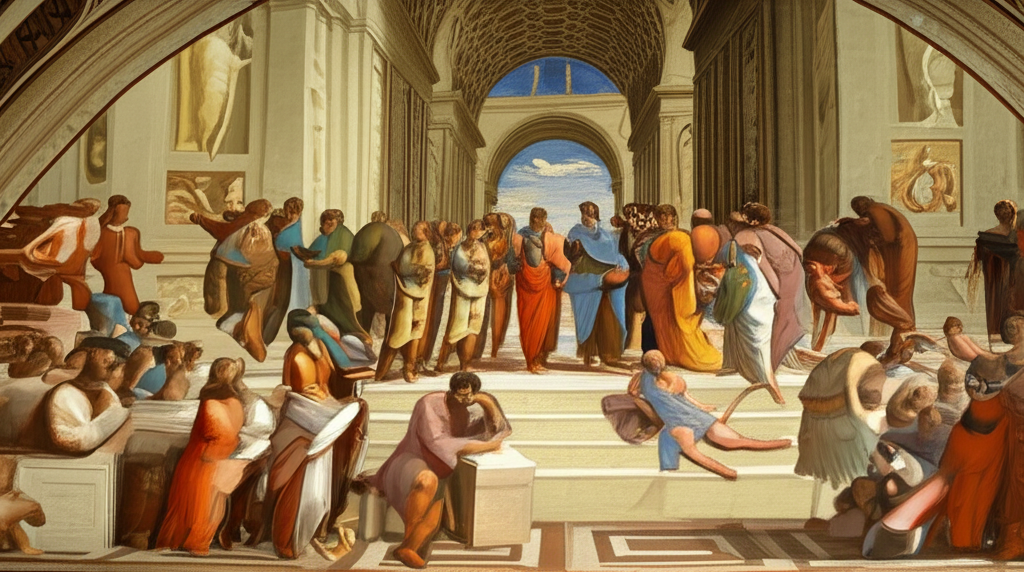
The roots of dialectic are ancient, stretching back to Socrates and Plato. Socrates, through his famous 'Socratic method,' engaged in a question-and-answer process to expose contradictions in interlocutors' beliefs, leading them to a deeper understanding, often about the nature of virtue or knowledge. Plato, in his dialogues, used dialectic as the supreme method for philosophical inquiry, ascending from opinions to true knowledge of the Forms.
Later, Hegel reinterpreted dialectic as a dynamic process of thesis-antithesis-synthesis, where an idea (thesis) encounters its opposite (antithesis), leading to a higher, more complex understanding (synthesis).
Key aspects of Dialectic include:
- Dialogue and Debate: It's inherently conversational and often adversarial in a productive sense.
- Exploration of Opposing Viewpoints: It thrives on the tension between different perspectives.
- Synthesis and Progression: The aim is not just to win an argument, but to transcend initial positions, leading to new insights or a more nuanced truth.
- Open-ended Inquiry: Unlike logic's definitive conclusions, dialectic can be an ongoing process of refinement.
Dialectic is about navigating the complexities of human experience and thought, often dealing with concepts that resist simple, formal definition.
Key Differences: A Comparative Look
To truly appreciate both, let's lay out their primary distinctions in a comparative table:
| Feature | Logic | Dialectic |
|---|---|---|
| Primary Goal | To establish valid and sound arguments; prove or disprove | To explore, refine, and advance understanding through dialogue |
| Method | Formal analysis of propositions and inferences; deductive/inductive | Questioning, debate, presenting opposing viewpoints; thesis-antithesis-synthesis |
| Focus | Structure of arguments; consistency, truth preservation | Content of ideas; exploration of meaning, resolution of contradictions |
| Outcome | Definitive conclusions (if sound); formal proofs | Deeper insights, nuanced understanding, new conceptual frameworks |
| Scope | Often narrow, precise, analytical | Broad, synthetic, interpretive |
| Nature | Analytical, objective, foundational | Dialogical, often subjective in process but aiming for objective truth |
The Interplay: Logic and Dialectic in Philosophical Inquiry
It's crucial to understand that Logic and Dialectic are not mutually exclusive; rather, they are complementary tools in the philosopher's toolkit. A truly robust philosophical investigation often requires both.
- Dialectic can help us identify the questions that need answering, flesh out the different facets of a problem, and explore the implications of various standpoints. It's the process of discovery, of uncovering the terrain.
- Once those ideas are on the table, Logic steps in to scrutinize them. Are the arguments presented within the dialectical exchange sound? Do the conclusions logically follow? Are there hidden fallacies in the reasoning? Logic provides the rigor and the criteria for evaluating the claims that emerge from the dialectical process.
Without dialectic, logic might operate in a vacuum, proving trivial points or failing to address the most pressing philosophical questions. Without logic, dialectic could devolve into mere sophistry or endless, unproductive debate, lacking the precision and rigor to advance genuine knowledge. Together, they form a powerful synergy for profound philosophy.
📹 Related Video: PLATO ON: The Allegory of the Cave
Video by: The School of Life
💡 Want different videos? Search YouTube for: ""Plato's Dialectic Explained" and "Aristotle's Logic in 5 Minutes""
Conclusion
So, as we navigate the complex tapestry of philosophy, remember the distinct yet interwoven roles of Logic and Dialectic. Logic provides the skeletal structure, ensuring the integrity and strength of our arguments. Dialectic breathes life into that structure, allowing for the exploration, challenge, and evolution of ideas. Both are indispensable for truly profound reasoning and for plumbing the depths of philosophical inquiry, guiding us through the intellectual riches found in works like those compiled in the Great Books of the Western World. Keep questioning, keep reasoning, and keep exploring!