

The Art of Thought: Differentiating Logic and Dialectic in Philosophy
In the grand tapestry of philosophy, understanding the tools we use for reasoning is paramount. Among the most fundamental of these tools are logic and dialectic. While often intertwined in intellectual discourse, they represent distinct approaches to inquiry, each with its unique purpose and methodology. Simply put, logic is concerned with the rules of valid inference and the structure of arguments, ensuring our conclusions follow from our premises, regardless of their content. Dialectic, on the other hand, is the art of reasoned argumentation through dialogue, often involving the clash of opposing viewpoints to arrive at a deeper understanding or truth. Both are indispensable, but their distinction is crucial for navigating complex philosophical landscapes.
Unpacking the Foundations: What is Logic?
When we speak of logic, we are entering the domain of formal validity. Derived from the Greek logos, meaning 'reason' or 'word', logic is the systematic study of valid inference. Its primary concern is the structure of arguments, ensuring that if the premises are true, the conclusion must also be true. This pursuit of formal correctness means that logic often operates independently of the factual content of the statements themselves.
Key Characteristics of Logic:
- Formal Validity: Logic assesses whether an argument's conclusion necessarily follows from its premises.
- Axiomatic Systems: It often relies on a set of axioms, rules, and symbols to represent and analyze arguments.
- Non-Contradiction: A cornerstone of logic is the principle of non-contradiction, where a statement and its negation cannot both be true at the same time and in the same respect.
- Deductive and Inductive Reasoning: While often associated with deductive reasoning (guaranteeing conclusions), logic also encompasses inductive reasoning (where conclusions are probable).
Figures like Aristotle, whose work on the syllogism forms a foundational part of the Great Books of the Western World, laid much of the groundwork for formal logic. He meticulously categorized forms of argument, providing a framework for evaluating their soundness and validity. For Aristotle, a logical argument was a pathway from known truths to new, certain conclusions.
Exploring the Dynamics: What is Dialectic?
Dialectic, conversely, is a more dynamic and often conversational approach to truth-seeking. Its roots trace back to ancient Greece, particularly to Socrates and Plato, also prominent voices within the Great Books. For them, dialectic was the method of philosophical inquiry through dialogue, where opposing ideas (thesis and antithesis) are presented, debated, and refined to reach a higher synthesis or a more profound understanding.
Key Characteristics of Dialectic:
- Dialogue and Argumentation: It typically involves an exchange of arguments between two or more participants.
- Truth-Seeking: The goal is often to uncover truth, clarify concepts, or resolve contradictions through critical engagement.
- Thesis-Antithesis-Synthesis: In its Hegelian form, dialectic describes a process where an idea (thesis) generates its opposite (antithesis), and their conflict leads to a new, more comprehensive idea (synthesis).
- Contextual and Evolving: Unlike formal logic, dialectic is often context-dependent and its outcomes can evolve through the process of discussion.
Plato's Socratic dialogues are prime examples of dialectic in action. Socrates would engage his interlocutors in a series of questions and answers, challenging their assumptions and leading them to discover inconsistencies in their own beliefs, thereby moving closer to a more robust understanding of concepts like justice, virtue, or knowledge. Later, philosophers like Kant used dialectic to explore the inherent contradictions (antinomies) of reason, while Hegel famously applied it to the unfolding of history and ideas.
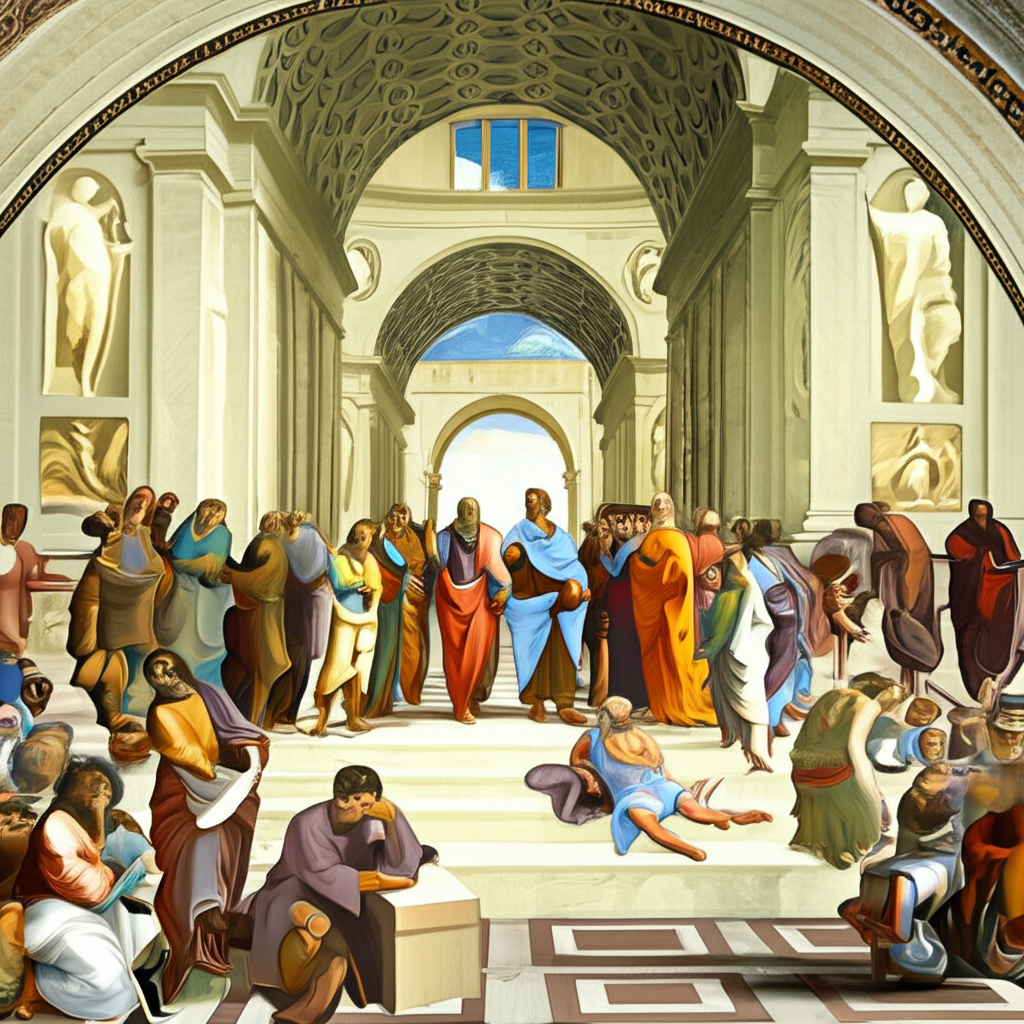 , while Aristotle gestures horizontally towards the empirical world (representing logical, systematic observation). They are surrounded by other philosophers engaged in animated discussion and scholarly work, highlighting the interplay of different philosophical methods.)
A Comparative Glance: Logic vs. Dialectic
To truly appreciate the distinction, let's juxtapose their primary characteristics:
| Feature | Logic | Dialectic |
|---|---|---|
| Primary Goal | Validity and Soundness of Arguments | Truth-seeking through discourse, deeper understanding |
| Methodology | Formal Inference, Rules, Deduction, Analysis | Dialogue, Argumentation, Synthesis, Critique |
| Nature | Analytical, Formal, Static, Universal | Dynamic, Conversational, Evolving, Contextual |
| Focus | Form of Argument, Consistency, Structure | Content of Argument, Ideas, Perspectives, Persuasion |
| Proponents | Aristotle, George Boole, Bertrand Russell | Plato (Socrates), Immanuel Kant, G.W.F. Hegel |
The Indispensable Interplay in Reasoning
While distinct, logic and dialectic are not mutually exclusive; indeed, they often complement each other in robust reasoning. A dialectical discussion, to be productive, must still adhere to basic logical principles. Fallacies, for instance, can derail any meaningful dialogue, and it is logic that helps us identify and avoid them. Conversely, a purely logical system, while formally sound, might lack the dynamic engagement required to explore new ideas, challenge entrenched beliefs, or persuade an audience.
In the pursuit of philosophy, we often use logic to scrutinize the individual steps of an argument presented within a dialectic. We employ dialectic to generate and refine the very premises that logic then rigorously evaluates. This synergy allows for both rigorous analysis and expansive inquiry, ensuring our reasoning is both sound and insightful.
Ultimately, understanding the distinction between logic and dialectic empowers us to be more effective thinkers. It teaches us when to demand formal rigor and when to embrace the open-ended, often challenging, process of dialogue to push the boundaries of our understanding. Both are powerful tools, and mastery lies in knowing when and how to wield each one.
📹 Related Video: PLATO ON: The Allegory of the Cave
Video by: The School of Life
💡 Want different videos? Search YouTube for: ""Plato's Dialectic Explained - Socratic Method" and "Aristotle's Logic: A Basic Introduction""