

Beyond the Syllogism: Unpacking the Distinction Between Logic and Dialectic
The Core Difference: Precision vs. Exploration in Philosophy
In the grand tapestry of philosophy, two fundamental approaches guide our quest for understanding: Logic and Dialectic. While often intertwined, recognizing their distinct roles is crucial for rigorous thought. Simply put, Logic provides the structured rules for sound reasoning and valid argumentation, ensuring that our conclusions follow necessarily from our premises. Dialectic, on the other hand, is a more dynamic, often conversational method of inquiry, designed to explore ideas, challenge assumptions, and resolve contradictions through intellectual exchange. One perfects the form of argument, the other perfects the content and direction of inquiry.
The Foundations of Philosophical Inquiry
From the ancient academies of Greece to the modern halls of academia, the pursuit of truth has relied heavily on our capacity for structured thought. The Great Books of the Western World are replete with examples of thinkers grappling with complex ideas, often employing both logical rigor and dialectical exploration. Understanding where Logic ends and Dialectic begins offers a clearer path through these intellectual landscapes.
The Unyielding Structure of Logic
Logic is, at its heart, the study of correct reasoning. It provides the formal tools and principles that allow us to evaluate arguments, discern truth from falsehood (within the confines of a given argument's structure), and construct coherent chains of thought. Think of Aristotle's Organon, which meticulously lays out the principles of syllogistic reasoning – a cornerstone of Western thought for centuries.
- Focus: Validity and soundness of arguments.
- Method: Formal rules, deductive and inductive inference, propositional calculus.
- Goal: To establish conclusions with certainty (deductive) or high probability (inductive) based on given premises, ensuring consistency and coherence.
- Key Question: Does the conclusion necessarily follow from the premises?
Logic cares less about the source of the premises and more about the relationship between them and the conclusion. If "all humans are mortal" and "Socrates is human," then "Socrates is mortal" is a logically valid conclusion, regardless of whether you like Socrates or not. This formal precision is indispensable for building robust philosophical arguments.
The Dynamic Dance of Dialectic
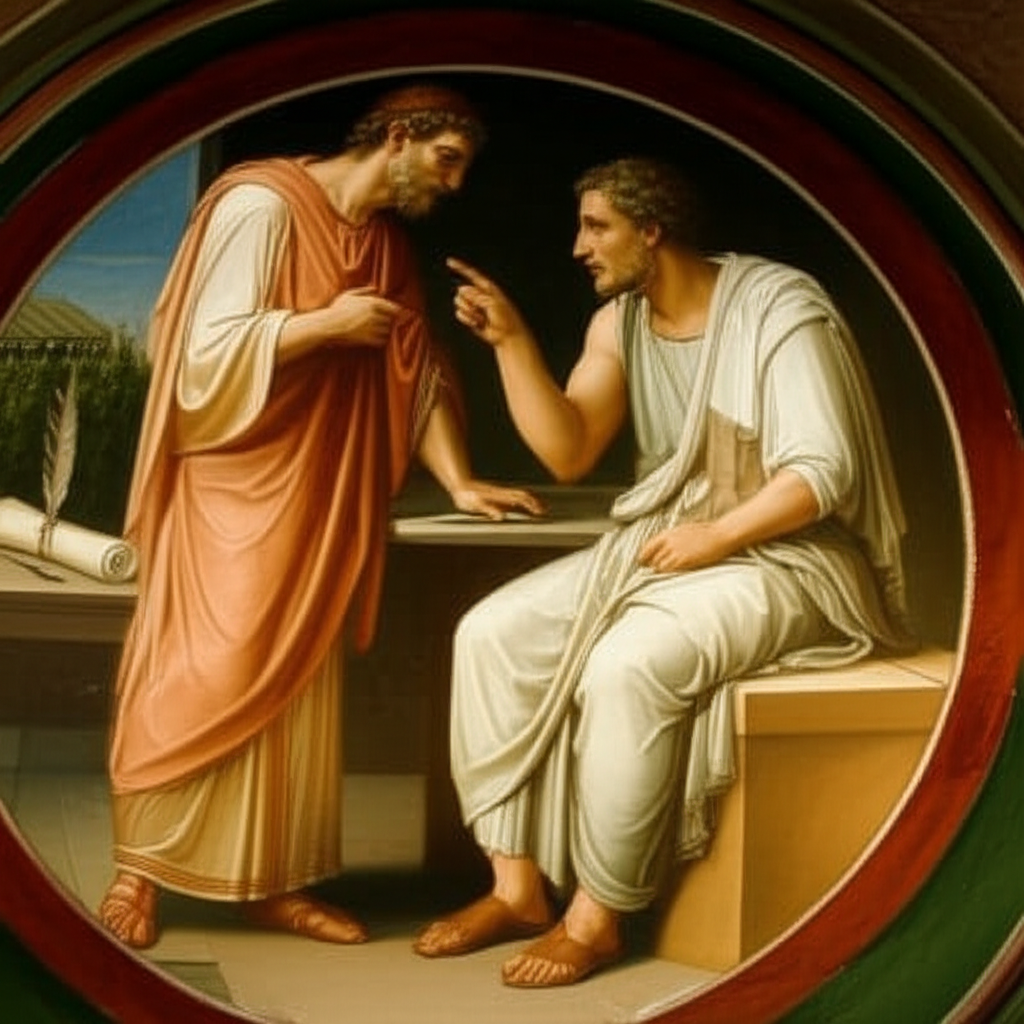
Dialectic, by contrast, is a method of philosophical inquiry that involves a process of question and answer, thesis and antithesis, aimed at reaching a deeper understanding or resolving a contradiction. Plato's dialogues, central to the Great Books canon, are perhaps the most famous embodiment of this approach. Socrates, through relentless questioning, would guide his interlocutors to confront the inconsistencies in their beliefs, thereby refining concepts like justice, virtue, or knowledge.
- Focus: Exploration of concepts, challenging assumptions, seeking truth through discourse.
- Method: Dialogue, questioning, identifying contradictions, synthesis of opposing views.
- Goal: To clarify concepts, expose hidden assumptions, arrive at a more comprehensive or nuanced understanding, or to achieve intellectual progress.
- Key Question: What do we truly mean by this concept, and how does it stand up to scrutiny?
Dialectic is less about the formal validity of a single argument and more about the unfolding of ideas, the journey of reasoning towards a more refined truth. It's a method of collective or internal investigation, often leading to the discovery of new premises or the re-evaluation of old ones.
Distinguishing Their Roles in Philosophy
To further clarify, consider the following comparison:
| Feature | Logic | Dialectic |
|---|---|---|
| Primary Aim | To ensure valid and sound argumentation. | To explore, refine, and deepen understanding. |
| Methodology | Formal rules, inference, proof. | Dialogue, questioning, thesis/antithesis. |
| Focus | Structure of arguments, truth preservation. | Content of ideas, conceptual clarity. |
| Starting Point | Given premises. | Often an initial premise or a problematic concept. |
| Outcome | Valid/invalid argument, sound/unsound conclusion. | Refined concept, deeper insight, new synthesis. |
| Historical Figure | Aristotle | Plato (Socrates) |
While Logic provides the rigorous framework for constructing and evaluating individual arguments, Dialectic offers the dynamic process through which we discover the premises, test the concepts, and challenge the assumptions that feed into those arguments. A philosopher might use dialectic to arrive at a clear definition of "justice" and then employ logic to construct a formal argument based on that definition.
The Synergy of Reasoning in Philosophical Practice
Ultimately, both Logic and Dialectic are indispensable tools in the philosopher's toolkit. A purely logical approach might lead to technically valid but ultimately trivial or ungrounded conclusions if the initial premises are never critically examined. Conversely, a purely dialectical approach, without the discipline of logical reasoning, could devolve into endless, unproductive debate.
Great philosophy thrives when these two modes of inquiry work in concert. We use dialectic to challenge, explore, and refine our understanding of fundamental concepts, and then we apply logic to build robust, coherent arguments from those refined concepts. This continuous interplay drives intellectual progress, allowing us to navigate the complexities of existence with both precision and profound insight. To truly engage with the rich tradition found in the Great Books, one must appreciate the dance between the structured certainty of logic and the exploratory spirit of dialectic.
📹 Related Video: PLATO ON: The Allegory of the Cave
Video by: The School of Life
💡 Want different videos? Search YouTube for: ""Plato's Dialectic: The Socratic Method Explained""
📹 Related Video: KANT ON: What is Enlightenment?
Video by: The School of Life
💡 Want different videos? Search YouTube for: ""Introduction to Logic: Arguments, Premises, and Conclusions""