

The Intricate Dance: Disentangling Logic and Dialectic in Philosophical Inquiry
Summary: While often intertwined in philosophical discourse, Logic and Dialectic represent distinct yet complementary approaches to reasoning and truth-seeking. Logic primarily concerns itself with the formal structures of arguments, ensuring their validity and soundness, and preserving truth through rigorous deduction and induction. Dialectic, on the other hand, is a method of inquiry, typically involving dialogue and the clash of opposing viewpoints, aiming to uncover deeper understanding, refine concepts, and arrive at new truths through a process of thesis, antithesis, and synthesis. Understanding their individual strengths and how they interact is fundamental to robust Philosophy.
The Foundations of Philosophical Reasoning
For centuries, philosophers have grappled with the best methods to understand the world, uncover truth, and construct compelling arguments. At the heart of this endeavor lie two formidable intellectual tools: Logic and Dialectic. While both are indispensable for rigorous reasoning, their natures, aims, and methodologies differ significantly. To truly engage with the rich tapestry of Western thought, as presented in the Great Books of the Western World, one must first appreciate this crucial distinction.
Logic: The Architect of Sound Thought
Logic is the systematic study of valid inference and correct reasoning. It provides the rules and principles that govern how we move from premises to conclusions, ensuring that if our premises are true, our conclusions must also be true. Rooted in the foundational work of Aristotle, particularly his Organon, Logic is primarily concerned with the form of an argument, rather than its specific content.
Key Characteristics of Logic:
- Focus on Validity and Soundness:
- Validity: An argument is valid if its conclusion necessarily follows from its premises. The structure is key.
- Soundness: An argument is sound if it is valid and all its premises are true.
- Truth Preservation: Logic aims to preserve truth. If you start with true premises and follow logical rules, your conclusion will be true.
- Formal Systems: It often employs formal languages and symbols to analyze arguments, stripping away ambiguity.
- Types of Reasoning:
- Deductive Reasoning: Moves from general principles to specific conclusions (e.g., All men are mortal; Socrates is a man; Therefore, Socrates is mortal).
- Inductive Reasoning: Moves from specific observations to general conclusions (e.g., Every swan I’ve seen is white; Therefore, all swans are white – though this can be overturned by new evidence).
Logic provides the bedrock for intellectual rigor, ensuring that our individual arguments stand on solid ground, free from fallacies and inconsistencies. It’s the internal consistency checker for our thoughts.
Dialectic: The Art of Intellectual Exploration
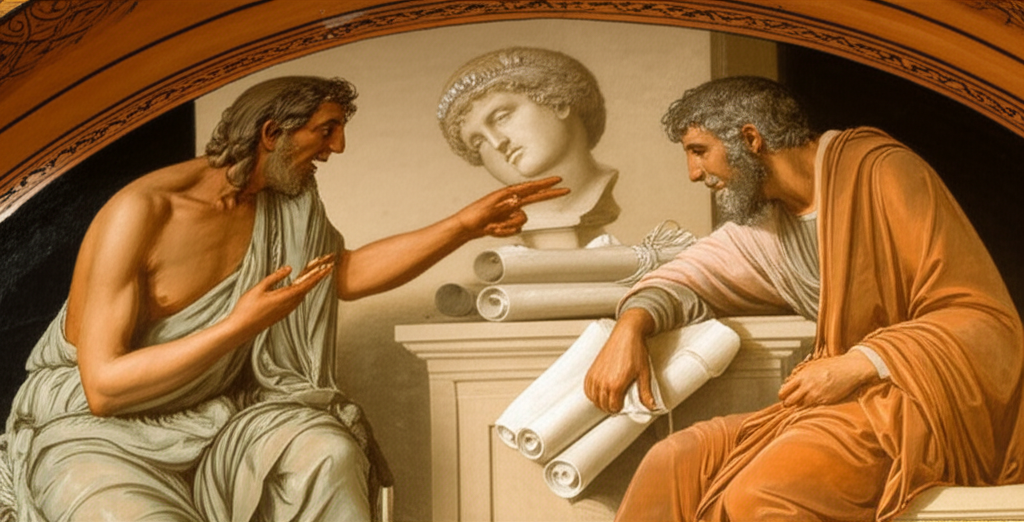
Dialectic, conversely, is less about the static structure of an argument and more about the dynamic process of inquiry. It is a method of philosophical reasoning through dialogue, debate, and the examination of opposing ideas. Its roots trace back to the ancient Greeks, most notably Socrates and Plato, whose dialogues (also central to the Great Books) exemplify this method.
Key Characteristics of Dialectic:
- Method of Inquiry: Dialectic is a process for discovering truth, not merely confirming it.
- Dialogue and Debate: It typically involves two or more participants (or internal self-reflection) engaging with differing viewpoints.
- Thesis, Antithesis, Synthesis: A common model involves:
- Thesis: An initial proposition or idea.
- Antithesis: An opposing argument or critique of the thesis.
- Synthesis: A new, more refined understanding that emerges from the tension and resolution of the thesis and antithesis. This synthesis then often becomes a new thesis, continuing the process.
- Refinement of Concepts: Through critical examination, concepts are clarified, ambiguities are resolved, and a deeper understanding is achieved.
- Historical Evolution: While Socratic dialectic sought to expose ignorance and clarify concepts, later philosophers like Hegel viewed dialectic as the very engine of historical and intellectual progress, where ideas evolve through conflict.
The Crucial Distinction: Logic vs. Dialectic
While both are essential tools in Philosophy, their fundamental differences can be summarized as follows:
| Feature | Logic | Dialectic |
|---|---|---|
| Primary Aim | To ensure validity and soundness of arguments; truth preservation. | To discover new truth, refine concepts, and achieve deeper understanding. |
| Method | Formal rules, analysis of argument structure, deduction, induction. | Dialogue, debate, clash of ideas, thesis-antithesis-synthesis. |
| Focus | Internal consistency, formal correctness, truth values. | Evolution of ideas, conceptual clarification, progress of thought. |
| Nature | Prescriptive (how arguments should be formed). | Exploratory, iterative, often conversational. |
| Output | Valid arguments, sound conclusions. | Refined concepts, new insights, intellectual progress. |
| Analogy | The blueprints and structural integrity checks for a building. | The collaborative design process and brainstorming sessions for the building's purpose and form. |
Why Both Matter in Philosophy
Neither Logic nor Dialectic can fully stand alone in the pursuit of profound philosophical understanding. Logic provides the essential framework for building robust arguments; it ensures that once an idea is formulated, it can be expressed in a coherent, defensible manner. Without Logic, dialectical discussions could devolve into mere opinion-swapping, lacking the rigor needed to distinguish genuine insight from fallacy.
Conversely, Dialectic provides the dynamic process through which new ideas are generated, existing concepts are challenged, and collective understanding is advanced. It pushes the boundaries of thought, questioning assumptions that Logic might take as given premises. It's the engine that propels Philosophy forward, preventing stagnation and encouraging continuous critical engagement.
Together, they form a powerful synergy. Dialectic might lead to a new synthesis, which then requires the tools of Logic to be rigorously tested, structured into sound arguments, and defended against critique. The ongoing reasoning process in Philosophy is an intricate dance between the exploratory freedom of Dialectic and the structural discipline of Logic.
YouTube Video Suggestions:
-
📹 Related Video: PLATO ON: The Allegory of the Cave
Video by: The School of Life
💡 Want different videos? Search YouTube for: ""Plato's Dialectic Explained""
2. ## 📹 Related Video: ARISTOTLE ON: The Nicomachean Ethics
Video by: The School of Life
💡 Want different videos? Search YouTube for: ""Aristotle Logic Introduction""