

Beyond the Syllogism: Unpacking the Dance Between Logic and Dialectic
In the grand tapestry of philosophical inquiry, Logic and Dialectic often appear as two sides of the same coin, yet their roles are distinct and profoundly complementary. While Logic provides the rigorous framework for sound argumentation, ensuring our conclusions validly follow from our premises, Dialectic is the dynamic process of exploring ideas through dialogue, questioning assumptions, and synthesizing opposing viewpoints to arrive at a deeper understanding. Together, they form the bedrock of robust philosophical reasoning, guiding us through the labyrinth of thought with both precision and profound curiosity.
The Foundations of Clear Thought: Understanding Logic
At its heart, Logic is the study of correct reasoning. It's the toolkit philosophers use to build arguments that are sound, valid, and compelling. Think of it as the architect's blueprint for thought – it defines the rules by which premises lead to conclusions, ensuring structural integrity.
What is Logic?
Logic concerns itself with the form of arguments, rather than solely their content. It asks: Does the conclusion necessarily follow from the premises? If the answer is yes, the argument is considered valid. If, in addition, the premises themselves are true, then the argument is sound.
Key Aspects of Logic:
- Formal Systems: Logic often employs symbolic language to represent propositions and their relationships, allowing for precise analysis free from the ambiguities of natural language.
- Deductive Reasoning: This is the most common form associated with classical logic, where if the premises are true, the conclusion must be true. (e.g., All men are mortal. Socrates is a man. Therefore, Socrates is mortal.)
- Inductive Reasoning: While less definitive than deduction, induction draws general conclusions from specific observations, forming the basis of scientific inquiry.
- Truth Preservation: The primary goal of deductive logic is to ensure that truth, if present in the premises, is preserved in the conclusion.
For centuries, from Aristotle’s Organon to modern symbolic logic, this discipline has been the bedrock for establishing certainty and coherence in our intellectual pursuits. It teaches us to scrutinize our own thoughts and the arguments of others, ensuring that our reasoning holds up under critical examination.
The Art of Intellectual Exploration: Exploring Dialectic
While logic provides the tools for constructing valid arguments, Dialectic offers a method for discovering what those arguments should be about, and for challenging their underlying assumptions. It's less about proving a point and more about uncovering truth through a process of dynamic engagement.
What is Dialectic?
Dialectic, particularly as practiced by figures like Socrates and Plato in the Great Books of the Western World, is a method of inquiry where two or more people with differing viewpoints engage in a structured conversation, seeking to resolve their disagreements through reasoned argumentation. It's a journey of intellectual discovery, often moving from a thesis, through an antithesis, towards a synthesis – a more refined understanding.
Key Aspects of Dialectic:
- Dialogue and Discourse: Dialectic thrives on conversation, questioning, and the exchange of ideas.
- Exploration of Assumptions: It often begins by questioning commonly held beliefs or initial propositions (the thesis).
- Resolution of Contradictions: By presenting opposing viewpoints (the antithesis), dialectic aims to expose inconsistencies or limitations in initial understandings.
- Emergence of New Understanding (Synthesis): The goal is not merely to win an argument, but to transcend the initial opposing views to arrive at a more comprehensive and robust truth.
- Dynamic and Iterative: Dialectic is an ongoing process, often leading to new questions and further inquiry.
Think of Plato's dialogues, where Socrates tirelessly questioned his interlocutors, not to impose his own views, but to lead them (and us) to a deeper understanding of justice, virtue, or knowledge itself. This process, often challenging and sometimes frustrating, is fundamental to the spirit of philosophy.
Logic vs. Dialectic: A Table of Distinction
To clarify their distinct roles and how they complement each other in philosophical reasoning, let's lay out their primary characteristics:
| Feature | Logic | Dialectic |
|---|---|---|
| Primary Goal | To validate arguments; ensure sound reasoning. | To explore ideas; discover deeper truths. |
| Methodology | Formal rules, syllogisms, truth tables. | Dialogue, questioning, thesis-antithesis. |
| Focus | Argument structure and validity. | Argument content, assumptions, implications. |
| Nature | Prescriptive, analytical, foundational. | Exploratory, synthetic, evolving. |
| Outcome | Sound conclusions from given premises. | Refined understanding, new insights, consensus. |
| Orientation | Establishing certainty within a framework. | Challenging certainty, expanding the framework. |
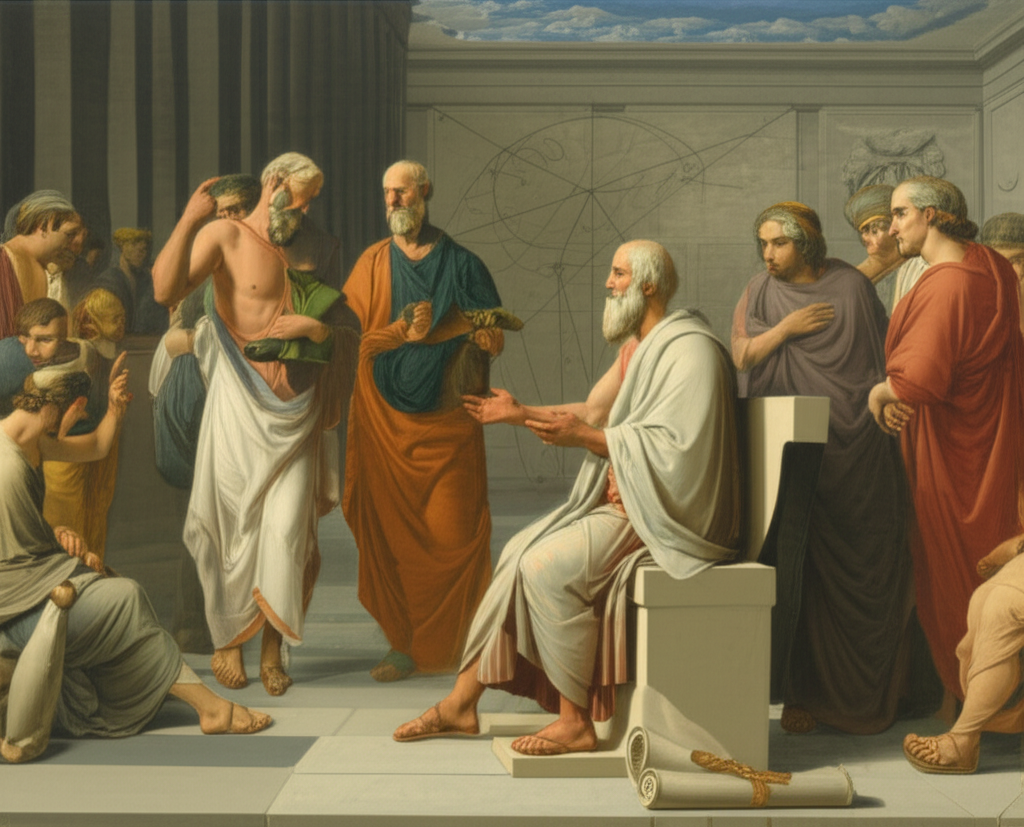
The Synergy of Reasoning: Why Both Matter
While distinct, Logic and Dialectic are not adversaries; they are essential partners in the pursuit of wisdom. A philosopher who only employs logic might construct impeccably valid arguments based on flawed or unexamined premises. Conversely, a purely dialectical thinker might engage in endless discussion without ever solidifying their insights into coherent, defensible arguments.
- Dialectic helps us find the right questions and formulate meaningful premises by thoroughly exploring a topic from multiple angles. It challenges our assumptions and pushes the boundaries of our initial understanding.
- Logic then steps in to ensure that once we've identified those premises, our subsequent reasoning is sound and our conclusions are truly warranted. It provides the rigor to test the ideas born from dialectical exploration.
Together, they form a powerful engine for intellectual progress. Dialectic sparks the initial inquiry, challenging the status quo and opening new avenues of thought. Logic then provides the discipline to navigate these new territories with precision, ensuring that the insights gained are robust and defensible. This dynamic interplay is what makes philosophy a living, breathing discipline, constantly refining its understanding of the world and our place within it.
Embracing the Journey of Philosophical Reasoning
For anyone embarking on a philosophical journey, understanding the distinction and interdependence of Logic and Dialectic is crucial. It empowers you not just to critique arguments, but to engage deeply with ideas, to challenge your own perspectives, and to build a more nuanced and comprehensive understanding of complex issues. Embrace both the meticulous precision of logic and the adventurous spirit of dialectic, and you will find your capacity for reasoning profoundly enriched.
Further Exploration:
📹 Related Video: PLATO ON: The Allegory of the Cave
Video by: The School of Life
💡 Want different videos? Search YouTube for: ""Plato's Dialectic Explained""
📹 Related Video: ARISTOTLE ON: The Nicomachean Ethics
Video by: The School of Life
💡 Want different videos? Search YouTube for: ""Aristotle's Logic Fundamentals""