

The Enduring Riddle: Unpacking the Distinction Between Body and Soul
From the earliest stirrings of philosophical thought, humanity has grappled with a profound question: What are we, truly? Are we merely sophisticated biological machines, or is there something more—an essence, a spirit, a soul—that animates our physical form? The distinction between body and soul is not just an academic exercise; it's a fundamental inquiry that shapes our understanding of identity, consciousness, morality, and ultimately, the very meaning of life and death. This foundational concept, explored by countless minds within the Great Books of the Western World, reveals a persistent human need to reconcile our tangible existence with our intangible experiences.
Charting the Philosophical Landscape: Ancient Roots and Modern Echoes
The idea that humans are composed of two distinct parts – one material, one immaterial – has been a cornerstone of philosophical and religious thought for millennia.
Ancient Greek Explorations
The philosophers of ancient Greece laid much of the groundwork for this enduring debate.
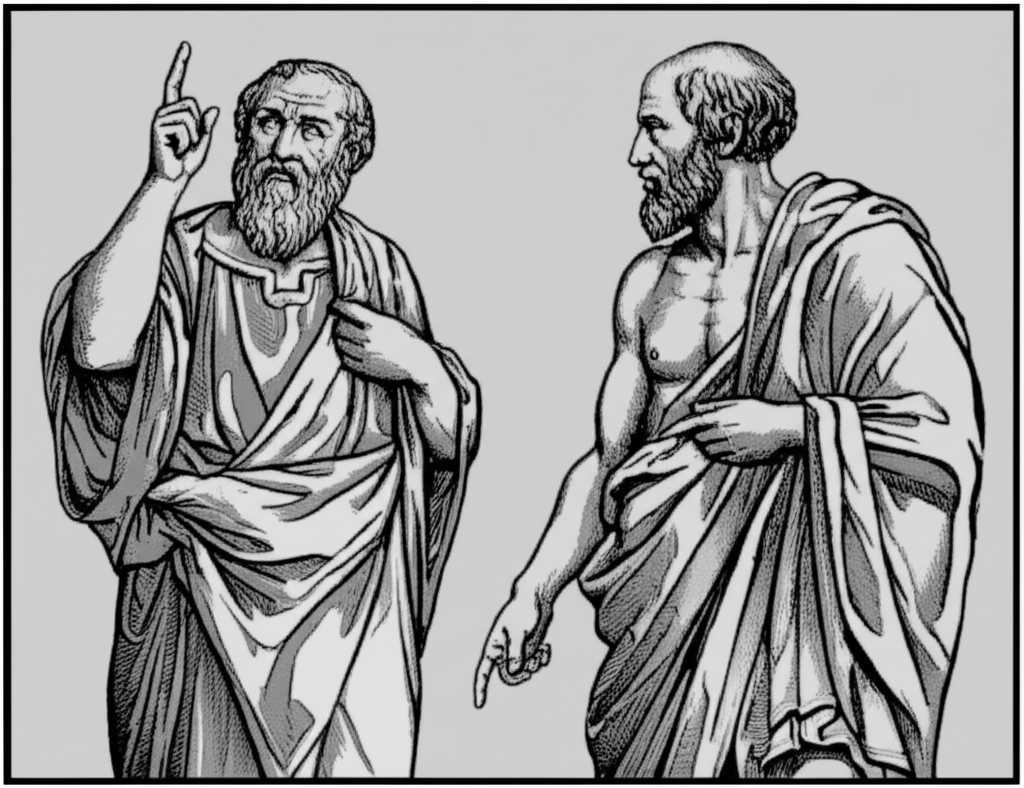
- Plato's Dualism: For Plato, the body was a temporary prison for the immortal soul. He posited that the soul was the seat of reason, intellect, and moral character, capable of apprehending eternal Forms, while the body was a source of distraction, desires, and illusions. The goal of philosophy was to liberate the soul from the body's influence.
- Aristotle's Hylomorphism: Aristotle, Plato's student, offered a more integrated view. He saw the soul not as a separate entity trapped within the body, but as the form of the body – its animating principle. Just as the shape of an axe defines it as an axe, the soul defines a living organism. For Aristotle, the soul was what gave the body its capacity for life, perception, and thought. While he recognized different types of souls (vegetative, sensitive, rational), the rational soul in humans was seen as having a unique, perhaps separable, element.
The Cartesian Revolution
Centuries later, René Descartes dramatically re-ignited the debate with his radical dualism.
- Mind-Body Separation: Descartes famously declared "Cogito, ergo sum" ("I think, therefore I am"), establishing the thinking "I" (the mind or soul) as distinct and separable from the extended, physical body. For Descartes, the body was a machine, governed by mechanical laws, while the soul was an unextended, thinking substance that interacted with the body primarily in the pineal gland. This clear-cut distinction gave rise to the enduring "mind-body problem": how can two such fundamentally different substances interact?
Unpacking the Components: What Do We Mean by Body and Soul?
To truly grasp the distinction, we must first attempt to define what we are distinguishing.
The Body: Our Tangible Vessel
The body is, in many ways, the most straightforward to define because it is empirically observable.
- Physicality and Extension: It occupies space, has mass, and is subject to the laws of physics.
- Sensory Experience: Through our senses, the body connects us to the external world, allowing us to see, hear, touch, taste, and smell.
- Biological Functions: It performs all the necessary functions for life – breathing, eating, circulating blood, reproduction.
- Mortality: Crucially, the body is finite; it is born, it ages, and it dies.
The Soul: The Elusive Essence
Defining the soul is far more complex, as it refers to an immaterial aspect of our being. Across different philosophical traditions, it has been understood as:
- Consciousness and Self-Awareness: The capacity for subjective experience, for knowing "that one knows."
- Reason and Intellect: The faculty of thought, logic, and abstract understanding.
- Emotions and Will: The source of our feelings, desires, and moral choices.
- Identity and Personality: What makes each individual unique and continuous over time, despite physical changes.
- Immortality: For many, the soul is considered imperishable, surviving the death of the body.
The Profound Implications for Life and Death
The way we understand the distinction between body and soul profoundly impacts our worldview, ethics, and our contemplation of life and death.
Shaping Human Experience
- Understanding Identity: If we are primarily our soul, then our physical attributes are secondary. If we are an integrated whole, then our physical and mental states are inextricably linked. This influences our views on disability, mental health, and personal responsibility.
- Ethical Frameworks: If the soul is immortal and destined for judgment, ethical decisions take on eternal significance. If life is purely biological, then morality might be seen as a social construct or a product of evolutionary advantage.
- Purpose and Meaning: The existence of a soul can imbue life with a transcendent purpose, linking us to something beyond the material world. Without it, purpose might be sought entirely within our finite existence.
Confronting Mortality: Life and Death
Perhaps nowhere is the distinction more acutely felt than in the face of death.
- What Happens After? If the soul is truly distinct and immortal, then death is merely the separation of the soul from the body, a transition rather than an end. This offers solace and hope for an afterlife.
- The End of Consciousness? If the soul is merely an emergent property of the body's complex functions, then death signifies the absolute cessation of consciousness, thought, and individual existence.
- Grief and Remembrance: Our rituals surrounding death often reflect these underlying beliefs. Do we mourn the loss of a person's entire being, or do we believe a part of them continues on?
The Enduring Quest
The distinction between body and soul remains one of philosophy's most fertile and challenging territories. While modern neuroscience and psychology offer increasingly sophisticated understandings of the brain, they haven't definitively resolved the philosophical question of consciousness or the nature of the self. The debate continues to evolve, drawing new insights from scientific discovery while still wrestling with the ancient questions posed by the likes of Plato, Aristotle, and Descartes. It reminds us that to be human is to constantly inquire, to seek meaning beyond the observable, and to ponder the profound mystery of our own existence.
YouTube:
- "Plato's Theory of the Soul and the Body Explained"
- "Descartes' Mind-Body Dualism Explained (Philosophy)"
📹 Related Video: What is Philosophy?
Video by: The School of Life
💡 Want different videos? Search YouTube for: "The Distinction Between Body and Soul philosophy"