

The Enduring Enigma: Unraveling the Distinction Between Body and Soul
The perennial philosophical inquiry into the distinction between the body and the soul has captivated thinkers for millennia, shaping our understanding of consciousness, identity, and the very nature of life and death. From ancient Greek metaphysics to modern dualism, this article explores the diverse perspectives found within the Great Books of the Western World, revealing how different eras have grappled with the profound implications of separating or uniting these fundamental aspects of human existence.
Hello, fellow travelers on the path of inquiry! Today, we delve into one of philosophy's most enduring and perplexing questions: the true distinction between the body and the soul. It's a query that touches the very core of what it means to be human, influencing everything from our ethical frameworks to our views on life and death. Is the soul merely an emergent property of the brain, or is it a separate, perhaps immortal, entity? Let's explore the rich tapestry of thought woven by the greatest minds in history, as preserved in the Great Books of the Western World.
Ancient Foundations: The Dawn of Dualism and Unity
The seeds of this profound debate were sown in ancient Greece, where philosophers first articulated systematic theories regarding the human constitution.
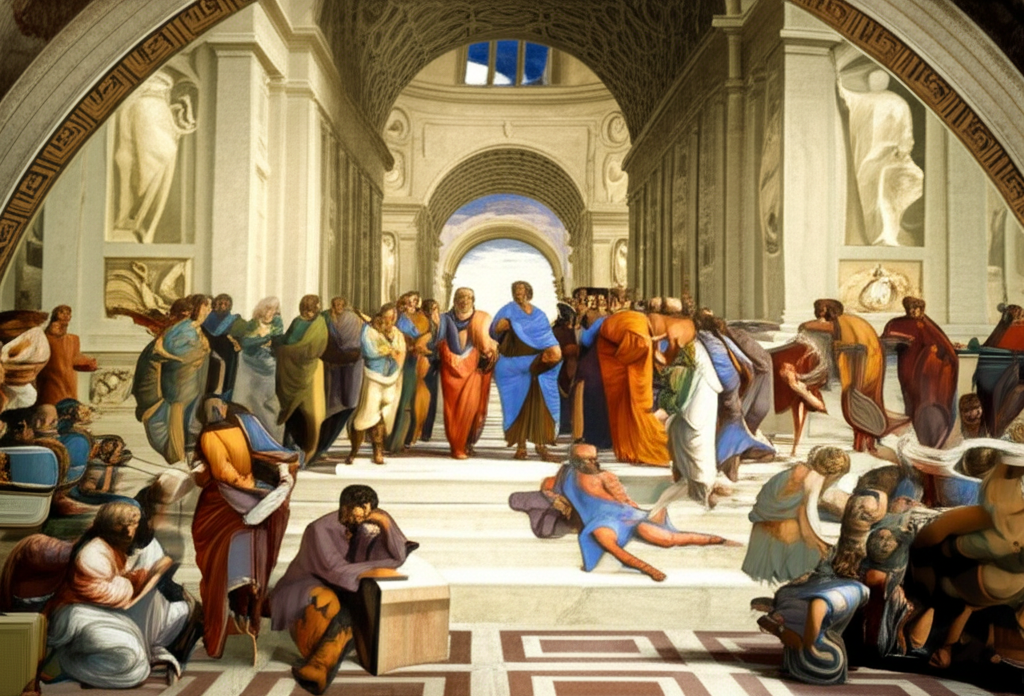
- Plato's Realm of Forms: For Plato, the soul is an immortal, divine essence, distinct from the perishable body. In works like Phaedo, he posits that the soul pre-exists the body, having once resided in the perfect World of Forms. The body is often described as a temporary prison or a hindrance, trapping the soul and preventing it from achieving true knowledge. Death, in this view, is merely the soul's liberation from its corporeal confines.
- Aristotle's Hylomorphism: Plato's student, Aristotle, offered a more integrated perspective. In De Anima, he argued that the soul is the "form" of the body, the animating principle that gives it life and defines its essence. For Aristotle, the soul is not a separate entity that can exist independently of the body, but rather the very organization and function of a living being. While he did ponder a separable intellectual faculty, for most living things, the soul perishes with the body.
Medieval Meditations: Faith and Reason Intertwined
With the advent of Christian theology, ancient philosophical concepts were re-examined through the lens of faith, leading to new interpretations of the distinction.
- Augustine's Inner Self: Influenced by Plato, St. Augustine of Hippo, in works like Confessions, viewed the soul as distinct and immortal, the seat of reason, memory, and will, and made in the image of God. The body serves the soul, which is the true self, capable of introspection and communion with the divine.
- Aquinas's Substantial Form: St. Thomas Aquinas, synthesizing Aristotle's philosophy with Christian doctrine in Summa Theologica, considered the human soul to be the substantial form of the body, giving it its human nature. While intimately united with the body, the human soul, being intellectual and spiritual, was also capable of existing separately after the body's demise, an essential tenet for the Christian belief in an afterlife.
Modern Philosophy: The Cartesian Divide
The Enlightenment brought a radical re-evaluation of the relationship, culminating in a stark dualism that continues to shape contemporary thought.
- René Descartes and Radical Dualism: René Descartes, in Meditations on First Philosophy, famously posited a clear and distinct distinction between two fundamental substances: res cogitans (thinking substance – the soul or mind) and res extensa (extended substance – the physical body). For Descartes, the soul is consciousness, non-physical, indivisible, and inherently thinking. The body, by contrast, is a machine, purely physical, extended in space, and subject to mechanical laws. This radical separation gives rise to the enduring "mind-body problem"—how do these two fundamentally different substances interact?
Key Arguments: For and Against the Distinction
The ongoing debate about the distinction between body and soul is fueled by compelling arguments from both sides.
Arguments for a Distinct Soul:
- Consciousness and Subjectivity: The subjective experience of "I," of qualia (the redness of red, the taste of chocolate), seems irreducible to mere physical processes. How can matter alone produce self-awareness?
- Reason and Morality: Our capacity for abstract thought, ethical judgment, free will, and the pursuit of truth often points to something beyond purely material mechanisms, suggesting a non-physical faculty.
- Personal Identity: What makes me me, even as my cells regenerate and my body undergoes constant change, suggests a continuous, non-physical self that persists over time.
- Spiritual and Religious Beliefs: Many world religions and spiritual traditions posit an immortal soul or spirit as the core of human identity, existing independently of the physical body.
Challenges and Counter-Arguments:
- Materialism/Physicalism: This view asserts that all mental phenomena are ultimately products of physical brain activity. There is no need for a separate soul; the mind is the brain.
- The Mind-Body Problem: If the soul is non-physical, how does it interact with the physical body? Where do they meet? Descartes suggested the pineal gland, but this explanation remains problematic for many.
- Dependence on the Body: Damage to the brain clearly affects consciousness, personality, memory, and cognitive abilities, suggesting a strong, perhaps inseparable, link between mind and body. If the soul is truly independent, why is it so affected by physical changes?
A Comparative Look at the Distinction
| Philosopher/Era | View of the Soul | Relationship to Body | Implications for Life and Death |
|---|---|---|---|
| Plato | Immortal, divine, pre-existent | Temporary prison, hindrance to true knowledge | Soul survives death, seeks the World of Forms |
| Aristotle | Form of the body, animating principle (entelechy) | Inseparable for living beings (except perhaps intellect) | Soul perishes with the body (mostly) |
| Augustine | Immortal, rational, seat of will, made in God's image | Body serves the soul, distinct but united | Soul survives death, faces judgment, seeks God |
| Descartes | Thinking substance (res cogitans), non-extended | Radically distinct from extended substance (res extensa) | Soul is immortal and indivisible; body is a perishable machine |
The Intricate Dance: Body and Soul in Life and Death
The question of the distinction isn't merely academic; it profoundly impacts our understanding of life and death. If the soul is distinct and immortal, then death is merely the separation of the soul from its temporary vessel. This offers hope for an afterlife, a continuation of consciousness beyond physical decay, as envisioned by Plato and many religious traditions. Conversely, if the soul is inextricably linked to the body, perhaps even identical to brain activity, then death represents the complete cessation of individual existence, the end of consciousness.
Isn't it fascinating how these ancient debates still echo in our modern existential anxieties? The very concept of personal identity, the meaning of suffering, and our approach to mortality are all shaped by where we stand on this fundamental distinction. Our views on the body's sanctity, the ethics of medical intervention, and the grief we experience at loss are all deeply tied to our underlying philosophical framework concerning the soul.
Conclusion
As we journey through the philosophical landscapes of the Great Books of the Western World, the distinction between body and soul emerges not as a simple dichotomy but as a rich tapestry of interconnected ideas. From Plato's immortal essence to Descartes' thinking substance, and Aristotle's animating form, each perspective offers profound insights into what it means to be alive, conscious, and ultimately, mortal. While no definitive answer may ever fully satisfy every inquiry, the persistent wrestling with this question continues to define our humanity, urging us to ponder the depths of our own existence and the profound mystery of life and death.
📹 Related Video: PLATO ON: The Allegory of the Cave
Video by: The School of Life
💡 Want different videos? Search YouTube for: ""Plato's Theory of the Soul Explained""
📹 Related Video: PLATO ON: The Allegory of the Cave
Video by: The School of Life
💡 Want different videos? Search YouTube for: ""Descartes Mind Body Dualism Explained""