

Unraveling the Enigma: The Enduring Distinction Between Body and Soul
The question of what constitutes a human being – whether we are merely flesh and bone, or something more, something intangible yet essential – has haunted philosophers for millennia. This article delves into the profound distinction between the Body and the Soul, tracing its evolution through the annals of Western thought. From ancient Greek metaphysics to modern philosophy of mind, we will explore how thinkers have grappled with this fundamental divide, its implications for our understanding of identity, consciousness, and the very nature of Life and Death. Prepare to journey through the core arguments that have shaped our perception of ourselves, challenging us to ponder what truly makes us us.
The Enduring Question: What Separates Us?
At the heart of human experience lies a persistent query: are we simply biological organisms, sophisticated machines driven by neural impulses, or is there an inner, non-physical essence that animates our physical forms? This isn't just an academic exercise; the way we answer this question profoundly shapes our understanding of morality, free will, consciousness, and the ultimate fate of our being after Life and Death. The very concept of a "self" hinges on how we delineate the Body from the Soul.
Throughout history, philosophers have offered compelling, and often conflicting, perspectives on this intricate relationship. Let's explore some of these foundational ideas that continue to resonate today.
Ancient Echoes: Plato, Aristotle, and the Dawn of Dualism
The earliest comprehensive discussions on the distinction between Body and Soul emerge from ancient Greece, laying the groundwork for much of subsequent Western philosophy.
Plato's Immortal Soul
For Plato, the distinction was stark and unambiguous. Influenced by Pythagorean thought, he posited that the Soul is an immortal, divine, and unchanging entity, trapped within the mortal, imperfect, and perishable Body. The Body is a prison, a source of distraction and desire, hindering the Soul's true purpose: to contemplate the eternal Forms – perfect, unchanging blueprints of reality.
In works like Phaedo and The Republic, Plato argues:
- The Soul pre-exists the Body and survives its death.
- Knowledge is a process of recollection, where the Soul remembers truths it knew before incarnating.
- The Soul has three parts: the rational (reason), the spirited (emotions), and the appetitive (desires), with reason ideally guiding the others.
This radical dualism suggests that our true self resides not in our physical form, but in our eternal Soul.
Aristotle's Integrated View: Hylomorphism
Aristotle, Plato's most famous student, offered a more integrated, yet still distinct, view. Rejecting the idea of the Soul as a separate entity dwelling in the Body, Aristotle proposed hylomorphism, where the Soul is the "form" of the Body. Think of it this way: a statue is made of bronze (matter), but its form (the shape of a human, for example) is what makes it a statue. Without the form, it's just a lump of bronze.
According to Aristotle, as articulated in De Anima (On the Soul):
- The Soul is the entelechy, or actualization, of a natural organic Body potentially having Life.
- There is a clear distinction between the living (with a Soul) and the non-living (without a Soul).
- He identified different types of souls:
- Nutritive Soul: Shared by plants, responsible for growth and reproduction.
- Sensitive Soul: Shared by animals, responsible for sensation and locomotion.
- Rational Soul: Unique to humans, responsible for thought and reason.
- While the lower functions of the Soul (nutritive, sensitive) perish with the Body, Aristotle debated the immortality of the purely rational part of the human Soul.
For Aristotle, the Body and Soul are two aspects of a single living being, inseparable in Life, though the rational faculty might possess a distinct, enduring quality.
Medieval Meditations: Aquinas and the Christian Synthesis
Centuries later, Thomas Aquinas, drawing heavily from Aristotle and Christian theology, further refined the understanding of the Body and Soul. In his Summa Theologica, Aquinas asserts that the Soul is the substantial form of the human Body, giving it its identity and its capacity for Life. This Aristotelian concept allowed him to reconcile philosophical reasoning with Christian doctrine.
Key tenets of Aquinas's view:
- The human Soul is a single, spiritual substance, directly created by God.
- It is the principle of Life for the Body, making a human being a unified composite of matter and form.
- While the Soul is intrinsically united with the Body to form a person, it is also capable of existing independently after the Body's death, possessing its own intellect and will. This ensures the possibility of resurrection and an afterlife.
This synthesis provided a robust framework for understanding the unique distinction of human beings within a theological context, affirming both the unity of personhood and the immortality of the Soul.
The Modern Divide: Descartes and the Mind-Body Problem
With the advent of modern philosophy, René Descartes delivered perhaps the most famous and influential articulation of the distinction between Body and Soul, pushing dualism to its logical extreme. In his Meditations on First Philosophy and Discourse on Method, Descartes sought to establish certain knowledge by systematically doubting everything.
He famously concluded:
- Body (res extensa): Defined by extension in space, divisibility, and mechanical properties. It is a machine.
- Soul / Mind (res cogitans): Defined by thought, consciousness, and indivisibility. It is non-physical.
Descartes argued that he could conceive of himself existing as a thinking thing without a Body, thus proving their distinct natures. This radical dualism, known as Cartesian Dualism, created the infamous "mind-body problem": how do these two fundamentally different substances interact? Descartes famously proposed the pineal gland as the point of interaction, a solution that many found unsatisfactory.
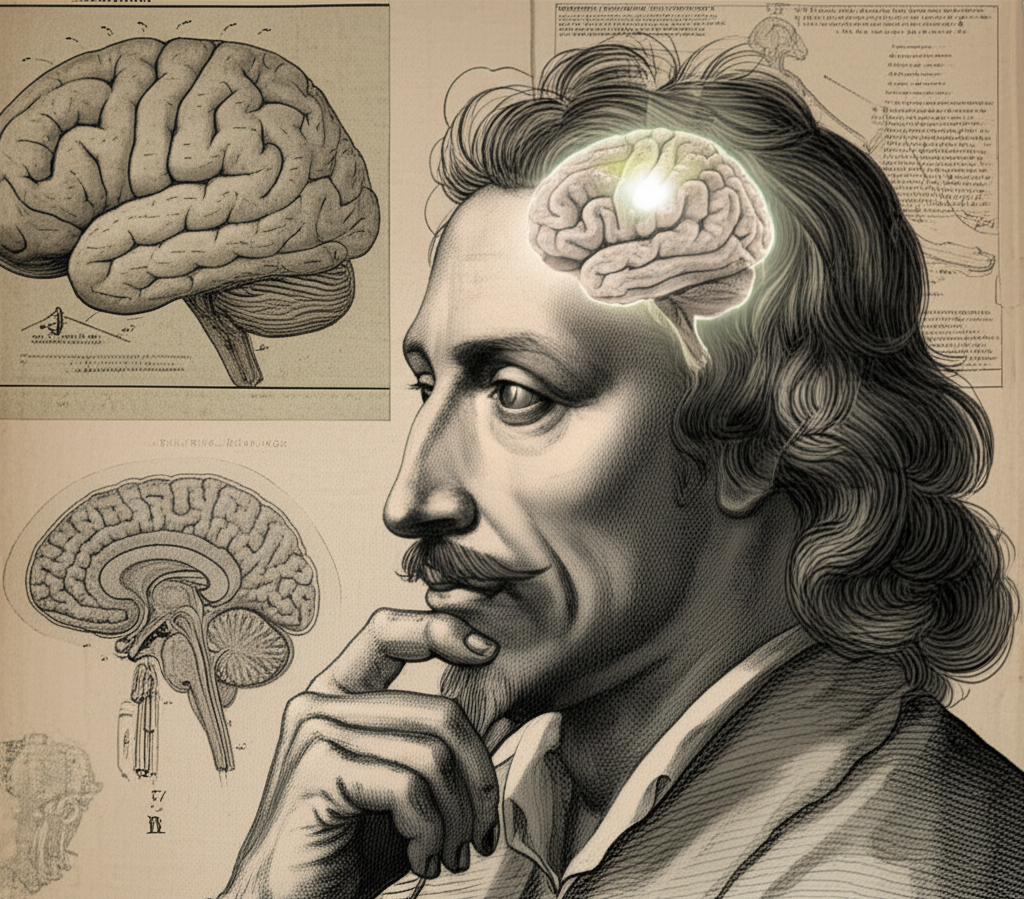
Descartes' clear distinction profoundly influenced subsequent philosophy, setting the stage for centuries of debate on consciousness, identity, and the very nature of reality.
Beyond Dualism: Alternative Perspectives
While dualism has a powerful historical lineage, many philosophers have sought alternative explanations for the distinction between mental and physical phenomena, or have rejected the distinction altogether.
Monism: One Fundamental Substance
Monism proposes that reality consists of only one fundamental substance.
- Materialism (Physicalism): Argues that everything is physical. The Soul or mind is not a separate entity but an emergent property of complex brain activity, or is reducible to brain states. Consciousness is a product of the Body. This view often aligns with scientific advancements in neuroscience.
- Idealism: Posits that everything is mental. The physical Body is merely a perception or idea within a larger consciousness (e.g., Berkeley's "to be is to be perceived").
Emergentism and Functionalism
More contemporary views often fall under these categories:
- Emergentism: Suggests that the mind or consciousness "emerges" from highly complex physical systems (like the brain) but is not reducible to them. It's a new level of reality that arises from, but is distinct from, its physical components.
- Functionalism: Defines mental states by their causal roles and functions, rather than by their intrinsic nature or what they are made of. A "mind" is whatever performs certain functions, regardless of whether it's a biological brain, a silicon chip, or something else entirely.
The Stakes: Implications for Life and Death, Identity, and Ethics
The way we understand the distinction between Body and Soul has profound implications for some of the most fundamental aspects of human existence.
| Aspect of Existence | Dualist Perspective (e.g., Cartesian) | Monist Perspective (e.g., Materialist) |
|---|---|---|
| Life and Death | Soul can survive Body's death; potential for afterlife/immortality. | Life ends with the cessation of Body functions; no separate afterlife. |
| Personal Identity | Rooted in the continuity of the Soul or conscious mind. | Rooted in the continuity of the Body, brain, or psychological states. |
| Consciousness | A non-physical property of the Soul. | An emergent property of the brain; reducible to physical processes. |
| Free Will | Often seen as a capacity of the non-physical Soul. | May be an illusion or a complex product of physical brain processes. |
| Ethics | Moral responsibility often tied to the rational Soul. | Moral responsibility tied to the functioning brain and social context. |
This table illustrates how deeply embedded the distinction debate is in our understanding of what it means to be human.
Contemporary Reflections and Unanswered Questions
Modern science, particularly neuroscience, has offered incredible insights into the workings of the brain, demonstrating a strong correlation between mental states and physical processes. Brain injuries can alter personality; drugs can change mood; specific brain regions are activated during particular thoughts. These findings often lend support to materialist or emergentist views, suggesting that the "mind" or "soul" is inextricably linked to, if not wholly a product of, the brain.
Yet, the "hard problem of consciousness" persists: how does subjective experience, the feeling of "what it is like" to be something, arise from purely physical processes? No amount of studying brain cells seems to fully explain the richness of our inner world. This enduring mystery keeps the distinction between Body and Soul a vibrant and essential area of philosophical inquiry.
YouTube Video Suggestions:
- "The Mind-Body Problem: Crash Course Philosophy #24"
- "Plato's Phaedo - The Immortality of the Soul"
Conclusion: The Enduring Quest for Self-Understanding
The distinction between Body and Soul is not a settled matter, nor is it likely to be anytime soon. From Plato's ethereal Forms to Aristotle's integrated Life force, from Descartes' radical separation to contemporary scientific materialism, each philosophical tradition has offered a unique lens through which to view ourselves.
What remains clear is the profound importance of this question. Our understanding of the distinction between Body and Soul shapes our deepest beliefs about identity, purpose, and the ultimate meaning of Life and Death. It compels us to look inward, to ponder the nature of our consciousness, and to forever question what truly makes us human. As Grace Ellis, I invite you to continue this journey of self-discovery, for in grappling with these ancient questions, we ultimately come closer to understanding ourselves.
📹 Related Video: What is Philosophy?
Video by: The School of Life
💡 Want different videos? Search YouTube for: "The Distinction Between Body and Soul philosophy"