

Unpacking Reality: The Philosophical Distinction Between Being and Existence
Have you ever stopped to ponder the fundamental nature of reality itself? It's a question that has captivated thinkers for millennia, from the ancient Greeks to contemporary philosophers. One of the most foundational insights in this grand philosophical quest is the distinction between "Being" and "Existence." While often used interchangeably in everyday language, philosophy meticulously separates these concepts, revealing profound implications for how we understand everything from a mythical creature to our own consciousness. Simply put, Being refers to what something is – its essence, its nature, its definition – while Existence refers to that something is – its actuality, its presence in reality. Grasping this nuanced definition is crucial for navigating the deeper currents of metaphysics and ontology.
What is 'Being'? Defining the Essence
In philosophy, when we speak of Being, we are delving into the realm of essence. It's about the fundamental nature, the inherent properties, or the quiddity of a thing. Think of it as the blueprint or the concept that defines what something is even before we consider if it's real.
- The Conceptual Realm: A perfect circle has Being. We can define it, understand its properties, and even draw it, yet a truly perfect circle (without any width to its line, for instance) might never perfectly exist in the physical world. Its definition grants it Being.
- Plato's Forms: Recalling the insights from the Great Books of the Western World, Plato's theory of Forms is a prime example of emphasizing Being. For Plato, the Form of Beauty, Justice, or a Table has a perfect, eternal, and unchanging Being in a transcendent realm, even if all earthly manifestations are imperfect copies.
- Aristotle's Essences: Aristotle, while differing from Plato, also focused on the essence – the "whatness" – of a thing. The essence of a human is rationality, regardless of whether a specific human individual currently exists or not.
Being allows us to talk about possibilities, concepts, and even impossibilities. A square circle has a kind of Being in that we can define its contradictory terms, even though it cannot possibly exist.
What is 'Existence'? The Act of Reality
In stark contrast to Being, Existence refers to the actuality of a thing – its presence in the spatio-temporal world, its instantiation in reality. It's the "that it is" rather than the "what it is."
- The Actuality of Presence: Your coffee cup currently sitting on your desk exists. The tree outside your window exists. These things are actual, tangible, and present in the world.
- Beyond Definition: While we can define a unicorn (giving it Being), a unicorn does not exist in the same way a horse does. It has a conceptual reality, but not an actual one.
- Aquinas's Contribution: St. Thomas Aquinas, building on Aristotle within the Great Books tradition, viewed existence (actus essendi) as the act by which an essence is made real. For Aquinas, God is pure Existence, whose essence is to exist.
Existence is what grounds a concept in reality. Without existence, a thing remains purely in the realm of thought or potentiality.
The Crucial Distinction: Why It Matters in Philosophy
The distinction between Being and Existence is not merely an academic exercise; it underpins many fundamental philosophical arguments and insights.
- The Problem of Universals: How do general concepts (like "redness" or "humanness") relate to individual existing things? This distinction helps frame the debate.
- The Ontological Argument: Anselm's famous argument for God's existence hinges on the idea that if God is defined as "that than which no greater can be conceived," then God must exist, because a God that exists is greater than one that merely has Being in the mind. This argument directly engages with the relationship between concept (Being) and reality (Existence).
- Kant's Critique: Immanuel Kant, a pivotal figure in the Great Books, famously argued that "existence is not a predicate." This means that adding "exists" to the definition of something doesn't add a new characteristic to its Being; it merely states that the concept is instantiated in reality. Saying "a triangle exists" doesn't change what a triangle is; it just confirms its presence.
- Existentialism: In the 20th century, existentialist philosophers like Sartre famously posited that "existence precedes essence" for humans. This revolutionary idea suggests that for conscious beings, we first exist, and then through our choices and actions, we create our own essence or Being.
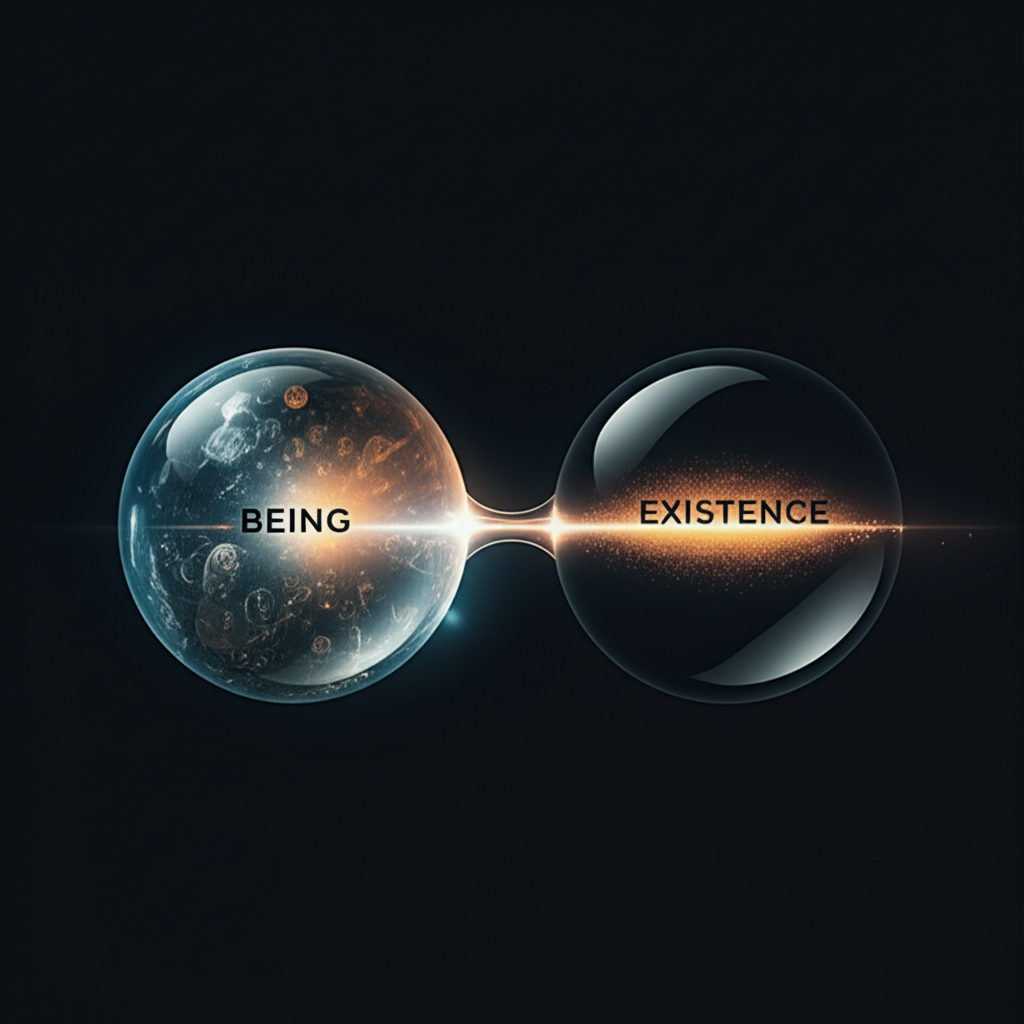
Summarizing the Differences
To further clarify this fundamental distinction in philosophy, let's look at their key attributes:
| Feature | Being (Essence) | Existence (Actuality) |
|---|---|---|
| Focus | What a thing is; its nature, properties, definition | That a thing is; its presence, actuality, instantiation |
| Realm | Conceptual, potential, ideal, universal | Real, actual, particular, spatio-temporal |
| Examples | A unicorn, the idea of justice, a perfect square | Your computer, the sun, a specific person |
| Philosophical | Plato's Forms, Aristotle's essences, conceptual truths | Kant's "not a predicate," Aquinas's actus essendi |
| Relationship | Can have Being without Existence | Requires Being to exist; Existence actualizes Being |
Concluding Thoughts: A Deeper Understanding of Reality
The distinction between Being and Existence is a cornerstone of philosophy, particularly metaphysics and ontology. It challenges us to look beyond surface-level assumptions and to meticulously define the terms we use when discussing reality. By understanding that something can be a certain way (its essence) without necessarily existing in the world (its actuality), we gain a more precise and profound framework for inquiry. This insight, cultivated over centuries by thinkers found in the Great Books of the Western World, empowers us to ask more penetrating questions about the nature of God, the reality of universals, the meaning of human life, and the very fabric of the cosmos.
YouTube Video Suggestions:
-
📹 Related Video: What is Philosophy?
Video by: The School of Life
💡 Want different videos? Search YouTube for: ""Being and Existence Philosophy Explained""
2. ## 📹 Related Video: KANT ON: What is Enlightenment?
Video by: The School of Life
💡 Want different videos? Search YouTube for: ""Kant Existence Is Not A Predicate""