

The Intertwined Paths: Unpacking the Distinction Between Art and Science
While both art and science are profound human endeavors that expand our understanding, their fundamental distinction lies in their primary aims and methodologies. Science seeks objective, verifiable knowledge through empirical observation and logical deduction, striving for universal truths. Art, conversely, explores subjective experience, emotion, and interpretation, often communicating truths that transcend mere facts. This article delves into their unique contributions to human knowledge, drawing insights from the rich tapestry of thought found in the Great Books of the Western World.
Introduction: Two Lenses on Reality
As an explorer of human thought, I've often pondered the vast landscapes of our intellectual and creative pursuits. Among the most fundamental are art and science—two pillars upon which civilization is built. At first glance, their differences seem stark, almost irreconcilable. One speaks the language of numbers and experiments, the other, of paint and poetry. Yet, a deeper look reveals a more nuanced relationship, a symbiotic dance where each, in its unique way, contributes to our ever-growing reservoir of knowledge. This exploration, inspired by the timeless wisdom within the Great Books of the Western World, aims to illuminate this crucial distinction while appreciating their shared human spirit.
Defining the Realms: Purpose and Methodology
The most apparent distinction between art and science emerges from their core objectives and the paths they take to achieve them.
- Science is fundamentally concerned with understanding the natural world through systematic observation, experimentation, and logical reasoning. Its goal is to discover universal laws and principles, to explain how things work, and to predict future phenomena. Thinkers like Aristotle, with his meticulous biological observations, or Francis Bacon, who championed the inductive method, laid much of the groundwork for what we now recognize as scientific inquiry. The pursuit of scientific knowledge demands objectivity, replicability, and verification.
- Art, on the other hand, is primarily concerned with expression, interpretation, and the creation of aesthetic experience. It explores the subjective dimensions of human existence—emotions, ideas, beauty, suffering, and the human condition itself. While it may draw inspiration from the external world, its aim is not to explain it empirically, but to evoke a response, to communicate a feeling, or to challenge perception. From Plato's discussions on mimesis (imitation) in poetry to Kant's exploration of aesthetic judgment, art's domain has always been deeply intertwined with human experience and meaning.
The Pursuit of Knowledge: Different Avenues to Understanding
Both art and science are powerful tools for generating knowledge, but they do so in profoundly different ways.
Science constructs knowledge through a process of hypothesis formation, empirical testing, and peer review. It builds models of reality that are constantly refined and, ideally, lead to technological advancements and a clearer understanding of the physical universe. This kind of knowledge is often quantitative, predictive, and aims for universal applicability.
Art, however, offers a different kind of knowledge—one that is often qualitative, intuitive, and deeply personal. A great novel can provide profound insights into human psychology, a powerful painting can convey the emotional weight of a historical event, and a symphony can articulate feelings beyond words. This knowledge cultivates empathy, broadens perspective, and enriches our understanding of what it means to be human. It challenges us to see the world not just as it is objectively, but as it can be or feels.
Historical Perspectives on the Distinction
The distinction between art and science has not always been as sharply defined as it is today.
- In Ancient Greece, the term techne often encompassed both skilled craftsmanship (art) and practical expertise (science). Philosophers like Aristotle were polymaths, engaging in both rigorous scientific observation (e.g., in biology) and profound literary analysis (e.g., in Poetics). Plato, while wary of art's mimetic nature, still grappled with its power and place in society.
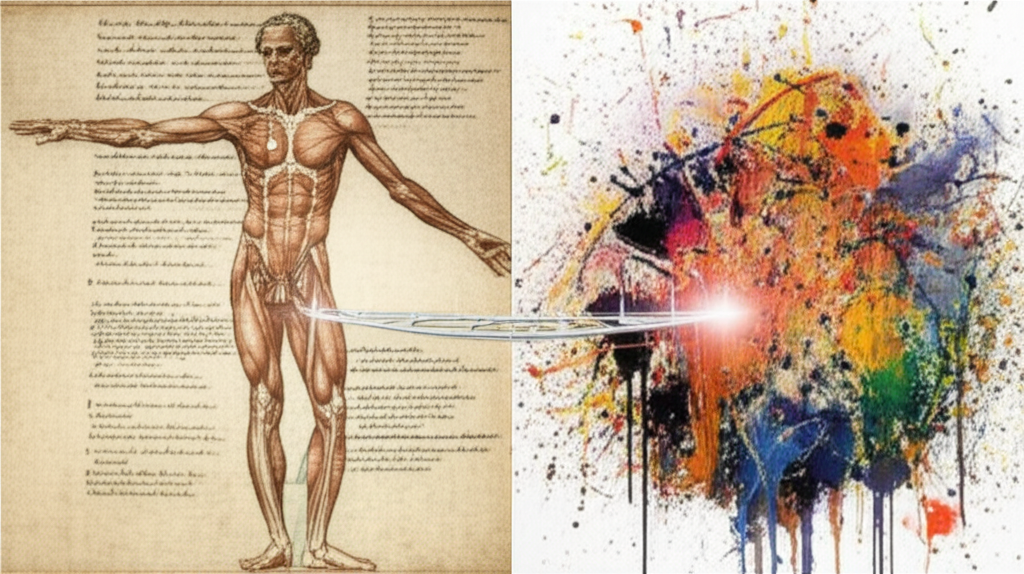
- The Renaissance period, vividly depicted in the Great Books, saw a remarkable synthesis. Figures like Leonardo da Vinci epitomized the 'Renaissance Man,' seamlessly blending scientific inquiry (anatomy, engineering, optics) with artistic creation (painting, sculpture). For them, understanding the world scientifically often informed artistic representation, and vice-versa.
- The Enlightenment brought a clearer separation. The rise of empirical science, championed by thinkers like Isaac Newton and René Descartes, solidified a methodology focused on objective reality, measurable phenomena, and universal laws. This led to a more distinct categorization, with science claiming the realm of objective truth and art increasingly exploring subjective experience and individual expression, culminating in movements like Romanticism. Immanuel Kant's Critique of Judgment further explored the unique nature of aesthetic experience, distinct from scientific understanding or moral imperative.
Core Distinctions Between Art and Science
To further clarify their unique contributions, consider this comparison:
| Feature | Art | Science |
|---|---|---|
| Primary Aim | Expression, interpretation, aesthetic experience | Explanation, prediction, objective truth |
| Methodology | Intuition, creativity, subjective experience | Observation, experimentation, logical reasoning |
| Focus | Qualities, meaning, emotion, beauty | Quantities, facts, causality, function |
| Truth Claim | Subjective, interpretive, experiential | Objective, verifiable, universal |
| Outcome | Insight, empathy, aesthetic pleasure, challenge | Laws, theories, technological advancement |
| Approach to Knowledge | Holistic, qualitative, often non-linear | Analytical, quantitative, systematic |
Overlapping Territories and Shared Virtues
Despite their differences, art and science share profound commonalities and often intersect in fascinating ways.
- Creativity and Imagination: Both demand immense creativity. A scientist formulating a groundbreaking hypothesis or designing an innovative experiment requires imaginative leaps as much as an artist conceiving a new masterpiece. The ability to envision what could be is central to both.
- Observation: Artists meticulously observe the world to depict its nuances; scientists observe to understand its underlying mechanisms. Both require keen attention to detail and a willingness to look beyond the superficial.
- Communication: Both aim to communicate something profound about the world or human experience. While their languages differ—one symbolic and emotional, the other precise and logical—the drive to share discoveries and insights is universal.
- Problem-Solving: Art solves problems of expression, representation, and meaning; science solves problems of understanding, control, and application. Each, in its way, confronts the unknown and seeks to bring order or beauty to it.
The Enduring Value of Both
Ultimately, the distinction between art and science is not a chasm, but a useful way to categorize our diverse approaches to understanding the universe and ourselves. Neither is superior; both are indispensable. Science provides the framework of our physical reality, revealing the intricate mechanisms that govern existence, while art gives meaning and color to our experience within that framework, exploring the depths of human emotion and aspiration. Together, they form a complete picture of human knowledge and aspiration, continuing the grand conversation begun by the thinkers in the Great Books of the Western World.
Conclusion
In conclusion, while art and science operate with fundamentally different aims and methodologies—one seeking objective knowledge through empirical verification, the other exploring subjective truths through expression and interpretation—both are vital human endeavors. The distinction is not one of opposition, but of complementarity. Each enriches our understanding, challenges our perceptions, and pushes the boundaries of what it means to know. To truly grasp the breadth of human knowledge, we must embrace the profound contributions of both the artist and the scientist.
📹 Related Video: What is Philosophy?
Video by: The School of Life
💡 Want different videos? Search YouTube for: ""The Art of Science vs The Science of Art" philosophy"
📹 Related Video: PLATO ON: The Allegory of the Cave
Video by: The School of Life
💡 Want different videos? Search YouTube for: ""Plato Aristotle Art Science Knowledge" Great Books"